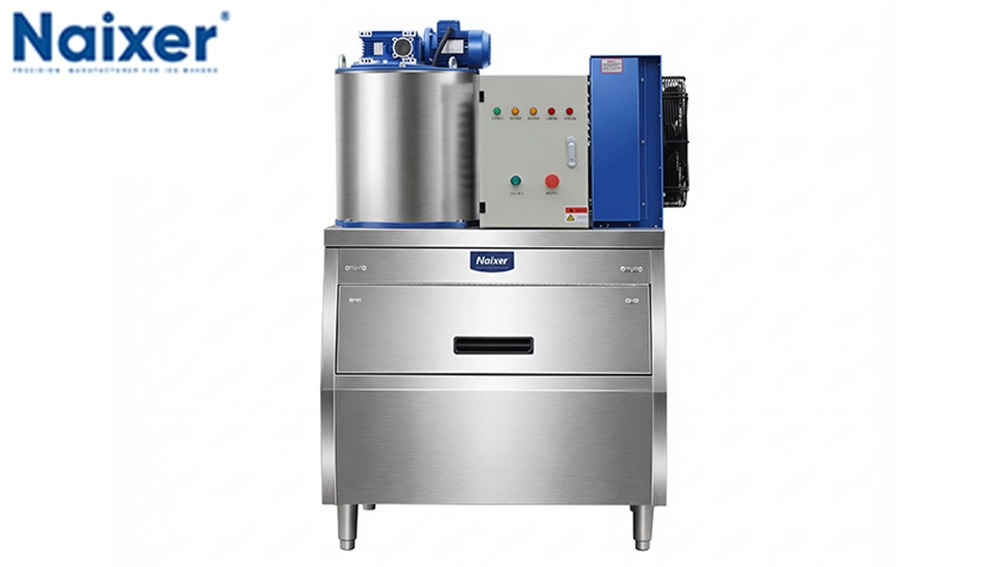
Ice Machine Cleaning: The 2026 Commercial Maintenance Guide & FAQs

A clean ice machine is not a suggestion. It is a health code requirement, a warranty condition, and the single most important factor in how long your machine lasts and how good your ice tastes. Ice is classified as food by the FDA. The machine that makes it is a food-contact surface, subject to the same sanitation standards as your prep tables and walk-in coolers.
Yet ice machine cleaning is also one of the most frequently neglected maintenance tasks in a commercial kitchen. It gets postponed. It gets forgotten. It gets done with the wrong product because someone grabbed whatever was under the sink.
This article answers the eight most common questions about commercial ice machine cleaning—how often, with what, and why—and lays out a maintenance schedule that will keep your Naixer machine running clean, compliant, and efficient for years.
For a complete, step-by-step walkthrough of the cleaning process for a specific model, see our guide on how to clean a Naixer ice machine .
In this guide, you will learn:
How Often Should I Clean My Commercial Ice Machine?
Every six months, at minimum. This is the standard recommended by manufacturers and required by most health codes.
That six-month interval is not arbitrary. It is based on the rate at which mineral scale from your water supply builds up on the evaporator and internal surfaces. Scale acts as an insulator, reducing heat transfer efficiency and forcing the compressor to work harder. It also provides a rough surface where bacteria and biofilm can attach and grow.
Some conditions call for more frequent cleaning. If your kitchen is located in a hard-water area, scale will accumulate faster, and you should clean every three to four months. The same applies if your machine runs near its maximum capacity daily, or if your kitchen environment is particularly humid, dusty, or near cooking lines where airborne grease and particulates are heavy.
If you notice a musty smell when you open the ice bin, if your ice tastes off, or if you can see visible white or chalky deposits on any internal surface, clean the machine immediately regardless of the schedule.
Naixer machines include a One-Touch Cleaning function that automates the descaling cycle. Press a button, and the machine circulates the cleaning solution, drains, and rinses without disassembly. This feature removes the biggest barrier to frequent cleaning—the time and complexity of doing it manually.
What Cleaner Should I Use on My Ice Machine?
A nickel-safe commercial ice machine cleaner, specifically formulated for descaling and removing mineral deposits. Never use bleach, dish soap, all-purpose kitchen cleaners, or any product not explicitly labeled as safe for ice machines.
The reason is chemical. Many commercial ice machine evaporators are plated with nickel to resist corrosion. Household bleach and acidic cleaners not designed for nickel surfaces can pit, corrode, or strip that plating. Once the nickel layer is damaged, the underlying metal is exposed to water and air, and the evaporator will eventually fail. A replacement evaporator can cost thousands of dollars.
Nickel-safe ice machine cleaner is a phosphoric or citric acid-based formula designed to dissolve calcium and magnesium scale without attacking metal surfaces. It is food-safe when used according to instructions, and it rinses away cleanly without leaving residue that could affect ice taste.
Do not confuse cleaner with sanitizer. They are two separate products with two separate jobs. Cleaner removes scale and mineral deposits. Sanitizer kills bacteria, mold, and biofilm. Both are required in a complete cleaning process, and they must be done in the correct order—descale first, rinse thoroughly, then sanitize. Combining them into a single step reduces the effectiveness of both.
Do I Need to Sanitize My Ice Machine, or Is Cleaning Enough?
You need both. Cleaning removes the visible deposits. Sanitizing kills what you cannot see.
Mineral scale is not alive. A descaling solution will dissolve it, but it will not kill the bacteria, mold spores, or yeast colonies that may be living on the machine’s damp interior surfaces. For that, you need a food-safe sanitizer—typically a quaternary ammonia solution or a peroxide-based formula approved for food-contact surfaces.
The order matters. Descale first. If you sanitize before descaling, the sanitizer cannot reach the surfaces that are still covered in scale. Once the scale is dissolved and rinsed away, apply sanitizer to every surface that contacts ice or water—the evaporator, the water trough, the distribution tubes, the bin interior, and all removable parts like the ice scoop and curtain. Allow the sanitizer to air dry. Do not rinse it off. Most food-safe sanitizers are no-rinse formulas, and rinsing would undo the sanitizing step.
For more on the broader context of keeping your ice safe and free of contamination, read our article on can ice get moldy , which explains what happens inside a machine that is not properly cleaned and sanitized.
How Do I Know If My Ice Machine Needs Cleaning Ahead of Schedule?
There are four signs that tell you the machine needs immediate attention.
First, a noticeable change in ice quality. If your ice is cloudy when it used to be clear, or if it comes out misshapen, partially formed, or softer than normal, scale is interfering with the freezing process. The evaporator cannot pull heat out of the water efficiently, so the ice freezes unevenly.
Second, any off-taste or odor in the ice itself. This is the most direct sign of microbial contamination. Mold, yeast, and biofilm produce compounds that impart a musty, earthy, or sour flavor to ice. If you taste it, your customers taste it too.
Third, a visible white or chalky residue on internal components. Open the machine and look at the evaporator, the water trough, and the interior walls of the bin. If you see crusty white deposits, you are past due for descaling.
Fourth, a noticeable reduction in daily ice output. If the machine used to produce a full bin by 10 a.m. and now it is still half empty by noon, scale is almost certainly the cause. The compressor is running longer cycles to compensate for the insulating effect of the scale, and the machine simply cannot keep up.
Does My Ice Machine Need Cleaning if I Use Filtered Water?
Yes. A water filter slows down scale accumulation. It does not eliminate it.
A high-quality commercial water filter removes sediment, chlorine, and some dissolved minerals. It will extend the time between necessary descaling cycles. But no filter removes all minerals from water—that would require a reverse osmosis system, which most commercial kitchens do not have installed on their ice machine lines.
Even with a filter, trace minerals will still pass through and eventually deposit on the evaporator. And water filtration does nothing to prevent airborne contaminants—dust, grease particles, yeast, mold spores—from entering the machine every time the bin door is opened. Those airborne particles settle on damp interior surfaces and contribute to biofilm formation regardless of how clean the incoming water is.
Think of a water filter as a way to extend your cleaning interval, not a replacement for cleaning. If you operate in an area with moderately hard water and have a quality filter installed, you may be able to safely stay on the six-month schedule. Without a filter, or in very hard water areas, you should be cleaning every three to four months even if the water looks clean.
How Should I Adjust My Cleaning Schedule for a Hot or High-Use Environment?
Hot kitchens and high-volume operations should shorten the cleaning cycle to every three to four months. There are two reasons for this.
First, heat accelerates bacterial growth. A commercial ice machine operates in a temperature range that is cool enough to make ice but warm enough—particularly in the bin and on exterior surfaces—for microorganisms to multiply. In a hot kitchen, the machine’s internal temperature stays higher between cycles, reducing the natural pause in bacterial growth that cooler environments provide.
Second, high-volume machines cycle more frequently. Every freeze-and-harvest cycle moves water through the system and exposes surfaces to airborne particles. More cycles mean more mineral deposition per day and more opportunities for contamination. A machine that runs near its maximum capacity for 18 hours a day accumulates scale and biofilm faster than one that cycles intermittently.
If your kitchen ambient temperature routinely exceeds 32 degrees Celsius, or if your machine produces close to its rated daily capacity on a regular basis, move to quarterly cleaning. The extra two cleanings per year are far cheaper than a compressor failure or a health code violation.
How Do I Maintain My Ice Machine Between Deep Cleanings?
Three things, done consistently, will keep your machine in good shape between its semi-annual deep cleans.
Wipe down the exterior surfaces weekly with a damp cloth and a mild detergent. This prevents dust and grease from accumulating around the door seals, the ventilation grille, and the control panel.
Clean the condenser coils every three months. The condenser is the part of the machine that rejects heat. In an air-cooled machine, it looks like a radiator with thin aluminum fins. Dust and grease coat those fins over time, reducing their ability to shed heat. The compressor then runs hotter and longer, shortening its life. Naixer’s product manual instructs you to use a soft brush and clean along the fin direction—never sideways, which can bend the delicate fins【产品说明书 Page 7-8】.
Replace the water filter every six months, on the same schedule as your deep clean. A saturated filter stops filtering and becomes a source of contamination itself. If you are in a hard-water area, consider replacing the filter every three to four months, aligned with your descaling schedule.
For a broader look at how long a well-maintained machine should last and the factors that determine its lifespan, read our commercial ice maker lifespan guide .
What Are the Most Common Ice Machine Cleaning Mistakes?
Using the wrong cleaner is the most expensive mistake, because it can permanently damage the evaporator. Bleach, oven cleaner, and all-purpose degreasers are not formulated for nickel-plated surfaces and will cause corrosion that cannot be reversed.
Skipping the sanitizing step is the most common mistake. A machine that has been descaled but not sanitized looks clean but is not food-safe. Bacteria and mold spores survive descaling and will recolonize the machine within days.
Using abrasive tools is a slow, cumulative mistake. Steel wool, metal scrapers, and hard-bristle brushes scratch the evaporator surface and the bin interior. Those scratches become hiding places for bacteria and make future cleanings less effective. Use only soft cloths, non-abrasive sponges, and nylon brushes.
Neglecting the condenser is the mistake that most directly shortens the machine’s life. A dirty condenser is the leading cause of compressor failure in commercial ice machines. Three months of dust buildup is enough to measurably increase run times and energy consumption. A year of neglect can take years off the compressor’s expected lifespan.
Your Ice Machine Cleaning Schedule
The rhythm of ice machine maintenance is not complicated. Clean the condenser every three months. Replace the water filter and deep clean the entire machine every six months. In hard water, high-heat, or high-volume environments, do both more frequently.
Naixer commercial ice machines are built to make this maintenance as straightforward as possible. The One-Touch Cleaning function automates the most labor-intensive part of the process. The front-venting, removable-panel design gives you direct access to the condenser without moving the machine. Food-grade 304 stainless steel throughout the ice zone resists corrosion and cleans easily.
A clean ice machine produces better ice. Better ice makes better drinks. Better drinks keep customers coming back. It is the simplest maintenance task in your kitchen, and one of the most consequential.
Need replacement filters, cleaning supplies, or technical support for your Naixer ice machine? Contact our team or browse our maintenance resources.