Answer box
Naixer manufactures commercial ice cube makers in Guangzhou, China and supplies them to Malaysia from 30 kg to 550 kg of ice per 24 hours on a standard 220V/50Hz supply. Every unit produces a 22 × 22 × 22 mm cube and carries CE and ISO 9001 certification, held continuously since 2011. Machines are built for OEM and distributor programmes, with FOB pricing quoted per configuration and volume.
Malaysia Is Three Markets, Not One
Most articles about ice machines in Malaysia treat the country as a single market. It is not, and the difference matters when you are specifying equipment.
The first market is rental. A significant share of Malaysian food and beverage operators do not buy ice machines at all — they rent them, on monthly terms or rent-to-own. Search “ice cube maker malaysia” and you will find rental pages sitting on page one alongside retail listings. Any buying decision here is really a decision between renting and owning, not between two brands.
The second is climate. Malaysia does not have a summer. Ambient temperature sits in the low thirties year-round, humidity rarely drops below 80%, and there is no cool season to recover in. A machine that performs well in a temperate market for ten months and struggles for two will simply struggle for twelve here.
The third is geography. Peninsular Malaysia and East Malaysia are separate logistics markets. A container landing at Port Klang does not automatically reach Kuching or Kota Kinabalu at the same cost, and East Malaysian buyers often face a materially different landed price for the same machine.
If you are sizing against cost before you have sized against climate, our how commercial ice machine cost scales with capacity explains where the price steps actually fall.
What Commercial Ice Cube Makers Cost in Malaysia
Malaysian ice machine pricing is unusually wide, and the spread is not explained by capacity alone. Below is what we observed on 29 October 2026.
| Product / Model | Daily Capacity | Price (RM) | RM per kg/day | Sales Channel |
|---|---|---|---|---|
| Happypopper IM-M0002 | 60 kg | 918 | 15.30 | Retailer |
| Generic 80–100 kg unit | 80–100 kg | 1,390 | 13.9–17.4 | Shopee |
| Generic 60 kg unit | 60 kg | 1,390 | 23.2 | Shopee |
| Unspecified commercial unit | Not stated | 4,000 | — | Lazada |
| Solid Cool cube maker | 105 kg | 5,788 | 55.12 | Shopee |
| Solid Cool cube maker | 350 kg | 9,702 | 27.72 | Shopee |
| Frezmac modular machine | 315 kg | 9,800 | 31.11 | Specialist |
| Scotsman / Hoshizaki range | 35–125 kg | 3,800–10,500 | 84–109 | FNB Stores |
| Simplus ZBJH001 | 12 kg | 356.50 | 29.7 | Lazada |
| Chris countertop unit | 12 kg | 1,410.89 | 117.6 | Lazada |
Price comparison note: Retail asking prices observed on Shopee Malaysia, Lazada Malaysia, Happypopper, Frezmac and FNB Stores Malaysia on 29 October 2026. These are listed prices, not confirmed transaction prices, and are intended to illustrate the market price range rather than recommend specific products. RM per kg/day is a simple price-to-rated-capacity calculation, not a measure of energy efficiency, machine quality or total cost of ownership. Naixer does not sell through these channels.
Two things stand out.
First, price per kilogram of daily capacity varies by more than three times. At the low end, a 60 kg/24h unit sells for RM 918 — about RM 15 per kg of daily capacity. At the other end, a 105 kg/24h unit sells for RM 5,788 — about RM 55 per kg. Same island, same basic function, three-and-a-half times the unit economics.
Second, capacity does not predict price reliably. A 12 kg countertop unit appears at RM 356.50 and another 12 kg countertop unit appears at RM 1,410.89. Nearly four times the price for identical stated output. Something other than capacity is driving that number — compressor grade, cabinet construction, control electronics, warranty terms, or simply the channel.
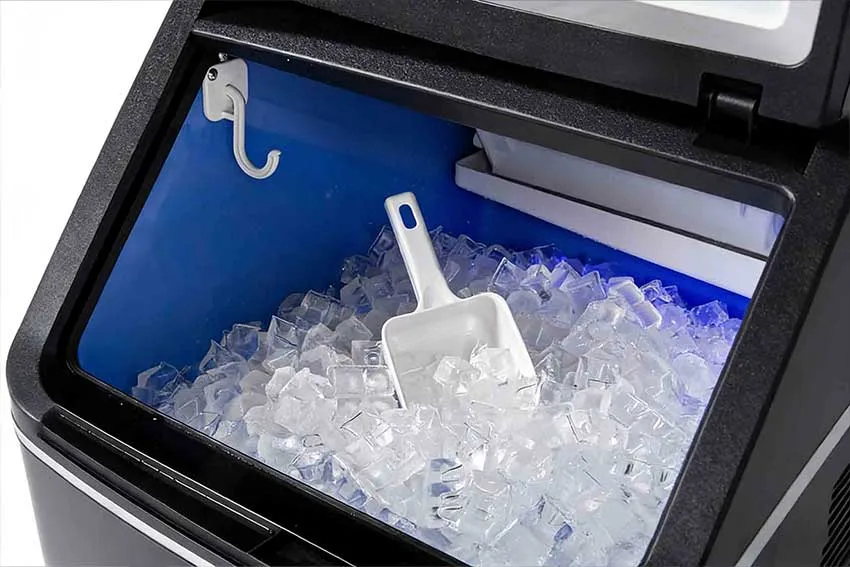
This is the single most useful thing to understand before you shortlist. A price list without specification context tells you almost nothing. The questions that separate a RM 918 machine from a RM 5,788 machine are: which compressor, what insulation thickness, what control board, what happens when ambient hits 35 °C, and who answers the phone in year three.
For a side-by-side of how Chinese factories differ on capacity, MOQ and OEM terms, see Chinese ice machine manufacturers compared by capacity and MOQ. For brand positioning across the major global names, see commercial ice machine manufacturers ranked by segment.
Why "Tropicalized" Matters More Here Than Anywhere
You will see the word tropicalized used by Malaysian equipment sellers. It is not marketing language — it describes a real engineering difference, and it is the most important specification to interrogate.
Here is why.
Naixer specification sheets state the test condition for every capacity figure: room temperature 21 °C, water temperature 10 °C. That is an industry-standard reference point, and every manufacturer publishes against something similar so that numbers can be compared.
Malaysia does not operate at 21 °C. A commercial kitchen in Petaling Jaya or Johor Bahru runs well above that, and inlet water from an exposed rooftop tank arrives considerably warmer than 10 °C.
An air-cooled ice machine rejects heat into the surrounding air. When the surrounding air is already hot, the condenser has less headroom, the freeze cycle lengthens, and daily output falls below the rated figure. This is physics, not a brand defect, and it applies to every air-cooled machine sold in Malaysia regardless of origin.
What “tropicalized” means in practice is that the machine has been configured for this: a larger condenser surface relative to compressor size, a fan and airflow path sized for high ambient, and control logic that tolerates longer cycles without faulting. Acson, a Malaysian brand, markets tropicalized units with vertical evaporator grid plates — that detail matters because grid-plate evaporators shed water and frost differently from coil designs in humid conditions.

Three practical consequences for a Malaysian installation:
- Specify one frame size above your calculated demand. If your arithmetic lands on 120 kg, quote the 160 kg model.
- Give the machine air, not a cupboard. Rear and side clearance is a hard requirement in a 33 °C plant room, not a suggestion.
- Consider water-cooled above roughly 300 kg/24h in an unconditioned space. Water-cooled units reject heat into water rather than air and hold output far more stably in high ambient — at the cost of water consumption and a permanent drain.
The trade-off is set out in more detail in air-cooled vs water-cooled ice machines for tropical climates. Clearance distances are in ventilation and clearance requirements for commercial ice machines.
The Naixer Range on 220V/50Hz
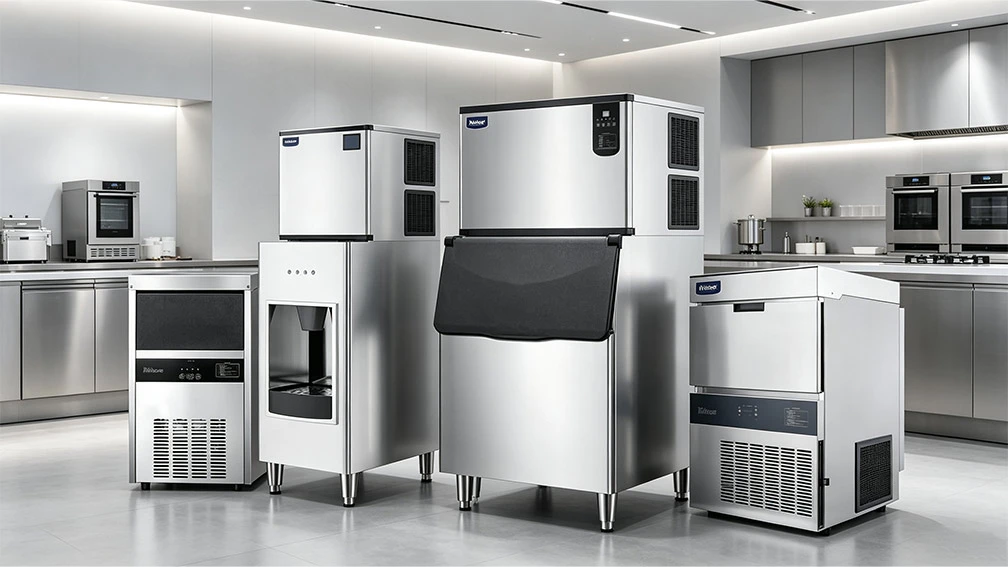
The regular ice cube range runs from a 30 kg/24h countertop unit to a 550 kg/24h floor-standing machine, all producing the same 22 mm cube and all built at 220V/50Hz.
| Model | Daily Capacity | Bin Capacity | Power | Dimensions (mm) | Refrigerant |
|---|---|---|---|---|---|
| TH50 | 30 kg/24h | 12 kg | 220V / 330 W | 423 × 500 × 760 | R290 |
| TH80B | 38 kg/24h | 12 kg | 220V / 330 W | 425 × 496 × 765 | R290 |
| TH120B | 55 kg/24h | 20 kg | 220V / 370 W | 530 × 550 × 850 | R290 |
| TH150B | 75 kg/24h | 45 kg | 220V / 750 W | 660 × 690 × 920 | R290 |
| TH210B | 95 kg/24h | 45 kg | 220V / 750 W | 660 × 690 × 920 | R290 |
| TH260B | 120 kg/24h | 45 kg | 220V / 950 W | 660 × 690 × 920 | R290 |
| TH280B | 120 kg/24h | 130 kg | 220V / 950 W | 560 × 820 × 1490 | R290 |
| TH320B | 160 kg/24h | 130 kg | 220V / 1050 W | 560 × 820 × 1630 | R404A |
| TH420B | 190 kg/24h | 130 kg | 220V / 1100 W | 560 × 820 × 1630 | R404A |
| TH500B | 225 kg/24h | 180 kg | 220V / 1200 W | 760 × 820 × 1700 | R404A |
| TH700B | 320 kg/24h | 180 kg | 220V / 1500 W | 760 × 820 × 1700 | R404A |
| TH1000B | 460 kg/24h | 180 kg | 220V / 2680 W | 760 × 820 × 1935 | R404A |
| TH1200B | 550 kg/24h | 180 kg | 220V / 2680 W | 760 × 820 × 1935 | R404A |
Performance and selection note: Published production ratings are based on an ambient temperature of 21°C and an inlet water temperature of 10°C. Actual ice production may vary with ambient temperature, inlet water temperature, ventilation, installation and operating conditions. For Malaysian installations, contact Naixer to confirm expected production under your site's operating conditions before selecting a model. Confirm the required voltage, frequency and electrical configuration for the destination market. Undercounter, crescent, flake and nugget ice machine options are also available; specifications vary by model.
Beyond the TH range there are dedicated formats: the Naixer E30 undercounter, 35 kg/24h for bars and small cafés, crescent machines from 65 kg/24h upward, PB-series flake machines for fish counters and bakeries, and the KL-60 nugget machine at 60 kg/24h.
The two models most often specified for Malaysian projects are the Naixer TH320B, 160 kg/24h for mid-size restaurants and the Naixer TH1000B, 460 kg/24h for central kitchens and hotel back-of-house.
Voltage and Plug: What 240V Means for a 220V Machine
Malaysia’s declared single-phase supply is 240V/50Hz with Type G sockets. Naixer machines are built at 220V/50Hz.
The 240V figure sits about 9% above the 220V nameplate. That falls inside the ±10% band that commercial refrigeration equipment is normally engineered for, and Malaysian supply in practice fluctuates around 230–240V rather than sitting pinned at the upper limit. In normal operation, a 220V machine runs on a Malaysian supply without modification.
That said, we are not going to tell you it makes no difference at all, because at the top of the tolerance band it is a genuine engineering question and not a marketing one. If you are specifying for a site with a known high-voltage history — an older building, an industrial estate near a substation — raise it before ordering and ask whether a 240V build is available for your model.

The plug is the more practical detail. Malaysian premises use Type G. Naixer machines ship either hardwired or with a supply cable, and the plug type should be specified on the order rather than adapted on site. A locally fitted plug is a small thing that becomes a warranty argument later.
Rental vs Buying Outright
Rental is a genuinely reasonable option in Malaysia and we are not going to pretend otherwise.
Rent when: you need a machine next week, your site is leased on a short term, your volume is genuinely uncertain, or you have no in-house maintenance capability and want a single monthly number that covers breakdowns.
Buy when: your site is yours or on a long lease, your ice demand is predictable and material, you are running multiple outlets, or you need a capacity or cube format the rental fleet does not carry.
The arithmetic that decides it is not the monthly rental figure — it is the total cost over the actual holding period, including installation, service visits and the replacement cycle. A rental at a low monthly rate over five years can comfortably exceed the purchase price of a mid-range machine plus two service calls a year. Run that sum before you sign, not after.
There is also a specification problem with rental that rarely gets discussed: rental fleets are standardised. If your operation needs 160 kg/24h and the fleet tops out at 120 kg, renting does not solve your problem — it just postpones it, and you will rent a second unit at full second-unit cost.
Sizing by Application
Most sizing questions reduce to one: how much ice does this operation actually consume on its busiest day? Our how to size a commercial ice maker by covers per day walks through the arithmetic. The short version by application is below.
| Application | Peak Demand Driver | Typical Production Range | Preferred Ice Format |
|---|---|---|---|
| Coffee Shop / Milk Tea | Cups per day and blender count | 55–95 kg/24h | 22 mm cube |
| Takeaway Coffee | Cups per hour | 55–120 kg/24h | Octagonal cylinder |
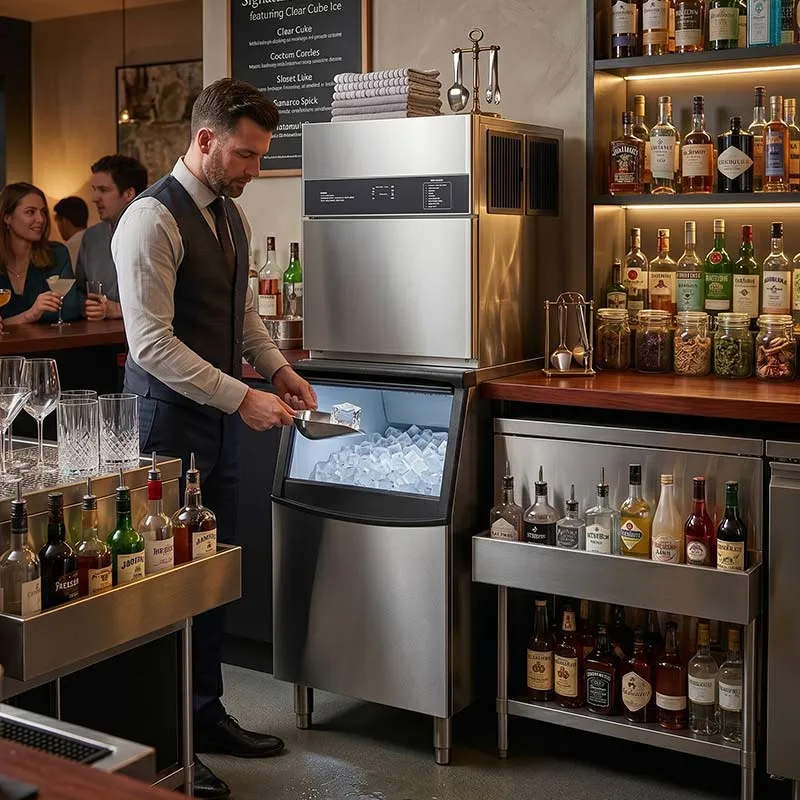
| Bar / Cocktail | Peak-hour covers | 35–75 kg/24h | Large cube, clear ice |
| Restaurant | Peak service plus display | 120–225 kg/24h | 22 mm cube |
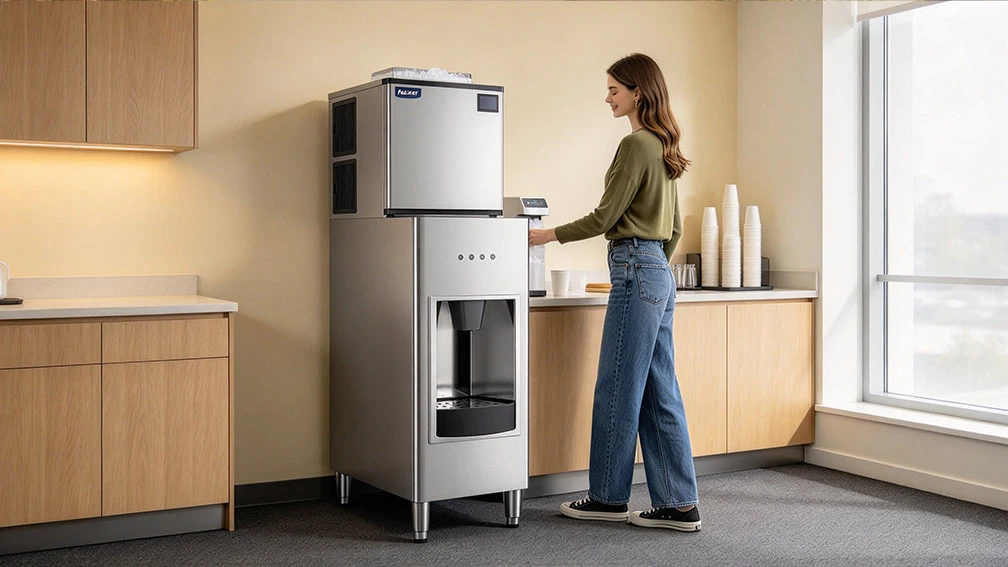
| Hotel, Guest Floors | Rooms per floor | Per-floor dispensers | Ice dispenser |
| Hotel Banquet / Central Kitchen | Banquet covers per sitting | 320–460 kg/24h and above | Modular cube |
| Fish Counter / Bakery | Display turnover | 150–300 kg/24h | Flake ice |
| Bagged Ice Production | Bags per day | 460 kg/24h and above | Cube plus bagger |
Ice machine sizing note: These ranges are preliminary planning estimates, not guaranteed production requirements. Final sizing depends on bin capacity, ambient and inlet water temperatures, peak demand profile, ventilation and whether the machine operates in a conditioned or unconditioned space. Contact Naixer to confirm the appropriate model and expected production under your actual installation conditions before ordering.
Coffee shops and milk tea
Malaysia’s coffee and milk tea sector is the single largest driver of ice demand per square metre, and it has a specific requirement: the cube must melt slowly enough not to dilute the drink before the customer finishes it. That is why 22 mm cubes and larger dominate here rather than flake. Nugget ice is the opposite choice — fast-melting and chewable, suited to blended drinks.
The trade-offs between formats, including the octagonal cylinders used widely in takeaway coffee, are set out in ice cube shapes and the drinks each one suits.
Restaurants and central kitchens
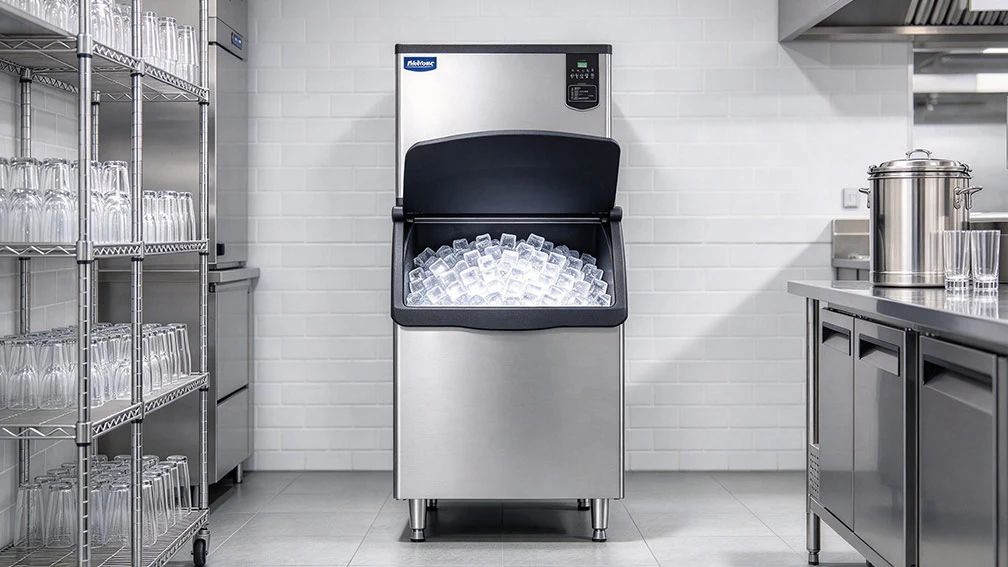
Restaurants size against peak service, not daily average. A mid-size restaurant typically lands in the 120–225 kg/24h band once beverage service, buffet display and any chilled seafood counter are counted. Central kitchens producing for multiple outlets should be looking at 460 kg/24h and above, and should be considering two machines rather than one large one — redundancy matters more than unit economy when a single failure stops production.
Hotels and banquet halls
Guest floors, banquet kitchens and bars have three separate ice demands and should not be served by one machine. Corridor dispensers serve guests; the banquet kitchen needs volume; the bar needs a slower-melting format. Specifying one central unit for all three is the most common design error we see in hotel projects.
Layout guidance is in ice machines for hotel guest floors and banquet kitchens.
Fish counters, bakeries and food display
Guest floors, banquet kitchens and bars have three separate ice demands and should not be served by one machine. Corridor dispensers serve guests; the banquet kitchen needs volume; the bar needs a slower-melting format. Specifying one central unit for all three is the most common design error we see in hotel projects.
Layout guidance is in ice machines for hotel guest floors and banquet kitchens.
OEM and Distribution
Naixer’s Guangzhou base runs at an annual output capacity of 100,000 units across ice machines, coffee equipment and bakery equipment, on an OEM + ODM model — private label, custom control panels, custom packaging and model numbering under your own brand.

For Malaysian distributors the practical questions are MOQ, territory and spare-parts support. The Naixer distributor and OEM programme sets out the terms. In short: MOQ is agreed per model mix rather than as a single number, and territory discussion begins once there is a committed first order.
We do not currently have an appointed distributor in Malaysia. If you are an established refrigeration or food service equipment importer, that is an open conversation rather than a closed one.
Frequently Asked Questions
What is the price of an ice cube maker in Malaysia?
Retail asking prices observed in October 2026 ranged from about RM 918 for a 60 kg/24h unit to around RM 9,800 for a 315–350 kg/24h commercial machine, with brand-name units in the RM 3,800–10,500 band. Factory-direct FOB pricing is a different structure and depends on capacity, configuration and volume.
Why are some 60 kg ice makers RM 918 and others RM 5,788?
Capacity is only one input. Compressor grade, insulation thickness, evaporator design, control electronics, warranty and sales channel account for the rest. A unit built to hold rated output at 35 °C ambient costs materially more to build than one rated at 21 °C.
Do Naixer ice machines work on Malaysia’s 240V supply?
Naixer machines are built at 220V/50Hz, which sits within the normal ±10% tolerance of Malaysia’s 240V/50Hz supply. For sites with a known high-voltage history, confirm with the factory before ordering whether a 240V build is available.
What does “tropicalized” actually mean?
It describes equipment configured for high ambient temperature — larger condenser surface relative to compressor size, airflow sized for hot environments, and control logic that tolerates longer cycles. It matters in Malaysia because ambient is in the low thirties year-round with no cool season.
Why does my ice machine produce less than its rated capacity?
Rated capacity is measured at 21 °C ambient and 10 °C water. Malaysian kitchens and rooftop water tanks run well above that. Air-cooled machines lose output as ambient rises, so specify one frame size above your calculated requirement and ensure adequate ventilation.
Is it cheaper to rent or buy an ice machine in Malaysia?
It depends on holding period, service costs and whether the rental fleet covers your required capacity. Rental wins on short terms and uncertain volume. Buying wins on long holding periods, predictable demand and capacities above the standard rental range.
What approval is needed to import an ice machine into Malaysia?
Electrical equipment may require SIRIM QAS testing and, for prescribed categories, a Certificate of Approval from the Energy Commission. Confirm the classification for your specific model with your importer and the certification body before shipping.
Which capacity do I need for a coffee shop or milk tea outlet?
Most outlets land between 55 and 95 kg/24h, using a 22 mm cube. High-volume outlets with multiple blenders should be looking higher and should size against peak hour rather than daily average.
Can you supply spare parts to Malaysia?
Yes. Spare-parts support is part of the distributor arrangement; agree the stocking level you need when territory is discussed.
Do you have a distributor in Malaysia?
Not at present. We are actively looking for one. If you import refrigeration or food service equipment, the conversation usually starts with the Naixer distributor and OEM programme.
Next Step
If you are specifying for a Malaysian site, send us the application, the required daily capacity and the destination port. We will come back with a model recommendation, an FOB price and a packing list you can hand to a freight forwarder.
If you are evaluating distribution, tell us your current portfolio and territory — that conversation is worth having before you place an order.
Browse the full Naixer ice machine catalogue for specifications on every model.