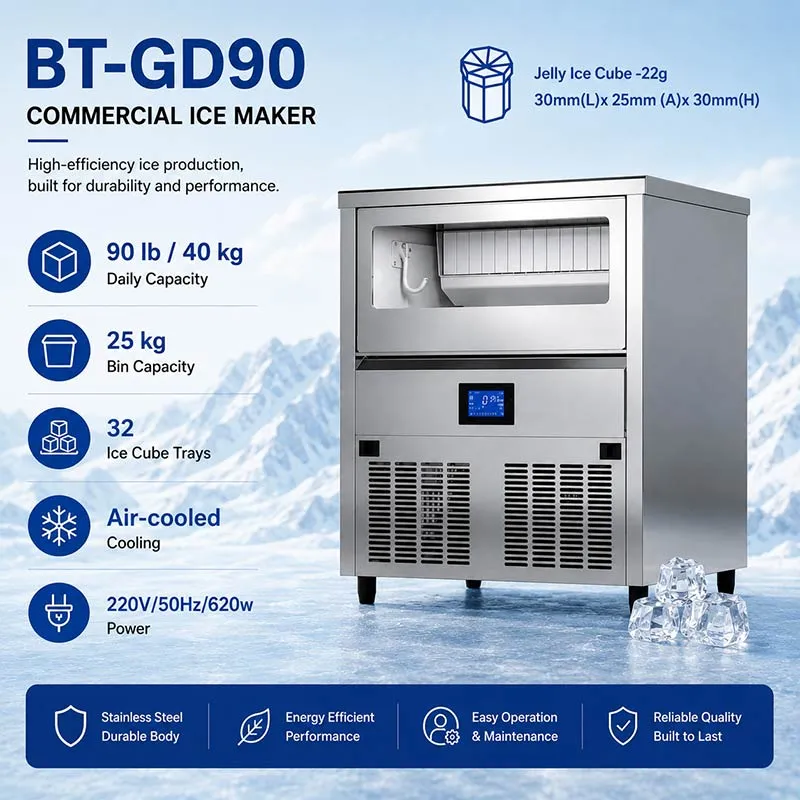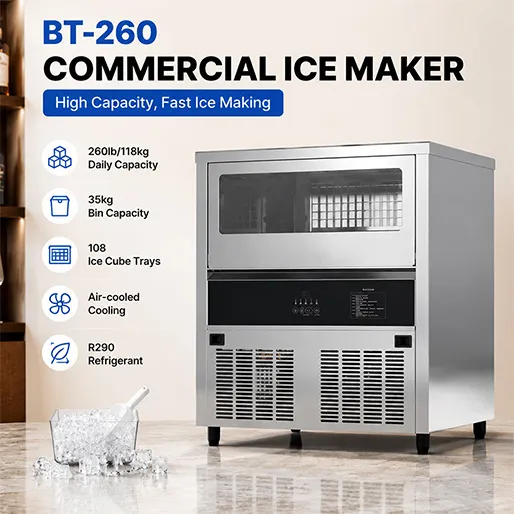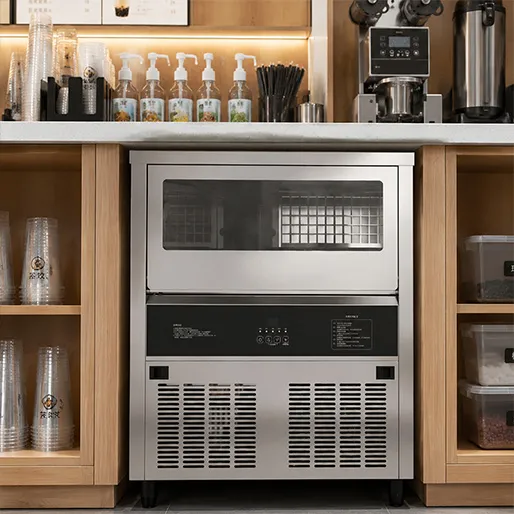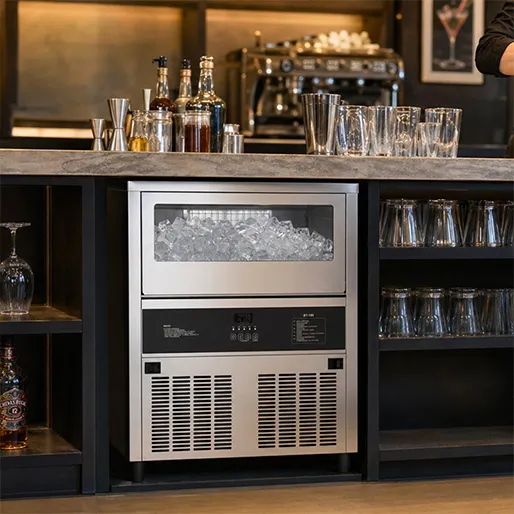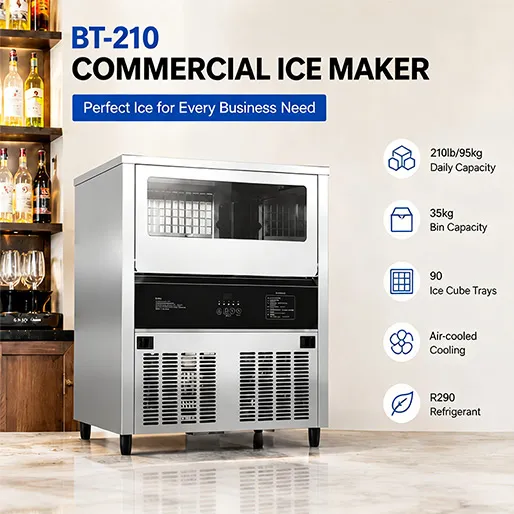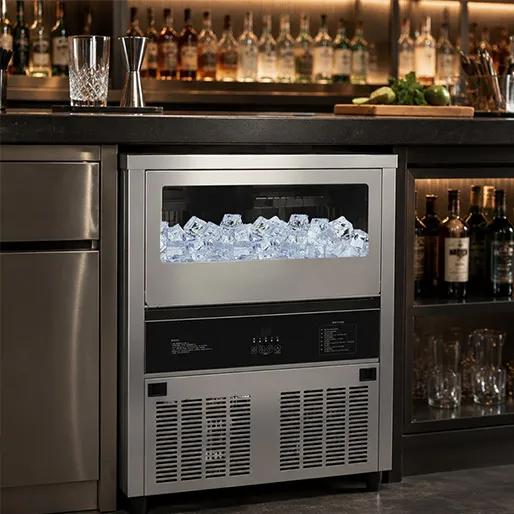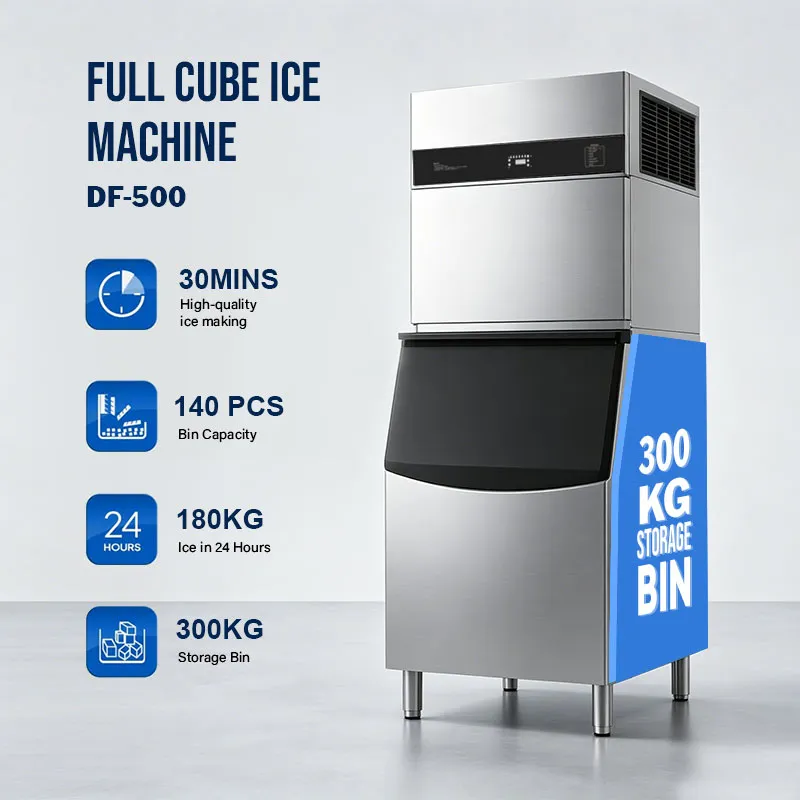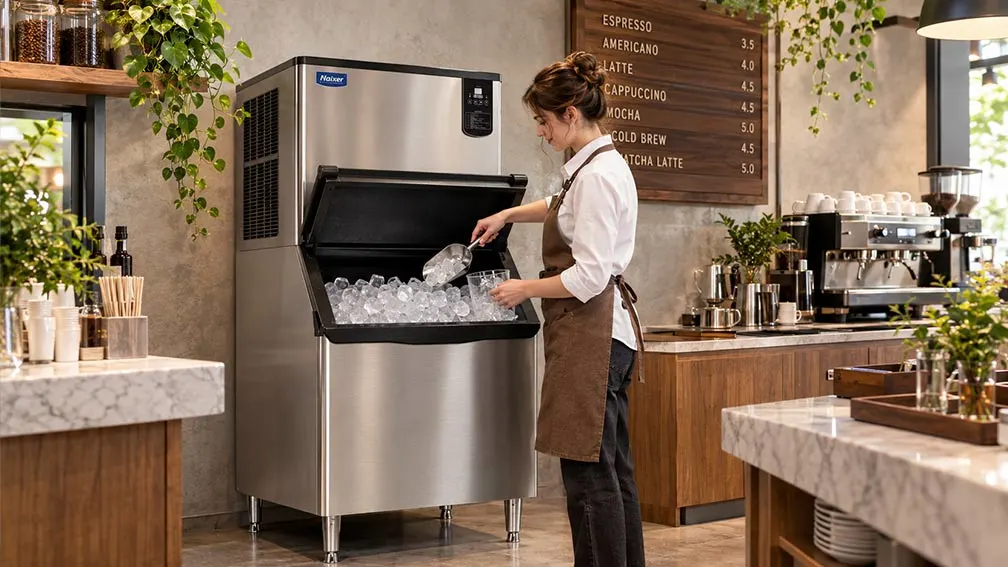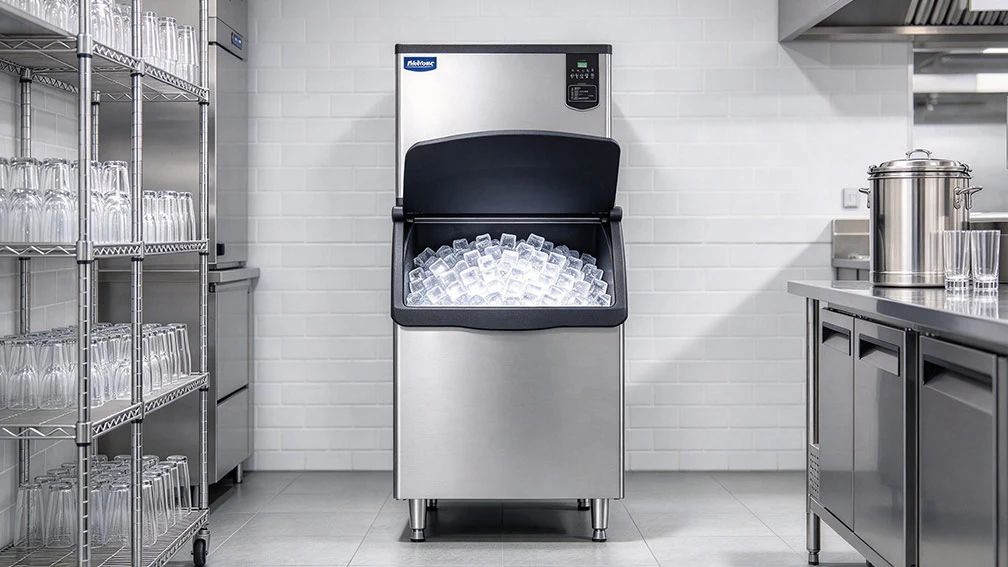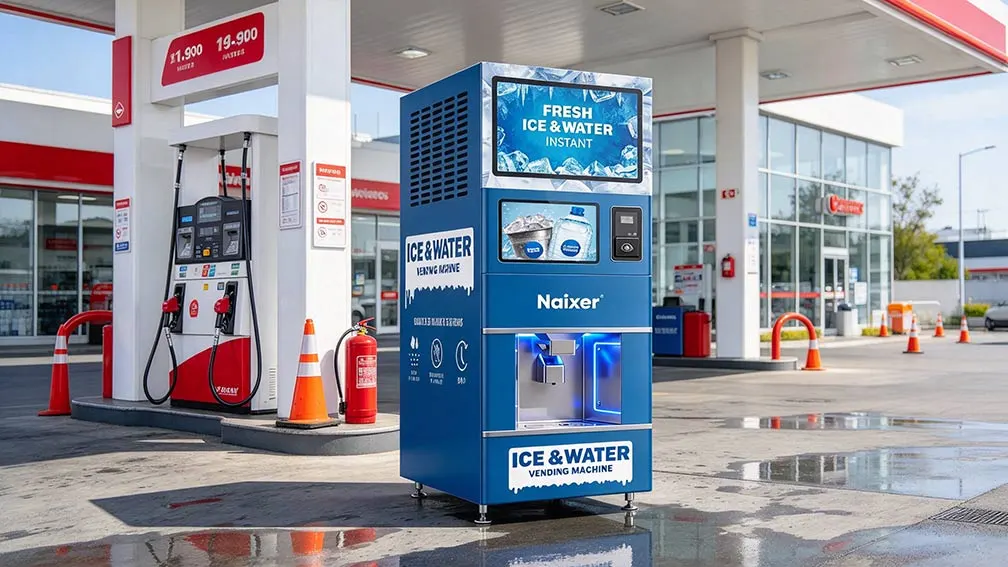
Quick answer. An ice and water dispenser is a plumbed appliance that holds ice in an insulated bin and releases it — usually by push-button, lever or sensor — for self-service use. Commercial buyers typically specify 150–500 lb of daily production and 80–250 lb of storage. The number most spec sheets lead with is production. The number that actually decides whether the machine survives a Saturday checkout is bin capacity.
In this guide, you will learn:
Three Buyers, Three Different Decisions
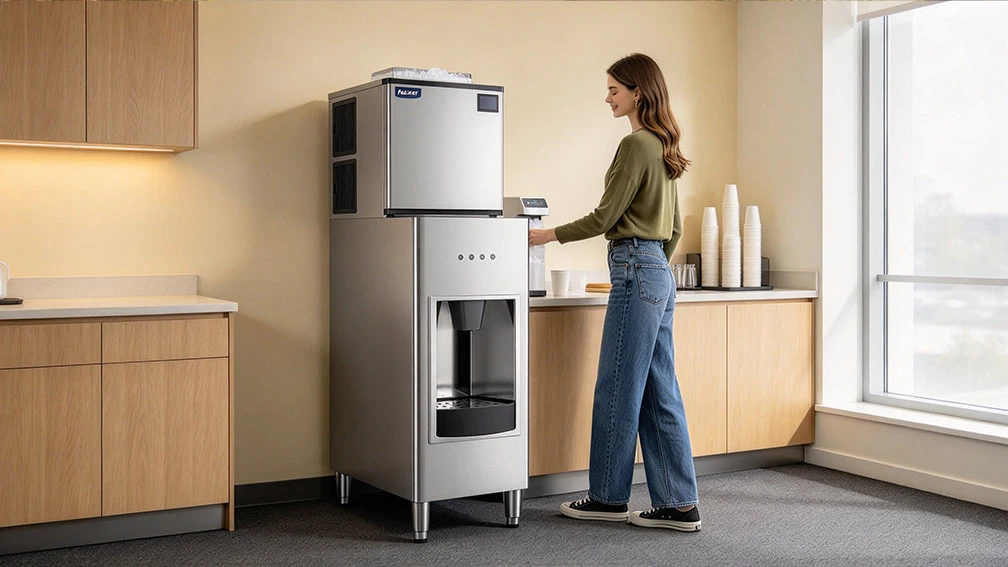
An ice machine makes ice. A dispenser stores it and hands it to a person without opening a lid.
That distinction sounds academic until you look at where dispensers get installed. Guest floors, hospital pantries, self-service canteens, staff break rooms, hotel breakfast areas. In all five, the machine is used by people who are not trained on it, often one-handed, often in a hurry. Every design decision follows from that.
Four categories get confused constantly. Here is the line between them.
| Equipment Type | What It Stores | Who Operates It | Typical Buyer |
|---|---|---|---|
| Ice Dispenser | Ice only | Guests, patients and staff | Hotels and hospitals |
| Ice and Water Dispenser | Ice and chilled water | Guests, patients and staff | Hotels, hospitals and offices |
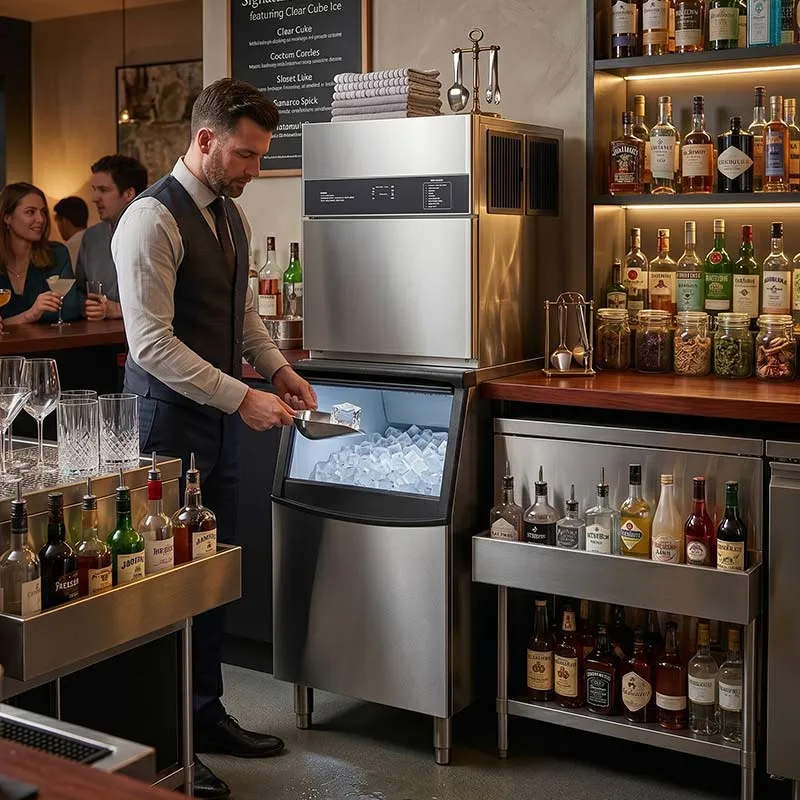
| Ice Machine | Ice, with lid or scoop access | Trained kitchen staff | Restaurants, bars and factories |
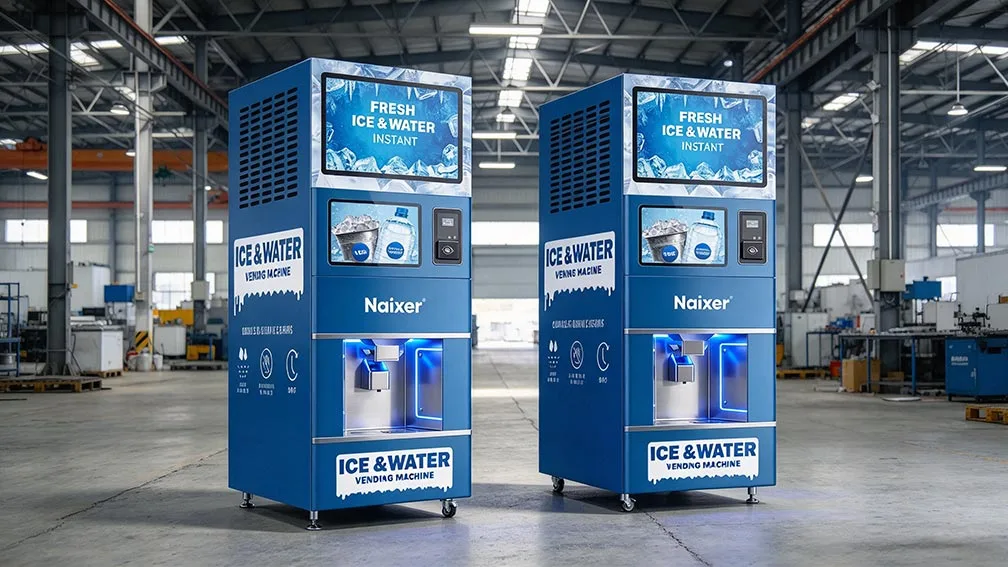
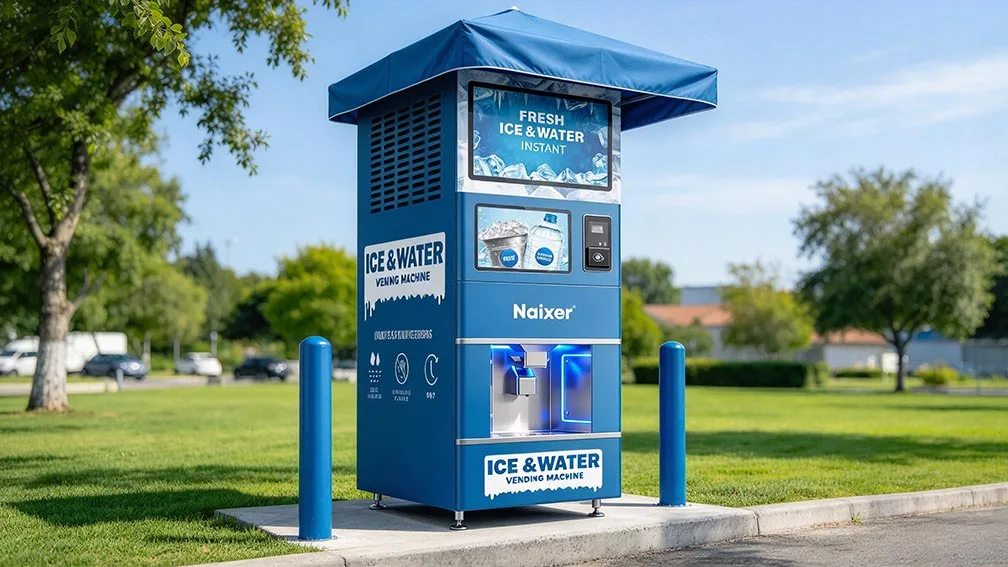
| Ice and Water Vending Machine | Ice and bagged water | Paying customers | Retail stores, forecourts and unattended sites |
The fourth row is a different business entirely — if coin-operated unattended retail is what you’re actually shopping for, see our guide to how ice and water vending machines are built.
Why bin capacity matters more than production
Here is the pattern that repeats across almost every countertop dispenser sold in North America.
A leading brand lists up to 500 lb of production per day and 25 lb of storage. Read that again. Twenty-five pounds is roughly 11 kg — about fifty 8-oz glasses of ice. The machine can make ice faster than any hotel floor will ever use it, and it can hold less ice than one busy breakfast service.
This is not a design flaw. It’s a design trade-off. Countertop units are built for footprints where nobody will give up 30 inches of counter to a bin. The bin is sacrificed.
Floor-standing dispensers flip it. A 100 kg (220 lb) bin holds roughly eight times more ice than a 25 lb countertop unit. For a dispenser that has to carry a guest floor from 6 am to midnight, that difference is the whole ballgame.
The practical rule: size the bin for your worst four hours, not your average day. Production refills the bin overnight and in the quiet hours. The bin is what gets you through the rush.

The five configurations you'll be quoted
Almost every quote you receive will be one of these.
1. Countertop ice and water dispenser
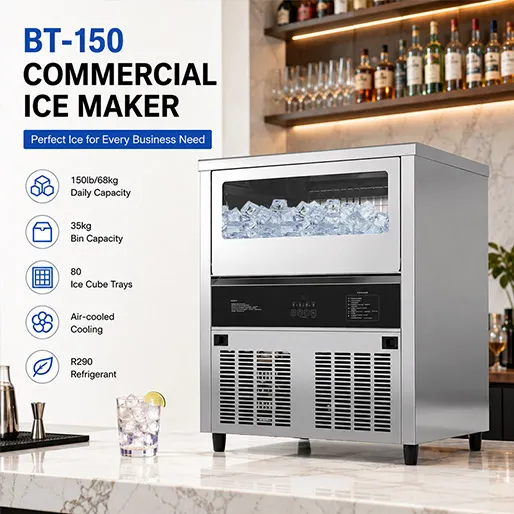
22–26 inch width, sits on a counter. Small bin (20–30 lb), high production. Needs a nearby drain and a 120V circuit. Cheap to buy, expensive to keep up with at peak.
2. Floor-standing ice dispenser
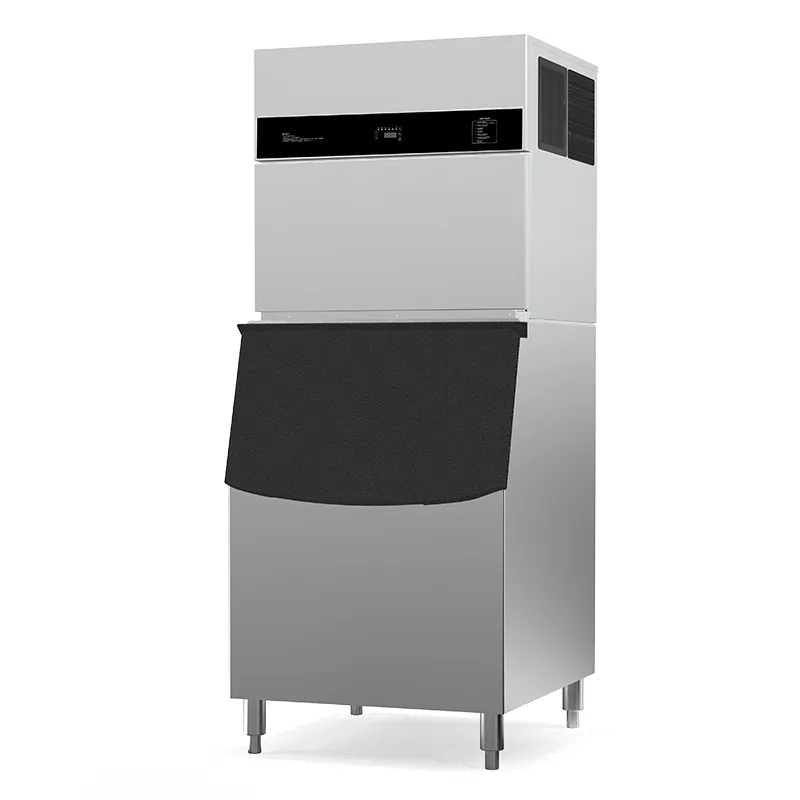
Waist-to-chest dispensing height, 220–290 lb bins. This is the workhorse for hotel corridors and hospital pantries. Takes floor space you have to plan for.
3. Built-in bin ice machine
Ice maker sits on top of its own bin. Not a dispenser, but it’s what you buy when a dispenser is overkill and a bare machine is too awkward.
4. Modular dispenser with a detachable ice head
The dispenser body and the ice-making head are separate items. You buy the bin once and change the head when your volume changes. This is how you avoid replacing a $6,000 unit because your occupancy doubled.
5. Bottleless ice and water dispenser
Filtered mains water instead of 5-gallon bottles. Removes the bottle-delivery contract, adds a filter-replacement contract.

Sizing a dispenser without guessing
Ignore the “rooms per machine” charts. They’re built on assumptions you can’t see.
Use the formula instead:
Daily ice demand (kg) = Rooms × Occupancy % × kg per occupied room
Peak-hour demand (kg) = Daily demand × Peak factor ÷ 24
Required bin (kg) ≥ Peak-hour demand × 4
Required production ≥ Daily demand ÷ 0.8
The last line carries a 20% headroom. Production figures are quoted at 21 °C room and 10 °C water — a kitchen corridor in July will not hit those numbers. Derating by 20% is the honest way to compare brands.
Worked example — illustrative only. A 120-room hotel at 70% occupancy, 2.5 kg per occupied room per day:
Daily demand = 120 × 0.70 × 2.5 = 210 kg
Peak factor 2.0 → peak hour = 17.5 kg
Required bin ≥ 17.5 × 4 = 70 kg
Required prod. ≥ 210 ÷ 0.8 = 263 kg/24h
Run the same maths on your own building with our commercial ice machine size calculator.
| Rooms @ Occupancy | Daily Demand | Peak-Hour Demand | Minimum Bin Capacity | Minimum Production |
|---|---|---|---|---|
| 50 @ 70% | 88 kg | 7 kg | 30 kg | 110 kg/24h |
| 100 @ 70% | 175 kg | 15 kg | 58 kg | 219 kg/24h |
| 150 @ 75% | 281 kg | 23 kg | 94 kg | 352 kg/24h |
| 250 @ 75% | 469 kg | 39 kg | 156 kg | 586 kg/24h |
Specifications that decide whether it fits the building
Three specs sink more projects than any other: voltage, drain height, and door width.
Voltage. North America, the Philippines, Saudi Arabia, parts of Brazil and much of the Caribbean run 60 Hz. Most Chinese-built dispensers are 50 Hz unless specified. A 50 Hz unit on a 60 Hz supply runs the compressor ~20% fast — it makes more ice, runs hotter, and voids most warranties. Confirm 110V/60Hz or 220V/50Hz in writing on the order.
Drain. Gravity drain means the discharge must fall. If your floor drain is 4 inches above the unit’s outlet, a gravity unit will not work and you need a pump kit. Check this before the concrete is poured.
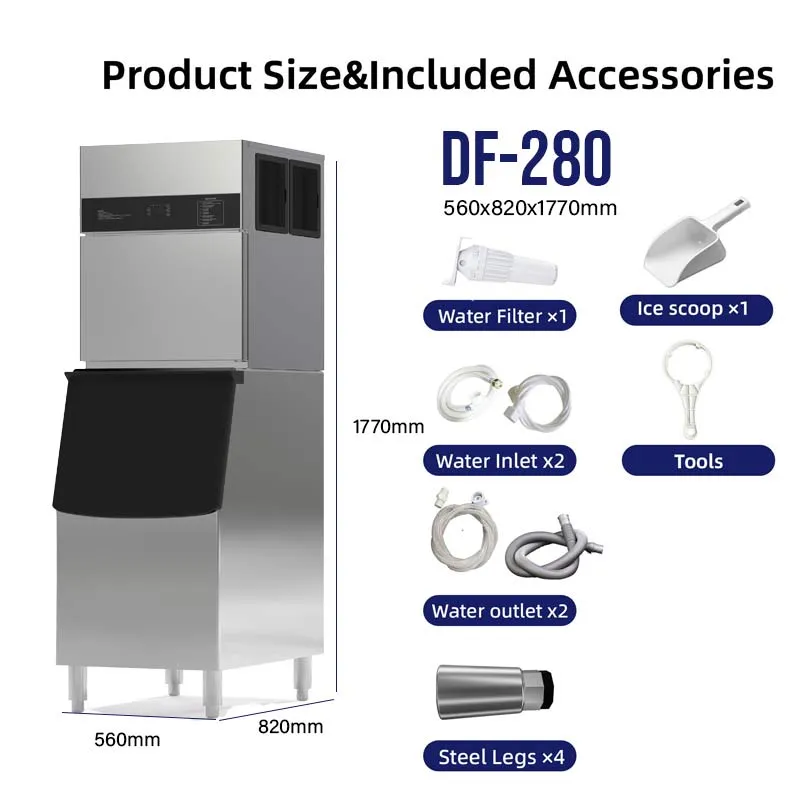
Door width. A floor-standing dispenser at 855 mm deep and 1,920 mm tall will not go through a 30-inch service door upright. Either confirm a 36-inch opening or plan the delivery route.
Which ice shape survives a dispenser
| Ice Type | Dispenser Compatibility | Typical Applications | Considerations |
|---|---|---|---|
| Full Cube 22 × 22 × 22 mm | Yes — common option | Hotel floors, canteens | May melt or refreeze in poorly managed storage conditions |
| Nugget / Chewable | Yes — with compatible system | Healthcare, guest preference | Requires a compatible nugget ice-making and dispensing mechanism |
| Crescent | Yes — model dependent | Mixed-use environments | Clumping may occur under humid conditions or during poor storage management |
| Flake | Not typically suitable | Fish counters, food displays | Can compact and obstruct dispensing mechanisms not designed for flake ice |
| King Cube Approx. 50 mm | Limited compatibility | Cocktail bars | May exceed the opening size of standard ice dispensing chutes |
Compatibility note: Ice dispensing performance depends on the dispenser's chute dimensions, auger or dispensing mechanism, ice storage conditions and the shape and size of the ice. Always confirm compatibility with the equipment manufacturer before combining an ice machine with a separate dispenser.
Not every ice shape dispenses well. This matters more than most buyers expect.
- Full cube (22×22×22 mm) — the default for dispensers. Flows freely, resists bridging, doesn’t shatter in the auger. Best all-round choice.
- Nugget / chewable — dispenses beautifully and is what hospital patients and hotel guests ask for by name. Softer, melts faster, and needs a nugget head rather than a cube head.
- Crescent — fine in a dispenser, but more prone to clumping in humid rooms if the bin isn’t cycled.
- Flake — poor in a dispenser. It compacts, bridges and jams. Flake belongs on a fish counter, not in a guest corridor.
- King cube / 50 mm — too large for most dispenser chutes. Cocktail bars, not corridors.
If you need nugget specifically, it has to be designed in from the start — see how flake and nugget machines differ before you commit to a head.
Ice-only or ice-and-water? Decide this first
This is the fork in the road, and it’s worth ten minutes.
Choose ice-and-water if: your users expect a drinking-water tap at the same station, you have potable water and a drain at the location, and you’re willing to own a filter-replacement schedule.
Choose ice-only if: drinking water is already served elsewhere on the floor, you want fewer failure points in a corridor unit, or you’re specifying a large bin and the water circuit would just add a tank to clean.
Roughly half the hotel projects we quote end up splitting the two — an ice dispenser in the corridor, bottled or filtered water at the pantry. It’s usually cheaper to service and there’s less to go wrong.
The Naixer ZD-160 sits on the ice-only branch. It is a floor-standing ice dispenser: 160 kg/24h, a 100 kg (220 lb) bin, push-button dispensing, and a choice of TH320B or TH420B ice head. It dispenses ice only — if you need chilled water at the same point, plan a separate water unit or specify a combination dispenser instead.

Running costs, honestly
Nobody can give you a truthful kWh/kg figure without knowing your ambient temperature, water temperature and duty cycle. What you can do is bound it.
The ZD-160 draws 1,200 W at nameplate. Multiply by actual compressor run-time, not by 24 hours. A dispenser in a 24 °C corridor typically runs well under half the day; the same unit in a 35 °C plant room runs most of it.
Monthly kWh ≈ 1.2 kW × run-hours per day × 30
Everything else — filters, descaling, an annual service — scales with how hard the water is, not with the model.
Vetting a manufacturer
Ask for these six things before you place a deposit. A supplier who can’t produce them quickly isn’t a supplier you want one floor up from a guest room.
- Nameplate test conditions — 21 °C / 10 °C is standard. A figure quoted at 15 °C water is inflated.
- Voltage confirmed in writing — 110V/60Hz or 220V/50Hz, matching your market.
- Refrigerant and its compliance path — R404A is being phased down in many jurisdictions; R290 is the forward path but carries charge limits.
- Spare parts list with lead times — auger motors, bin thermistors, door switches. If they can’t quote a lead time, they don’t stock it.
- Certification documents for your market — ask for the actual certificate numbers, not a logo.
- OEM minimum order and tooling cost — if you intend to brand it.
We publish our own test conditions and voltage options up front; if a competitor won’t, treat that as the answer.
We publish our own test conditions and voltage options up front; if a competitor won’t, treat that as the answer.

Frequently asked questions
What is the difference between an ice and water dispenser and an ice machine?
An ice machine produces ice for staff to scoop. A dispenser holds ice in a bin and releases it directly to an untrained user through a chute. The dispenser needs a bigger bin relative to production, and a dispensing mechanism that survives public use.
Do I need plumbing for an ice and water dispenser?
Yes — a potable water inlet and a drain. Ice-only dispensers still need both, because ice is made from mains water and meltwater has to go somewhere.
How much ice storage do I need for a 100-room hotel?
Size the bin for your worst four hours, not the average day. At 2.5 kg per occupied room per day and 70% occupancy, a 100-room property needs roughly 60–80 kg of usable storage. Measure your own figure first.
Why do countertop dispensers have such small bins?
Counter space. A countertop unit trades bin volume for footprint, which is why production figures look impressive and storage figures don’t. Floor-standing units invert that trade.
Can an ice dispenser dispense water as well?
Only if it was built as an ice-and-water unit with a chilled water circuit. An ice-only dispenser like the ZD-160 will not — plan a separate water source.
What ice shape works best in a dispenser?
Full cube (22×22×22 mm) is the safest default. Nugget dispenses well and is preferred in healthcare, but needs a nugget head. Flake jams.
How long does installation take?
A straightforward swap on existing services is a half day. A new location needing a drain, a dedicated circuit and a water line is typically two to three days including commissioning.
What voltage do commercial dispensers use?
Both. Chinese-manufactured units are commonly 220V/50Hz by default and can be built to 110V/60Hz. Specify it on the order — don’t assume.
How often should an ice and water dispenser be cleaned?
Bin and chute weekly, full sanitising and descale quarterly, filter per the manufacturer’s pressure-drop spec. Healthcare sites usually double the frequency.
R290 or R404A?
R290 has a far lower global warming potential and is the direction regulation is heading. R404A is still widely supported and easier to service in some markets. Ask what your local technician can actually get.
How much does a commercial ice and water dispenser cost?
Commercial countertop units run roughly $4,900–$13,400 at US dealers. Floor-standing hotel-grade units are quoted per project because bin size and head choice move the number more than the brand does.
Can I get an OEM or private-label dispenser?
Yes. Expect a minimum order quantity, a tooling cost for branding, and a longer first-production lead time. Ask for the OEM terms alongside the standard quote.

Next Step
If you’re specifying for a hotel, hospital or canteen, send us the room count, occupancy and the ice shape your users expect. We’ll return a sizing with the assumptions written out, so you can check the maths rather than trust it.
Request a ZD-160 sizing and quote → · See the full ice dispenser range →