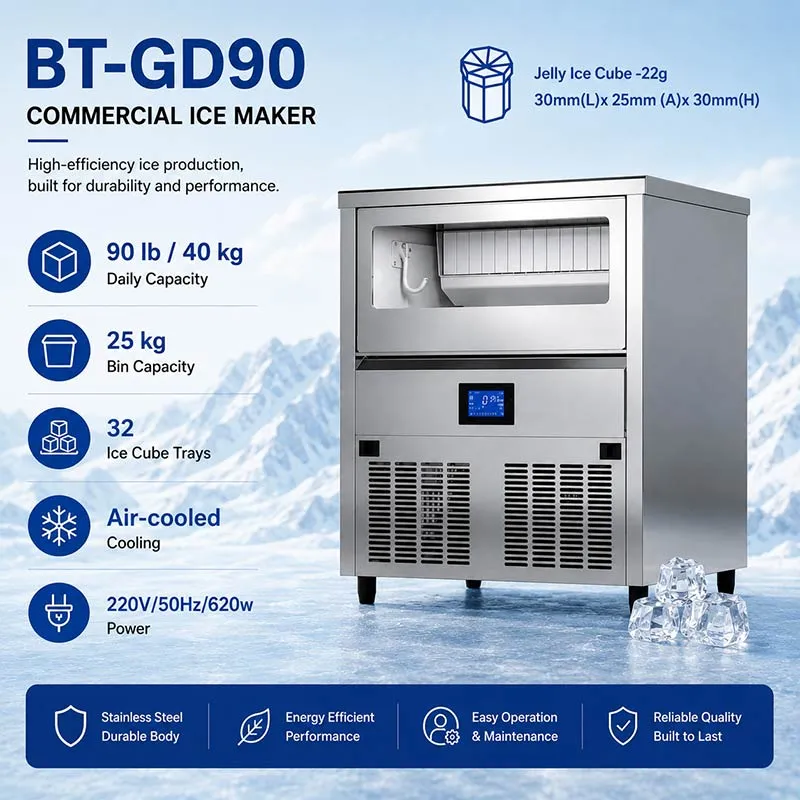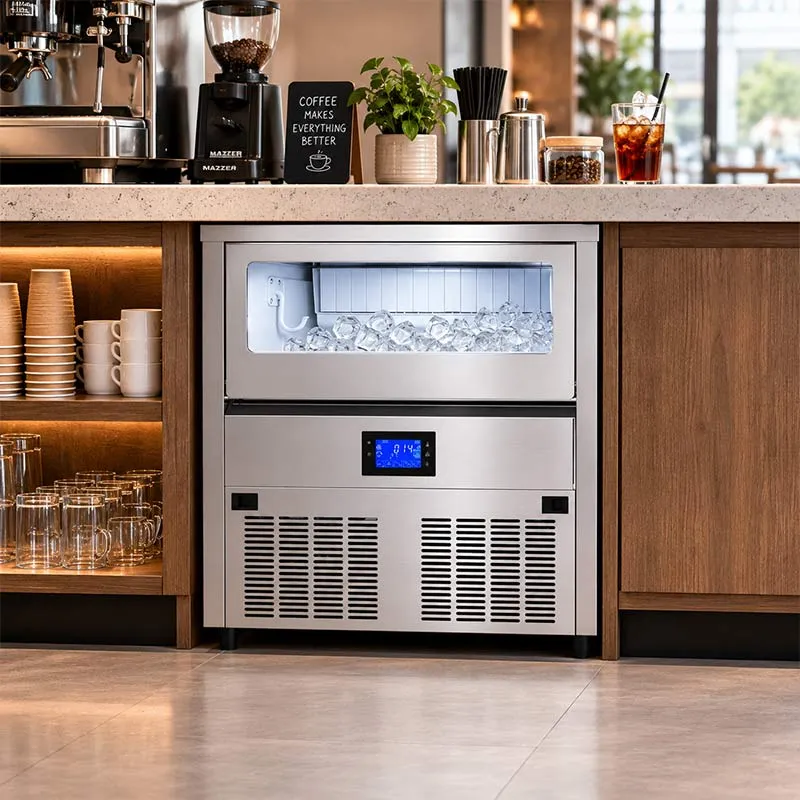
The same category of machine — self-service ice and water vending — sells for $4,948 and for $67,050. That is a thirteen-fold spread, and almost none of it is explained on the manufacturer websites.
Most buyers start by asking “who makes these?” and end up with a list of brand names, no prices, and a sales call. This guide does the opposite: it puts eight manufacturers side by side, with the prices they actually publish, and explains what separates a $8,789 machine from a $22,000 one.
Quick answer: Published prices for ice vending machines run from $4,948 (Manitowoc SPA312 dispenser) to $67,050 (Polar Station MX). Leer sits at $8,784–$10,409, Kooler Ice at $12,000–$22,000, Ice Depot at $21,211, and Naixer at $5,500–$6,500 depending on configuration.
In this guide, you will learn:
Who Actually Manufactures Ice Vending Machines?
“Manufacturer” is used loosely in this category. Three very different businesses use the word.
Actual factories build the refrigeration system, the cabinet, the dispensing mechanism and the control board, and will put your brand on the result. Most are in the United States, Italy, Turkey and China.
Brand assemblers design the machine but buy the ice head, the payment terminal and the compressor from others. Everest, for example, pairs its own VersaVend dispensing system with Scotsman ice makers and Everpure filtration.
Dealers and marketplaces list machines they do not build. Several of the listings in this category — including some at five-figure prices — are resellers.
The distinction matters because only the first group can change a spec for you. If you need a different voltage, a different bag size, or your own logo on the front panel, a dealer will tell you no and a factory will quote you.
For the broader landscape of who builds what, our guide to ice machine manufacturers in China covers factory verification, MOQ and certification checks, and the top commercial ice machine manufacturers list covers the general (non-vending) category.
The Price Table: Eight Manufacturers, One Comparison
This is the part that usually takes three weeks of emails.
| Manufacturer | Model | Price | Notes |
|---|---|---|---|
| Manitowoc | SPA312 | $4,948 | Ice dispenser only — not a self-contained vending machine |
| Naixer | Ice & water vending | $5,500 – $6,500 | Configuration-dependent; factory-direct |
| Leer | L040UASVP 47" | $8,784 | 80 × 10 lb bags, 110 V |
| Leer | VM40-R290 47" | $8,789 | Outdoor, R-290, auto defrost |
| Leer | Model 85 | $9,840 | — |
| Leer | VM85-R290 84" | $10,409 | Outdoor, R-290, steel doors |
| Kooler Ice | Vending machine | $12,000 | Across the range: 90 to 400+ bags/day |
| Ice Depot | High capacity | $21,211 | Commercial high-capacity unit |
| Kooler Ice | K810 | $22,000 | — |
| Polar Station | MX | $67,050 | 1,200 lb ice storage |
Prices observed in US listings, October 2026. Manitowoc SPA312 is a dispensing unit that accepts a standard ice maker head, not a standalone vending machine — it is included for price context, not as a like-for-like comparison.
Two notes before you read anything into that table.
It is not perfectly like-for-like. The Manitowoc SPA312 is a dispenser, not a self-contained maker-bagger-vendor. Sizes, bin capacities and payment systems differ across the rest. What the table does show is the shape of the market — and the fact that most manufacturers do not publish prices at all.
Everest and Ice House America are absent because they don’t publish prices. Both are major players in the US market and both require a quote. If you see a comparison list that ranks them without prices, it is ranking brands, not value.
For a deeper breakdown of what each price point buys in capacity and features, see how much ice vending machines cost.
Manufacturer by Manufacturer
Everest Ice and Water Systems
Based in Apopka, Florida. The VX series is the flagship, built around a patented VersaVend dispensing system that uses a single moving part to reduce jams. Machines pair Everest’s cabinet and dispensing with Scotsman ice makers, ozone injection for ice hygiene, and a five-stage Everpure filtration system.
Everest positions itself explicitly as a technology company rather than a cabinet builder. Pricing is by quote.
Ice House America
Operator of the Twice the Ice network and maker of the Ice Kiosk. Bins run 2,400 to 3,000+ lb, with multi-payment acceptance (cash, card, mobile wallet), SmartIce remote monitoring and the ICE2U consumer app.
The commercial detail worth noting: Ice House America will manufacture under your own brand with no franchise fees — a direct OEM offer, which makes them the closest US analogue to a factory-direct model. Pricing is by quote.
Kooler Ice
A range rather than a single machine: IM600 XL, IM1000 SIII, IM1500, IM2500 and Hydration Pro. Published capacity spans 90 to over 400 bags per day, with optional water vending and ICETalk remote monitoring. The company cites 18+ years in the category.
Kooler is the most transparent US brand on capacity, which makes it the easiest benchmark for sizing.
Leer
Four models appear consistently in US listings: L040UASVP 47″, VM40-R290, Model 85 and VM85-R290 84″. All-steel weather-resistant construction, R-290 refrigerant, automatic defrost, and VendNovation portal integration for remote management.
Leer’s edge is outdoor durability at a mid-market price — the $8,784–$10,409 band is the most competitive segment in this table.
Manitowoc
The SPA series is a touchless vending ice dispenser, not a full vending machine: ADA-compliant floor models that accept a standard ice maker head. The SPA312 holds 180 lb.
If your site already has a Manitowoc ice machine and you want self-service dispensing without a full vending platform, this is the cheapest legitimate route in the table.
Ice Depot
High-capacity commercial units, listed around $21,211. Positioned toward operators who need volume rather than a compact footprint.
Polar Station
The MX model vends both purified ice and water, with 1,200 lb of ice storage, listed at $67,050. This is the top of the market — a machine built for high-traffic commercial sites rather than a single forecourt.
Naixer
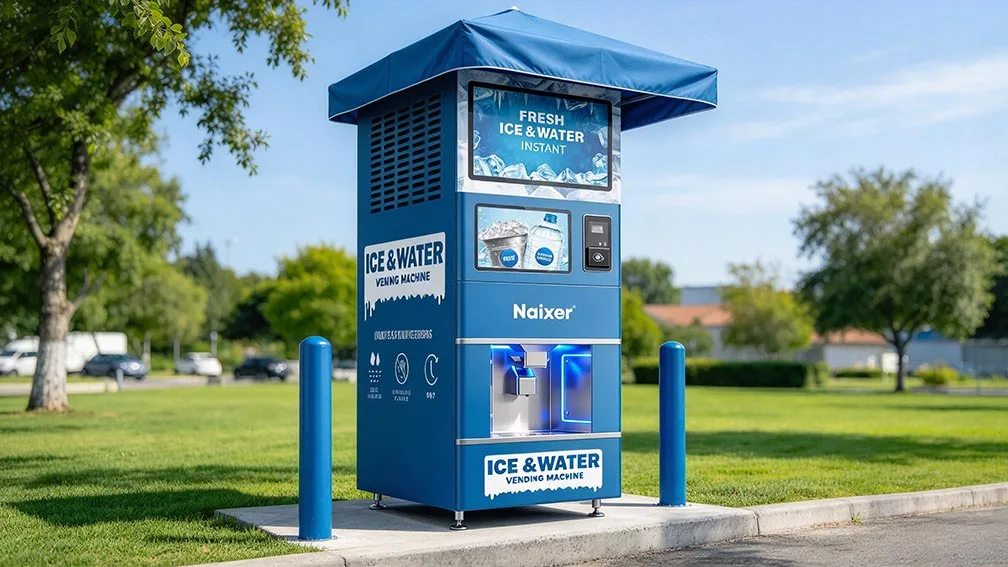
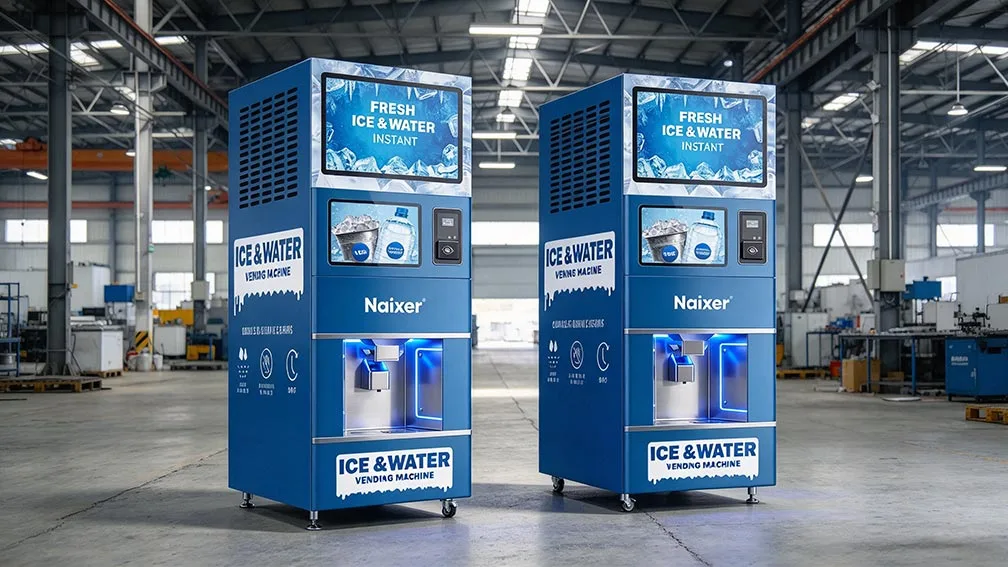
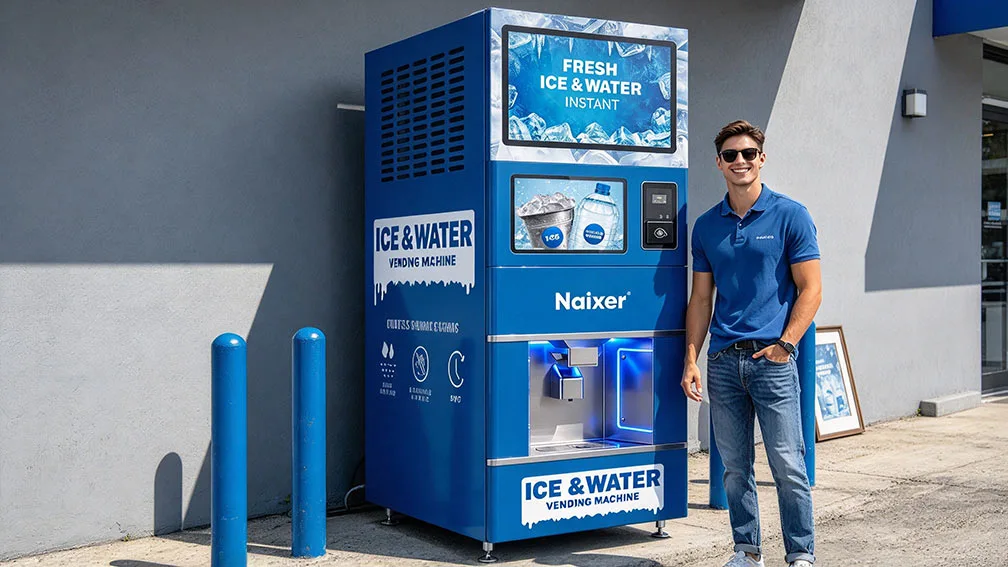
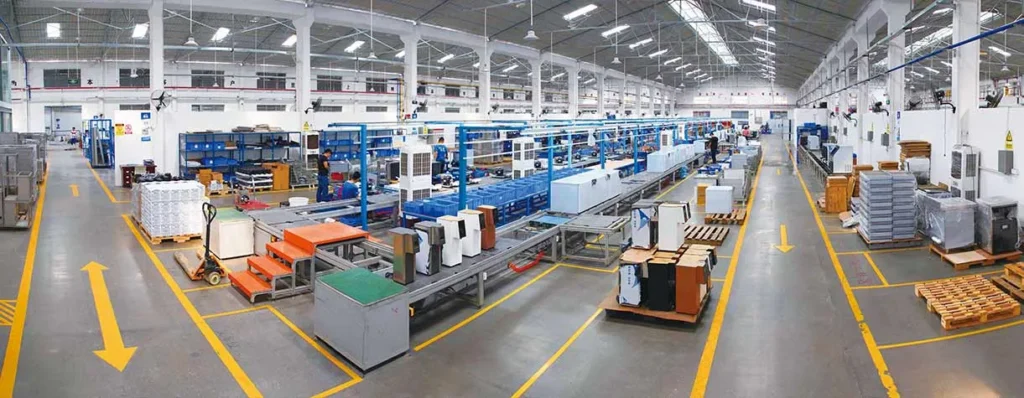
Guangzhou-based, founded 2010, operating a 30,000 m² factory and exporting to 100+ countries. Ice and water vending machines are quoted at $5,500–$6,500 depending on configuration, with OEM and ODM available.
That price sits below every US-branded vending machine in the table. Whether that is a bargain or a warning sign depends entirely on how the factory is vetted — which is the next section.
What Drives a $4,948 vs $67,050 Gap
Five factors account for almost all of it.
Ice production capacity. The single largest cost driver. A machine making 400 lb a day and one making 2,000 lb a day share a shape, not a bill of materials.
Storage bin size. Polar Station’s 1,200 lb bin is why it costs what it costs. Storage is insulated, stainless-lined and expensive — and it is what determines whether you run out on a Saturday.
Dispensing mechanism. A single-moving-part design (Everest’s VersaVend) costs more to engineer and less to maintain. Manual-fill systems cost the opposite.
Payment and telemetry. Card readers, mobile wallets, remote monitoring and stock alerts are a meaningful share of a $6,000 machine and a rounding error on a $67,000 one.
Weather rating and refrigerant. Outdoor-rated, all-steel construction with R-290 and automatic defrost is a different product from an indoor unit. In hot or coastal markets this is not optional.
How to Vet an Ice Vending Machine Manufacturer
Price gaps this wide attract bad actors. Seven checks separate a factory from a broker.
| Ask | A real factory answers with | A broker answers with |
|---|---|---|
| 1. Factory address | A street address you can put into a map, plus a live video walkthrough | "Our factory is in Guangdong" — no address |
| 2. Production line | Video of your model being assembled, dated | Stock footage or catalogue photos |
| 3. Component list | Compressor brand, ice head, payment terminal, control board — by name | "High quality imported parts" |
| 4. Spare parts list | Part numbers with prices, available before you order | "We can supply parts" |
| 5. Certification | Certificate numbers you can verify independently | A logo on a slide |
| 6. Reference sites | Two or three operators you can contact, in your region | "Many customers in Europe" |
| 7. Payment terms | Deposit plus balance against shipping documents | 100% upfront, no documents |
A supplier that fails two or more of these is a trading company. That is not automatically disqualifying — but it should change your price expectations and your deposit terms.
Before you commit to any machine, confirm the site can support it: dedicated circuit, water supply, drainage and ventilation. Our commercial ice machine installation guide covers the requirements checklist, and it applies to vending sites as much as to kitchens.
OEM and Private Label: What to Ask For
OEM is where factory-direct supply becomes genuinely interesting — and where most buyers ask the wrong questions.
Ask about what can change, not just what can be printed:
- Branding — logo on the front panel, on the control interface, on the packaging, on the manual
- Bag size — 8 lb, 10 lb, 16 lb or 20 lb
- Voltage and frequency — 110–115 V and 220–240 V are both common requests, and frequency matters as much as voltage
- Payment stack — which card reader, which coin mechanism, which telemetry platform
Water treatment — filtration stages, ozone or UV - Cabinet finish — colour, panel material, wrap graphics
Then ask the commercial questions: minimum order quantity, tooling cost (if any), sample lead time, production lead time, and who owns the design files.
One honest warning: OEM pricing usually has a volume threshold. A single-unit private-label order will almost always cost more than the catalogue price, not less.
Naixer offers OEM and ODM on its ice and water vending machine range; the specification sheet is the right starting document for any custom request.

Factory-Direct vs US Brand: The Real Trade-off
The honest version, without pretending one side wins everything.
| Factor | Factory-direct | US brand |
|---|---|---|
| Unit price | Lower — often 30–70% at comparable capacity | Higher; includes dealer margin and local stock |
| Lead time | Weeks to months, including sea freight | Days to weeks from stock |
| Customisation | Yes — branding, spec, voltage, bag size | Limited to catalogue options |
| Service | Remote support; you or your partner do the hands-on work | Local technicians and stocked parts |
| Spare parts | Order ahead with the shipment | Next-day from domestic warehouse |
| Best for | Multi-unit operators, distributors, private-label brands | Single-site operators with no technical team |
The gap is not quality — it is who carries the service burden. Order spare parts with the first shipment and most of the downside disappears.
That last line is the whole argument in one sentence. Factory-direct supply works when you treat spares and documentation as part of the order, not as something you’ll sort out later. Operators who do that get the price advantage; operators who don’t discover the cost difference in month fourteen.

FAQ
Who are the main ice vending machine manufacturers?
In the US market the most visible are Everest Ice and Water Systems, Ice House America (Twice the Ice), Kooler Ice, Leer and Manitowoc. Factory-direct manufacturers in China, such as Naixer, supply the same category at lower unit prices, often under private label.
How much does an ice vending machine cost?
Published prices run from $4,948 for a Manitowoc SPA312 dispenser to $67,050 for a Polar Station MX. Most self-contained machines sit between $8,784 (Leer L040UASVP) and $22,000 (Kooler Ice K810).
Why is there such a wide price range?
Ice production capacity, bin size and dispensing mechanism account for most of it. A machine making 400 lb a day and one making 2,000 lb a day share a shape, not a bill of materials.
Do manufacturers publish prices?
Some do — Leer, Kooler Ice, Manitowoc, Ice Depot and Polar Station all appear in US listings with prices. Everest and Ice House America quote individually rather than publishing.
Can I get an ice vending machine under my own brand?
Yes. Ice House America explicitly offers manufacturing under your own brand without franchise fees, and factory-direct suppliers such as Naixer offer OEM and ODM. Expect a minimum order quantity and a tooling discussion.
What is the difference between an ice vending machine and an ice bagging system?
A vending machine makes, bags and sells ice in one unit. A bagging system only bags — it needs an existing ice supply and has no payment terminal. Our guide to the three types of bagged ice machine explains the split.
How do I verify a manufacturer is a real factory?
Ask for a street address, a dated video walkthrough of production, a named component list and spare part numbers. A supplier who cannot provide all four is a trading company.
What voltage do ice vending machines use?
Both 110–115 V and 220–240 V versions are common, and frequency differs by market — 50 Hz in much of the world, 60 Hz in the US. Confirm the nameplate before ordering, not after.
Next Step
If you are evaluating manufacturers for a multi-unit rollout, a distributorship, or a private-label programme, send us your target bags per day, site voltage, and destination port. We will come back with a configuration and a specification sheet you can compare against the US brands above.
Request a Naixer vending machine quotation →
Looking for the business case first? Start with what an ice vending machine actually earns, whether ice vending is profitable, how to find the right location, and how to start the business.