Answer box
Naixer builds ice and water vending machines in Guangzhou, China and supplies them to the Philippines at 145 kg / 190 kg of ice per 24 hours, with coin, bill, card and NFC payment. The Philippine grid runs at 220V / 60Hz — a 60Hz build must be specified at order, because Naixer’s standard production is 220V/50Hz. Factory-direct pricing sits in the USD 5,500–6,500 band depending on configuration. Units carry CE and ISO 9001 certification, held since 2011.

If you are still calibrating what a machine costs before you read local pricing, what ice vending machines cost across the market sets the global range first.
Three Buyers, Three Different Decisions
The Philippines does not have one ice vending market. It has three, and they buy differently.
The individual operator — the negosyo buyer. One machine, often financed from savings or a small loan, sited at a roadside location, a resort entrance, or beside a water refilling station. This buyer is highly sensitive to payback period and will judge the machine almost entirely on how quickly it returns capital.
The ice plant or distributor. Already in the cold chain, already has trucks and a customer list, and is adding vending as a route to sell ice without a delivery round. This buyer cares about output per day, uptime and spare-parts support — not about a touchscreen.
The chain or institution. Resorts, gasoline stations, hospitals, schools, transport terminals. Buys in multiples, needs consistent branding and a service agreement, and will ask for documentation the other two never mention.
Almost everything that goes wrong in a Philippine vending purchase traces back to a mismatch between the machine and the buyer type. A resort on the coast does not have the same machine requirement as a sari-sari store on a provincial road, even though both are buying “an ice vending machine.”
What They Cost in the Philippines
Philippine pricing for ice vending machines is unusually transparent for a market this young — several sellers publish numbers openly. As of 30 October 2026:
| Offer / Product | Daily Capacity | Listed Price | Equipment Type |
|---|---|---|---|
| CLIC Vendo | 200 kg/24h | ₱390,000 | Ice vending machine 21.5" touchscreen; published 6–8 minute cycle |
| OctoFreezePro ICE-H1000 | 1,000 kg/24h | ₱409,948 ₱457,204 as a package | Ice plant machine Produces ice; not an automatic retail vending machine |
| Marketplace Countertop Units | 12–15 kg/24h | ₱4,000–8,000 | Domestic ice maker Household countertop appliance, not a complete commercial vending system |
| Naixer ZD-160-A320/420A | 145 kg / 190 kg/24h | USD 5,500–6,500 ≈ ₱314,000–371,000 at ₱57/USD | Ice & water vending machine Coin, bill, card and NFC payment options as specified in the offer |
Price comparison note: Asking prices observed on Philippine seller pages and equipment websites on 30 October 2026, not confirmed transaction prices. The Naixer PHP conversion uses an illustrative rate of ₱57 per USD; recalculate using the exchange rate on the date of purchase. Naixer prices are FOB and exclude freight, import duties and local taxes. The offers represent different equipment categories and configurations, so the figures should not be treated as direct like-for-like price comparisons.
Three things stand out.
First, ₱390,000 is the current anchor. The CLIC Vendo unit at 200 kg/24h with a 21.5-inch touchscreen is the most visible single-machine offer in the market, and it has effectively set the reference price. Any machine you evaluate will be compared against it, whether you like that or not.
Second, ₱409,948 does not buy the same thing. The OctoFreezePro ICE-H1000 at 1000 kg/24h is an ice plant machine, not a vending machine. It produces ice; it does not dispense it, take payment, or run unattended. The price gap between an ice plant machine and a vending machine is not a margin — it is the cost of the dispensing mechanism, the payment stack, the enclosure and the remote monitoring. Buyers who compare these two numbers directly conclude that vending machines are overpriced. They are not; they are a different product.
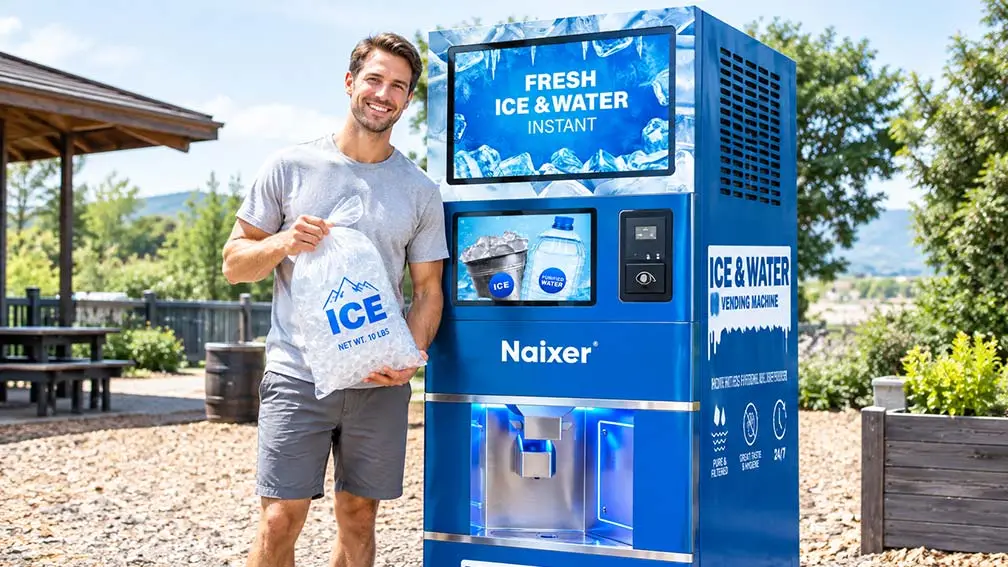
Third, the low-end prices you see on marketplaces are not this product. Compact countertop units at ₱4,000–8,000 and the ₱30,000-and-under filter Google offers are domestic appliances. They make a few kilograms a day and cannot run a business.
Where Naixer lands: factory-direct pricing is USD 5,500–6,500 depending on configuration. At ₱57 to the dollar that is roughly ₱314,000–₱371,000 — inside the same band as the ₱390,000 CLIC unit, with comparable capacity. Substitute your own exchange rate before you rely on that comparison; it moves.
For the broader picture on whether machine vending pays at all, see whether ice vending is actually profitable.
Power Supply: 220V / 60Hz — the Specification Nobody Checks
This is the section most buyers skip, and in the Philippines it is the one that most often decides whether a machine survives its warranty period.
The Philippines runs at 60Hz, at 220V single-phase, with Type A, B and C sockets. Naixer’s standard production range is built at 220V / 50Hz.
The voltage matches. The frequency does not.
Why frequency is not a formality
The compressor and the condenser fan are induction motors. Their running speed is tied directly to supply frequency. A motor wound and rated for 50Hz, energised at 60Hz, runs roughly 20% faster.
In practice that produces a chain of effects:
- Cooling capacity rises. The compressor pumps more refrigerant per hour, so a machine often out-produces its nameplate figure.
- Running current rises with it — and running current is what trips overload protectors. A unit already close to its protection threshold can nuisance-trip in a Philippine summer.
- Discharge temperature climbs, which shortens compressor life in a market that is already hot year-round.
- Fan motors overspeed, adding noise and bearing wear on a machine expected to run 24 hours a day.
- Control-board timing drifts. Defrost cycles, harvest timing and fault delays are written against a clock. On a different frequency they no longer run at the intervals they were designed for.
This is not a Naixer-specific issue. It applies to any 50Hz-built machine installed on the Philippine grid. It is also why “will it work?” is the wrong question, and “what build is this?” is the right one.
What a 60Hz build actually means
A machine genuinely specified for 60Hz differs from the 50Hz version in more than a label.
| Component | 50Hz Build | 60Hz Build |
|---|---|---|
| Compressor | 50Hz-rated motor winding | 60Hz-rated winding |
| Condenser Fan Motor | 50Hz-rated | 60Hz-rated |
| Control Board | 50Hz timing | 60Hz timing, or 50/60Hz auto-detect |
| Nameplate Output | Rated at 50Hz | Rated at 60Hz |
| Plug | Type I (China) or bare cable | Type A/B, or hardwired |
Electrical configuration note: Naixer's published product data describes a 220V/50Hz configuration. A 60Hz variant must be specified at the time of ordering and confirmed by the factory for the exact model. Verify the compressor, fan motor, control system, voltage rating, electrical protection and plug or hardwired connection requirements before shipment.

Ordering the correct build costs nothing extra at the factory. Discovering the wrong one has been shipped costs a compressor.
Five questions to ask before you commit
Ask any supplier — us included — these in writing:
- Is this machine built for 60Hz, or is it the 50Hz export model?
- Is the compressor nameplate rated at 60Hz?
- Does the control board auto-detect 50/60Hz, or does it require 60Hz firmware?
- What is the rated running current at 60Hz? This is the number your electrician needs.
- What plug type is fitted — Type A/B, or hardwired?
The Machine
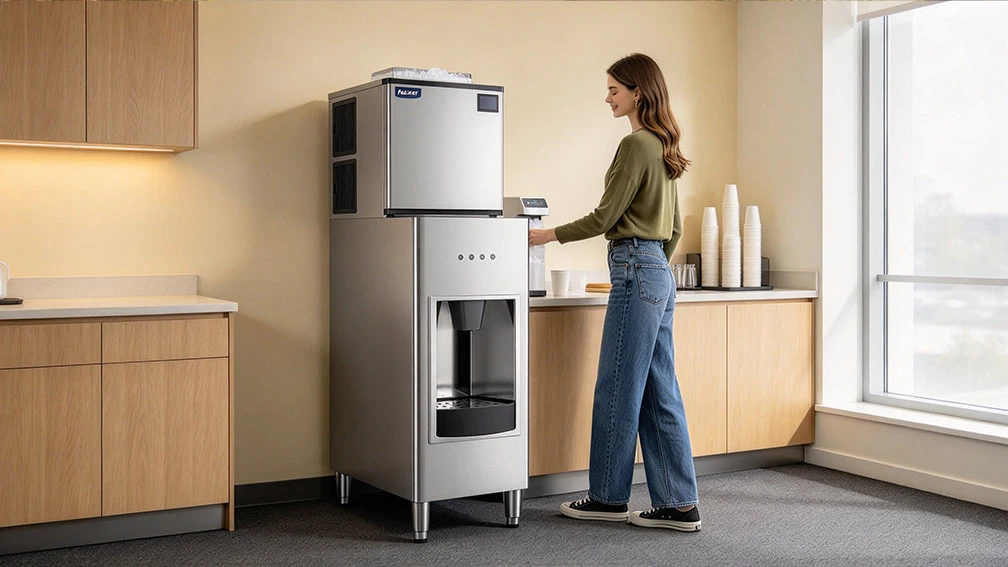
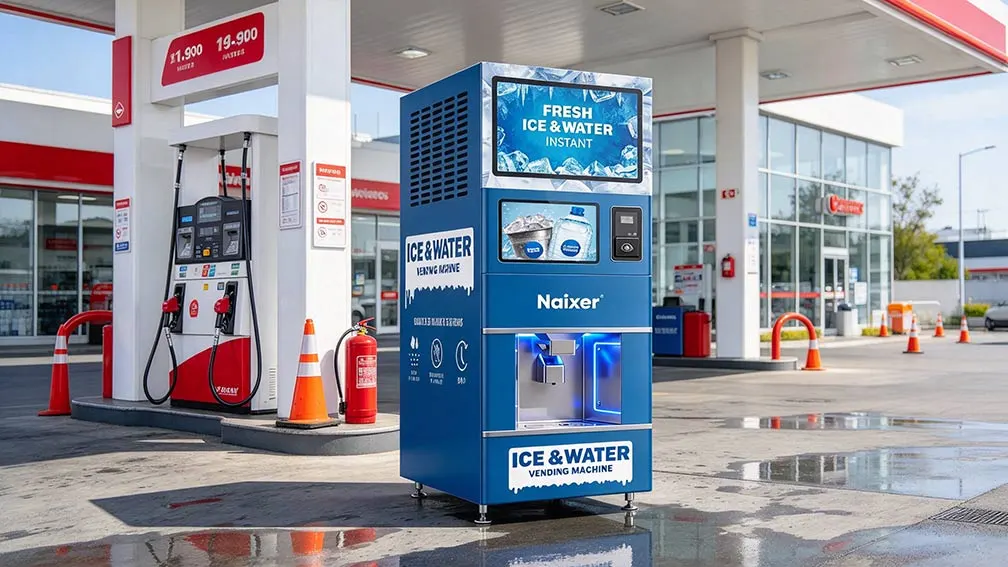
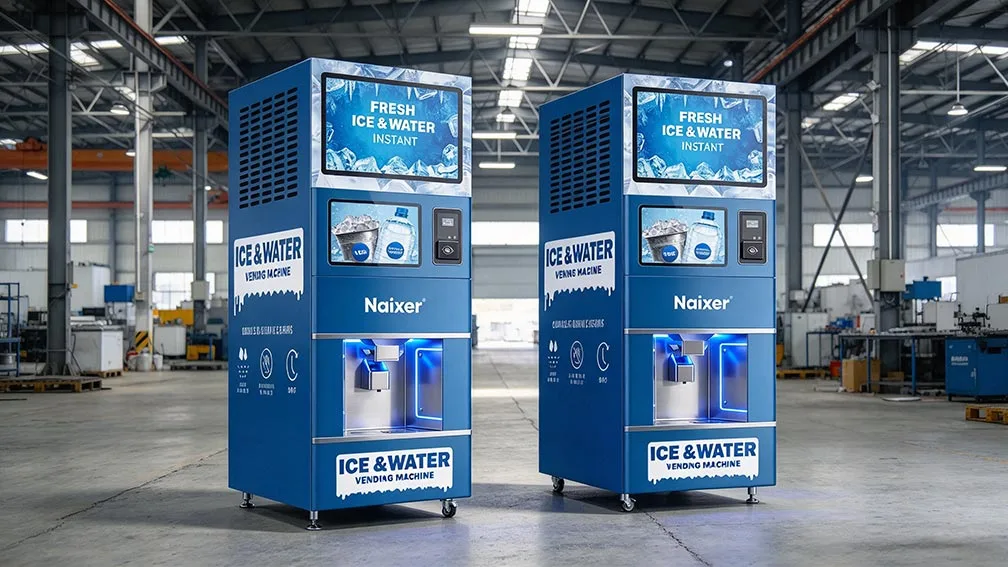
The ZD-160-A320/420A is a self-contained ice and water vending unit: it produces, stores and dispenses, with no attendant and no separate bagging step.
| Specification | Published Value |
|---|---|
| Ice Production | 145 kg / 190 kg 24h |
| Cube Size | 29 × 29 × 22 mm |
| Cubes per Cycle | 90 |
| Footprint (W × D × H) | 1140*890*2200 mm |
| Payment Methods | Coins, bills, cards and NFC |
| Remote Monitoring | Remote sales and fault monitoring |
| Water Dispensing | Yes — ice and purified water from one unit |
| Voltage |
220V
Frequency must be specified at order |
| Certification | CE, ISO 9001 |
Configuration note: Specifications are based on the published Naixer product information. Confirm the operating frequency, payment system configuration, storage bin capacity and destination-market electrical requirements for your specific order before shipment. Payment options and other configurations may vary by order.
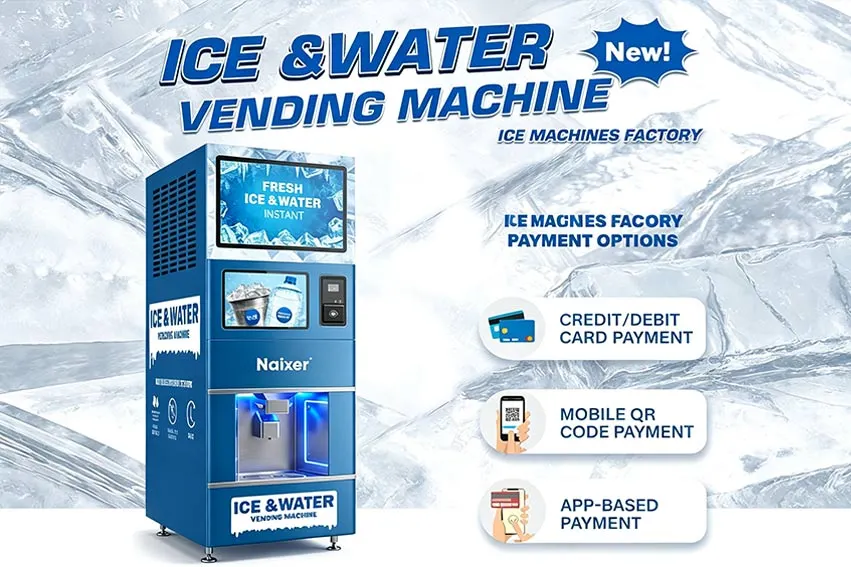
Full specifications and current pricing are on the ZD-160-A320/420A full specifications and pricing page. The points that matter most in a Philippine deployment:
Unattended operation. Nine cubes per vend cycle at 29 × 29 × 22 mm, dispensing through a self-service interface. No staff required, which is the entire economic premise of the model.
Four payment methods. Coins, bills, cards and NFC. In the Philippines, coin and bill acceptance still carries most transactions outside Metro Manila; card and NFC matter in malls, resorts and BPO districts. A machine that only takes coins limits where you can site it.
Remote monitoring. Sales and fault data without a site visit. On a machine running 24/7 in a location you do not live at, this is not a luxury — it is how you find out something broke before a customer does.
Footprint. 1140*890*2200 mm. Roughly the footprint of a small chest freezer plus headroom. Check door widths and canopy heights before you commit to a site; this catches more people than any technical specification.
Payback: The Four Numbers That Decide It
Vending machine ROI is arithmetic, not opinion. Four numbers determine it: price you pay, kilograms sold per day, contribution per kilogram, and operating cost. Get those right and the answer falls out.
Our a full ROI model for ice vending builds the full model with seasonality and financing. The short version:
Monthly contribution = kg sold per day × contribution per kg × 30
Operating cost = electricity + water + rent + consumables + maintenance
Net per month = contribution − operating cost
Payback (months) = machine price ÷ net per month
The grid below shows payback in months against the two variables you control least and estimate worst: daily volume and margin per kilogram. It assumes a machine price of ₱342,000 — the mid-point of Naixer’s USD 5,500–6,500 band at ₱57 to the dollar. Recompute at your own rate.
| Contribution per kg | 40 kg/day | 60 kg/day | 80 kg/day | 100 kg/day | 120 kg/day |
|---|---|---|---|---|---|
| ₱5 | 57.0 | 38.0 | 28.5 | 22.8 | 19.0 |
| ₱8 | 35.6 | 23.8 | 17.8 | 14.3 | 11.9 |
| ₱10 | 28.5 | 19.0 | 14.3 | 11.4 | 9.5 |
| ₱12 | 23.8 | 15.8 | 11.9 | 9.5 | 7.9 |
| ₱15 | 19.0 | 12.7 | 9.5 | 7.6 | 6.3 |
Payback calculation: Estimated payback months = ₱342,000 ÷ (daily ice sales in kg × contribution per kg × 30 days). Contribution per kg means sales revenue minus product cost only. This simplified calculation excludes electricity, water, rent, labour, maintenance, financing, downtime and other operating expenses. It assumes the stated daily sales volume is achieved and sold throughout each 30-day month. Actual payback will generally be longer. Daily sales volumes are illustrative scenarios, not verified market data.
Read it before you look at any brochure. If your realistic daily volume is 60 kg and your realistic margin is ₱8 per kilogram, you are looking at roughly two years before the machine pays for itself — before electricity, water, rent or maintenance. If that is not acceptable, the answer is a better site, not a cheaper machine.
Two things the grid deliberately excludes, and you should not:
Electricity. A 24-hour machine in a Philippine setting draws continuously. At industrial rates this is a real monthly line item, and it varies by region and by whether you are on a commercial or residential meter.
Uptime. A machine that is down 10% of the time does not earn 90% of the revenue — it loses customers who learn not to rely on it. Spare-parts availability is a financial variable, not a service nicety.
If you are thinking beyond a single machine, how many machines it takes to reach 100k works through the scaling arithmetic.
Power Stability: The Philippine Variable
Ask any operator in the provinces what breaks their equipment and the answer is rarely the equipment.
Voltage fluctuation. Supply does not always sit neatly at 220V. Sustained over-voltage stresses the compressor; sustained under-voltage makes it draw more current to do the same work, which stresses it differently. Both shorten life.
Brownouts and outages. A machine running unattended through a power cut will restart the moment supply returns, and restarting into a live refrigerant circuit is the single most damaging thing that can happen to a compressor. Short-cycle protection — a time delay before the compressor is allowed to restart — is not optional equipment in this market.

Generator transfer. Sites with backup power introduce a second supply with its own voltage and frequency behaviour. Confirm what your machine will do when the changeover happens.
What to specify
- Confirm the compressor has short-cycle protection with a defined restart delay. Ask for the delay in seconds.
- Ask for the operating voltage range, not just the nominal figure. A machine rated 220V ±5% and one rated 220V ±10% behave very differently in a fluctuating supply.
- Consider a voltage stabiliser at the site, sized to the machine’s running current.
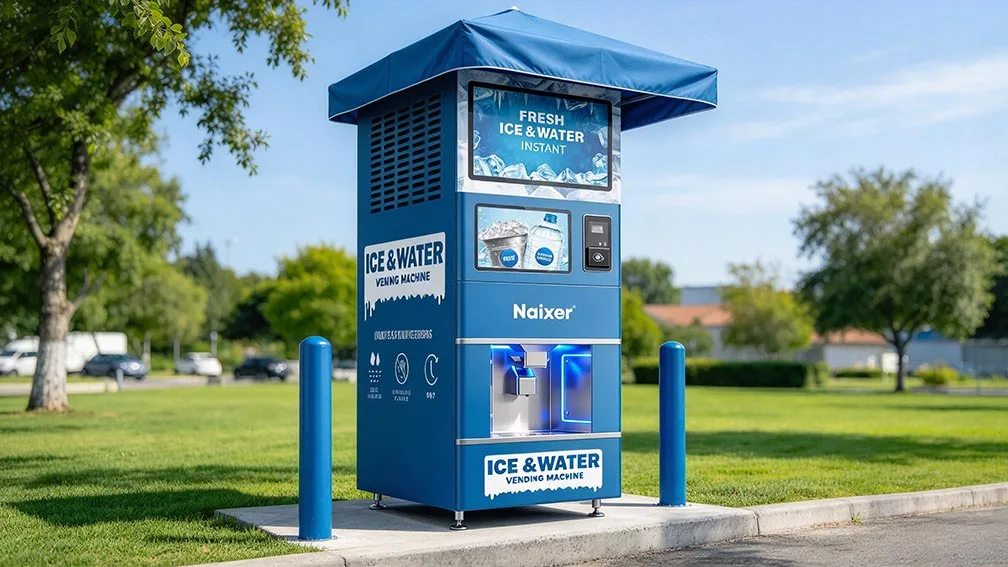
- Site the machine under cover. Rain ingress and direct sun both shorten component life, and a canopy is cheaper than a service call.
- For high-volume sites, revisit the cooling question — air-cooled vs water-cooled ice machines explains when water-cooled is the better answer in a hot, unconditioned location.
Ice and Water: Two Revenue Streams, One Site
Most ice vending businesses sell one thing. The ZD-160-A320/420A sells two.
Water refilling is already a mature, well-understood business in the Philippines — customers are trained to bring containers, and the refilling station model is familiar at barangay level. Adding a water vend to an ice machine reuses the same site, the same power connection, the same water supply and the same customer visit. The marginal cost of the second product is close to zero; the marginal revenue is not.

That matters for payback. A single-product machine needs its ice volume to carry the whole capital cost. A two-product machine splits that burden across two purchase occasions, and customers who come for water often leave with ice.
The revenue arithmetic for the combined model is worked through in revenue modelling for ice and water machines.
One caveat worth stating plainly: water vending brings water-quality obligations with it. Filtration, sanitisation schedules and testing are part of the business, not an afterthought. If you are not prepared to run that discipline, sell ice only.
Siting: Where the Machine Actually Earns
A vending machine is a real-estate business with a compressor attached. Location decisions outweigh machine decisions, and they are much harder to reverse.
Our how to choose an ice vending machine location covers the full framework. The Philippine-specific points:
Foot traffic beats passing traffic. A machine beside a market entrance, a transport terminal or a water refilling station is used by people already carrying containers. A machine on a highway verge is used by people who have to decide to stop — a much higher bar.
Power and water access determine viability before demand does. Confirm both at the site, and confirm who pays for the connection. A site with perfect traffic and no three-phase supply is not a site.
Heat and sun. A machine in direct afternoon sun works harder than the same machine under a canopy. This is worth a few percent of output, every day, for years.
Security and cash handling. Coin and bill machines hold cash. An unattended machine in a low-oversight location needs either cashless-only configuration or a managed collection schedule.
The strongest location types are set out in the locations that actually work for ice vending.
Importing: What to Prepare
If you are importing rather than buying local stock, settle these before the first container.
Frequency and voltage. Covered above, and it is the first thing to lock down in writing.
Electrical approval. Confirm with your importer and the relevant authority what documentation is required for your specific machine category before shipping. Do not assume a CE mark closes the question locally.
Taxes and duties. Duties are set by HS code and your customs broker confirms the rate. VAT and any other applicable taxes apply at import.
Container economics. Ask every supplier the same three numbers: units per 40HQ, gross weight, and packing dimensions. FOB comparisons without these are not comparisons.
Island logistics. Manila, Cebu and Davao are three different freight problems. A machine that lands cheaply in Manila can cost materially more to reach Mindanao. Get the quote to the actual destination port, not to Manila with an assumption bolted on.
Spare parts. Agree a spare-parts list with the machine order, not after the first failure. Boards, sensors and door seals are the usual culprits, and air-freighting them one at a time is expensive.
For the business build-out around the machine — registration, permits, pricing, route planning — see starting an ice vending business.
OEM and Distribution
Naixer’s Guangzhou base has an annual output capacity of 100,000 units and runs on an OEM + ODM model — private label, custom payment stacks, custom enclosure graphics and model numbering under your own brand.
For Philippine distributors the practical questions are MOQ, territory and spare-parts support. The Naixer distributor and OEM programme sets out the terms. In short: MOQ is agreed per model mix rather than as a single number, and territory discussion begins once there is a committed first order.
We do not currently have an appointed distributor in the Philippines. If you are an established refrigeration, food service or vending operator, that is an open conversation rather than a closed one.

Talking to Us
Naixer exhibited at Naixer at WOFEX Manila 2025, and the Philippines is an active region for us. If you are evaluating deployment, send us the application, the locality, the required daily output and the required frequency. We will come back with a model recommendation, an FOB price and a packing list you can hand to a freight forwarder.
For 60Hz and payment configuration questions, tell us the target city and the payment mix you expect — the configuration changes with both.
Browse the full Naixer ice machine catalogue for specifications on every model.
Frequently Asked Questions
How much does an ice vending machine cost in the Philippines?
Visible asking prices in October 2026 ran from ₱390,000 for a 200 kg/24h machine with a touchscreen to ₱409,948 for a 1000 kg/24h ice plant machine, which is a different product. Naixer’s factory-direct band is USD 5,500–6,500 depending on configuration.
Why is a 60Hz build needed in the Philippines?
The Philippine grid runs at 220V/60Hz, while Naixer’s standard production is 220V/50Hz. A 50Hz motor on 60Hz supply runs about 20% faster, raising current draw, discharge temperature and wear, and shifting control-board timing. The frequency must be specified at order.
Can I run a 50Hz machine on a Philippine supply with a converter?
It is possible but not recommended as a first choice. A converter sized for compressor inrush current is large and expensive, and adds a failure point to an unattended machine. Specify the correct build instead.
How much can one machine earn per day?
That depends entirely on location and price per kilogram, not on the machine. Use the payback grid above with your own site numbers — daily volume and contribution per kilogram are the two variables that determine the answer.
Do I need a franchise to operate an ice vending machine in the Philippines?
No. Buying a machine outright and operating it yourself is a straightforward route. Franchise arrangements exist in some markets but are not a requirement here.
What payment methods should I configure?
Outside Metro Manila, coin and bill acceptance still carries most transactions. In malls, resorts and BPO districts, card and NFC matter more. Most operators start with coin and bill and add cashless once volume justifies it.
How much electricity does an ice vending machine use?
It depends on ambient temperature, daily volume and how often the machine cycles. Ask for the rated running current at your specified frequency — that is the number your electrician needs to size the supply, and the one your utility bill will reflect.
Can the machine sell water as well as ice?
Yes. The ZD-160-A320/420A is an ice and water unit. Water vending brings filtration, sanitisation and testing obligations with it, which are part of the business rather than an afterthought.
How long does shipping from China to the Philippines take?
Transit to Manila, Cebu and Davao differs, and clearance sits on top of production lead time. Confirm both against your target opening date before committing.
Do you have a distributor in the Philippines?
Not at present. We are actively looking for one. If you already import refrigeration or vending equipment, the conversation usually starts with the Naixer distributor and OEM programme.
What do “yelo” and “tubig” refer to in the Philippines?
Yelo is ice and tubig is water in Tagalog. If you are briefing a local contractor or landlord, describing the machine as a yelo at tubig vending unit is clearer than the English product name.