Search “bagged ice machine” and you will get results priced at $184 and results priced at $70,000. Both are correct. They are simply not the same machine.
The phrase covers three distinct products: a bagging kit you bolt onto an ice maker you already own, an industrial bagging system for a supermarket or ice plant, and a vending machine that makes, bags and sells ice automatically. Choosing the wrong one is the most expensive mistake in this category — usually because someone bought a $250 bagger expecting it to do a $25,000 system’s job.
This guide separates the three, with real prices, real throughput numbers, and a clear way to decide which one your business actually needs.
Quick answer: A bagged ice machine is one of three things — a bagger kit ($184–$253), an automatic bagging system ($10,161–$25,124), or a self-bagging vending machine ($2,899–$70,000). Naixer’s ice and water vending machines sit at US$5,500–$6,500 depending on configuration.
In this guide, you will learn:
One Search Term, Three Machines
The real difference isn’t build quality. It’s who does the work — and whether the machine makes ice at all.
| Feature | Bagger Kit | Automatic System | Self-Bagging Vending Machine |
|---|---|---|---|
| Makes ice? | No — you supply it | Yes | Yes |
| Bags ice? | Manually | Automatically | Automatically |
| Sells ice? | No | No | Yes |
| Labour per bag | 30–60 seconds | Near zero | Zero |
| Typical price | $184 – $253 | $10,161 – $25,124 | $2,899 – $70,000 |
| Who it suits | Existing ice machine owners | Supermarkets, ice plants | Vending operators |
That single row — “Makes ice?” — eliminates most wrong purchases. If you don’t already own a commercial ice maker, a bagger kit on its own has nothing to bag.
Type 1 — Bagger Kits and Manual Baggers ($184–$253)
This is the cheapest category and the one most often misunderstood. A bagger kit is a frame, a bag holder and a tape dispenser. Some models add a scale. That’s the whole product.
What the money buys:
- Avantco Ice Bagger — around $184, handles 8 lb, 10 lb and 20 lb bags
- Generic bagger frames — from $191
- Choice Ice Bagger Kit — around $253, includes 8 lb bags, tape and dispenser
None of them make ice. They sit under the chute of an existing machine, hold a bag open, and let a person fill it. Throughput is therefore limited by the operator: roughly one bag every 30 to 60 seconds, stopping when that person stops.
Where it fits: a convenience store or bar that already has a commercial ice maker and wants to sell a handful of bags a day without buying new equipment. If the ice maker itself is still an open question, our breakdown of industrial ice cube machine costs covers that side.
Where it doesn’t: any operation selling more than roughly a hundred bags a day. Past that point, labour cost overtakes equipment cost, and an automatic system starts paying for itself.
Type 2 — Automatic Bagging Systems ($10,161–$25,124)
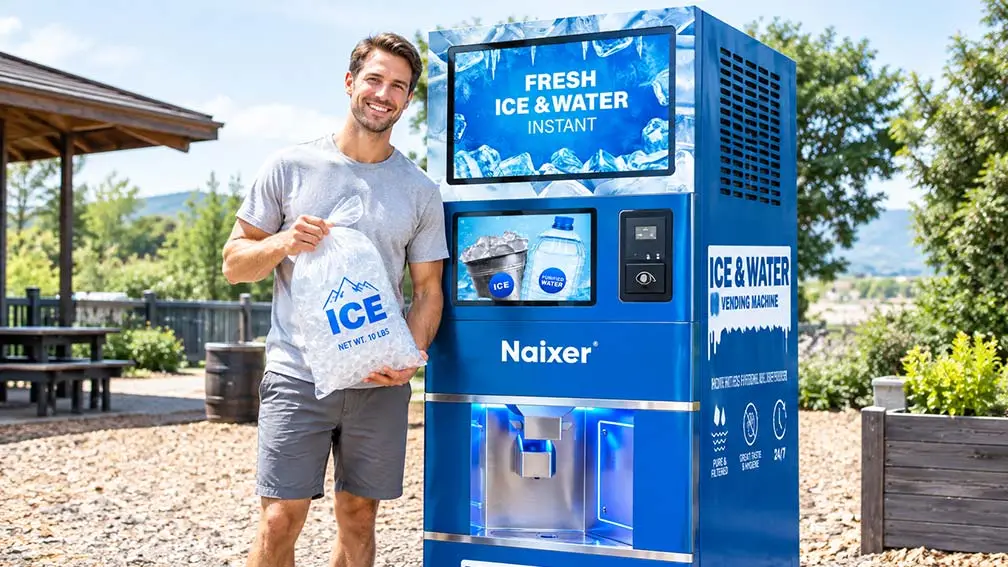
These are the machines behind the five-figure prices. They make ice, hold it in an insulated bin, weigh it, bag it and seal it — with the operator only changing film and moving pallets.
| Model | Capacity | Price |
|---|---|---|
| Follett DEV1350SG (bin) | 1,360 lb bin | $10,161 |
| ICEDOSER Semi-Automatic | — | $17,587 |
| Follett DB650SA | 650 lb | $19,596 |
| Hoshizaki HCD-1000B | 1,078 lb | $22,235 |
| Follett DB1000 | 1,000 lb | $23,409 |
| Follett DB1000SA (220 V) | 1,000 lb | $25,124 |
Prices observed in US listings, October 2026. Capacity is daily ice output unless marked "bin".
Two things worth understanding before comparing those numbers.
Capacity is not bag rate. A 1,000 lb system running 10 lb bags works out to 100 bags a day on paper — but only if ice production keeps pace, which it rarely does during peak hours. The bin, not the bagger, is what carries you through a busy Saturday.
The semi-automatic tier is usually the sensible one. On these platforms, “semi-automatic” means an operator still initiates each bag. It is generally priced below the fully automatic version of the same machine, and below a few hundred bags a day the difference in labour is negligible. If you need more than 1,000 lb/24h of ice to feed a bagger, see our guide to the 1,000 lb ice machine class for what the ice side looks like.

Type 3 — Self-Bagging Ice Vending Machines ($2,899–$70,000)
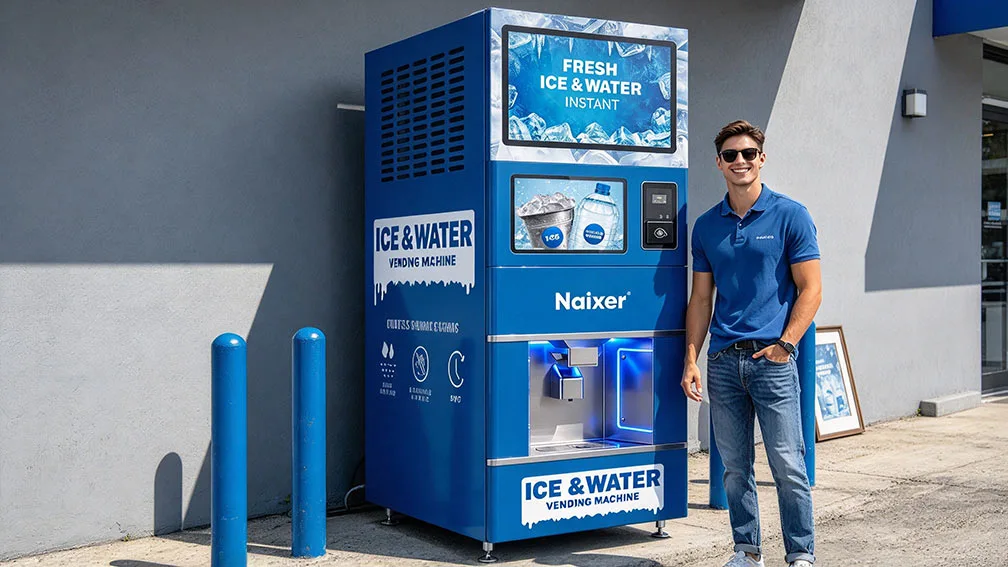
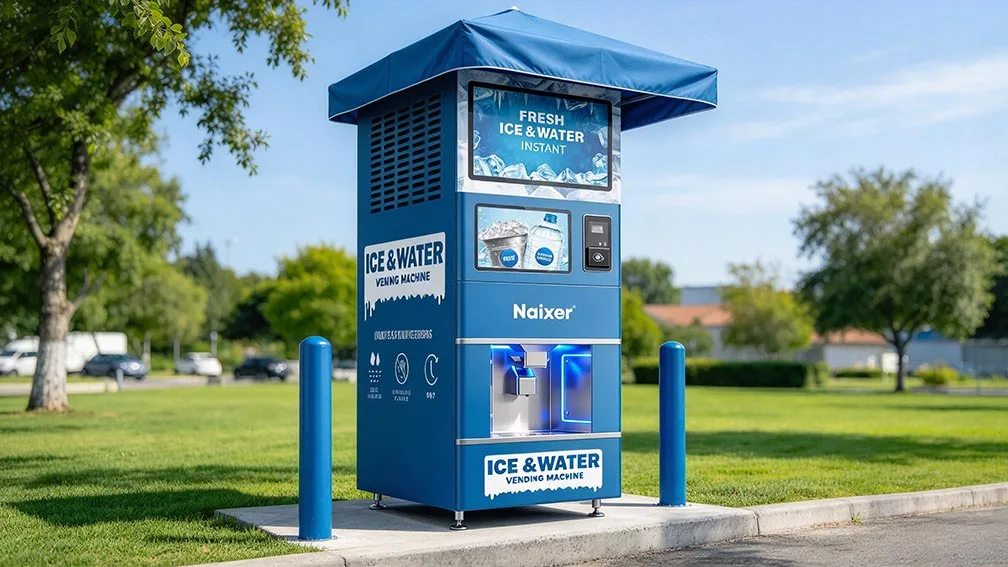
This is the category most buyers actually want, and the one the search term labels least clearly. A self-bagging vending machine does the whole job in one footprint: makes ice, stores it, bags it on demand, takes payment and dispenses — typically 24 hours a day, outdoors, unattended.
Current price points:
- New smaller units on marketplaces: $2,899 – $8,399
- Naixer ice and water vending machines: US$5,500 – US$6,500, depending on configuration
- Pre-owned automated self-bagging units: up to $70,000
That last figure is worth pausing on. A used automated machine selling for $70,000 tells you two things: the equipment holds its value, and the top of this category is a commercial asset rather than a convenience appliance.
Machines in this class typically vend 8 lb, 10 lb and 16–20 lb bags, and several also offer loose bulk dispensing. Everest’s VX explicitly offers both bagged and bulk vending; Kooler Ice’s IM2500 makes, stores, bags and dispenses on demand; Ice House America sells a smaller-footprint kiosk version.
For specs across Naixer’s own range, see the ice and water vending machine product page, or read which ice and water vending machine fits which site.

All Three Side by Side
Sorting every option by price makes the market easier to read than sorting by type.
| Price | Type | Examples |
|---|---|---|
| $184–$253 | Bagger Kit | Avantco bagger, generic frame, Choice kit |
| $2,899–$8,399 | Self-Bagging Vending | New smaller units (marketplace) |
| $4,452–$6,384 | Ice Merchandiser | Fogel ICB-1 / ICB-2 display freezers |
| $5,500–$6,500 | Self-Bagging Vending | Naixer ice & water vending machine |
| $10,161 | Automatic System | Follett DEV1350SG |
| $17,587 | Automatic System | ICEDOSER semi-automatic |
| $19,596 | Automatic System | Follett DB650SA |
| $22,235 | Automatic System | Hoshizaki HCD-1000B |
| $23,409–$25,124 | Automatic System | Follett DB1000 / DB1000SA |
| Up to $70,000 | Self-Bagging Vending | Pre-owned automated unit |
Prices observed in US listings, October 2026. Naixer price range supplied by the manufacturer; final price depends on configuration.
Read it as a ladder and one thing stands out: a vending machine in the $5,500–$6,500 band sits below every automatic bagging system on the list, yet does all three jobs — makes ice, bags it, and sells it. For a buyer whose alternative is a $19,000 bagging system plus a separate chest freezer plus a cashier, that gap is the entire business case. For a broader breakdown of machine costs and configurations, see how much ice vending machines cost.
Which One Fits Your Business?
Four scenarios cover most buyers.
You already own a commercial ice maker and want to sell a few bags. Buy a bagger kit. Nothing above $300 makes sense at that volume.
You run a supermarket or gas station and want bagged ice on the shelf. A self-bagging vending machine usually wins on economics — it removes the labour and lets customers serve themselves. For the site-level version of that decision, see gas station ice machine costs and ROI and ice machines for grocery stores.
You operate an ice plant and sell wholesale. An automatic bagging system with a large bin is the right tool. You need throughput and a big bin, not a payment terminal.
You want to run vending machines as a business. Here the machine is only half the decision. Site selection, power, water and footfall matter more than the model. Start with how to find the perfect vending machine location, the locations that actually work, and the three things to know before you invest.
Throughput Math: Bags per Day
Bag counts are arithmetic, not guesswork — you need two numbers: daily ice output and bag size.
| Ice Output / 24 h | 8 lb Bags | 10 lb Bags | 20 lb Bags |
|---|---|---|---|
| 300 lb (136 kg) | 37 | 30 | 15 |
| 500 lb (227 kg) | 62 | 50 | 25 |
| 700 lb (318 kg) | 87 | 70 | 35 |
| 1,000 lb (454 kg) | 125 | 100 | 50 |
| 1,500 lb (680 kg) | 187 | 150 | 75 |
Theoretical maximums, calculated as output ÷ bag weight. Real throughput is lower at peak because production and bagging draw on the same ice. Size the bin, not just the output.
For scale: Reddy Ice’s in-store bagging system is rated for up to 425 bags a day, which implies roughly 3,400–4,250 lb of ice daily at 8–10 lb bags. That is industrial territory.
Most single-site operators don’t need that. Work out your realistic bags per day, then match it to the table — and remember that the bin, not the headline output, is what decides whether you run out on a Saturday.
What Drives the Price
Five factors explain nearly the whole spread from $184 to $70,000.
Whether it makes ice. A bagger kit is a frame. A vending machine contains a refrigeration system, which is most of the cost.
Automation level. Semi-automatic versus fully automatic is the largest single step on the same platform.
Bin capacity. Insulated storage is expensive, and it determines whether you can survive a busy weekend.
Payment and telemetry. Card readers, remote monitoring and stock alerts add real cost — and real revenue.
Voltage and climate rating. A unit built for outdoor use in high ambient temperatures is a different bill of materials from an indoor one.

Buying a Used Bagged Ice Machine
Used equipment is a legitimate route here — the resale market is active, from a few thousand dollars up to $70,000 for automated vending units.
Three checks before you pay:
- Compressor hours and refrigerant history. Ask for service records, not assurances.
- Bagging mechanism wear. The sealing jaw and film feed fail first and are the hardest parts to source on older models.
- Parts availability for that exact model. A discontinued bagger is an expensive sculpture.
A rebuilt machine with a written warranty is a different risk profile from as-is equipment, and the price should reflect that difference.
Financing, Rental and Franchise Models
Two searches keep appearing next to this one — “ice vending machine financing” and “bulk ice machine franchise.” Both exist because the entry cost is real.
Equipment financing spreads a $5,500–$25,000 purchase across 24–60 months, trading interest for the ability to start now.
Rental exists too. Easy Ice advertises all-inclusive commercial ice machine service from around $170 per month, though that is restaurant ice service rather than a bagged-ice vending operation.
Franchise bundles equipment, site selection and branding for a fee. Worth comparing against buying outright, especially with no vending experience behind you.
Before committing to any of them, model the revenue side honestly. Our guides to what an ice vending machine actually earns and whether ice vending is genuinely profitable use realistic operating assumptions rather than best-case ones.

FAQ
What is a bagged ice machine?
The term covers three products: a manual bagger kit ($184–$253) that bags ice from a machine you already own, an automatic bagging system ($10,161–$25,124) for commercial volumes, and a self-bagging vending machine ($2,899–$70,000) that makes, bags and sells ice unattended.
How much does a bagged ice machine cost?
From about $184 for a bagger frame to $25,124 for a 1,000 lb automatic system. Self-bagging vending machines sit between — typically $2,899–$8,399 new for smaller units, up to $70,000 for large pre-owned automated models.
Do I need a separate ice machine to use a bagger kit?
Yes. A bagger kit contains no refrigeration — it is a frame, bag holder and tape dispenser. Without an existing commercial ice maker, there is nothing to bag.
How many bags can a bagging system produce per day?
It depends on ice output and bag size. A 1,000 lb/24h system running 10 lb bags is 100 bags on paper, though real output dips at peak. As a benchmark, Reddy Ice’s in-store system is rated for up to 425 bags daily.
What bag sizes are standard?
Most commercial machines handle 8 lb, 10 lb and 20 lb bags, with some supporting 16 lb. Retail formats favour 8 lb and 10 lb; bulk buyers favour 20 lb.
Can a bagged ice machine run unattended?
Self-bagging vending machines are designed for it — they take payment and dispense around the clock. Automatic bagging systems still need someone to change film, move pallets and check quality.
Is a used bagged ice machine worth buying?
Only with documented compressor service history, an inspection of the sealing jaw and film feed, and confirmed parts availability. Discontinued models are a recurring problem in the used market.
What voltage do these machines use?
It varies by market and model — both 115 V and 220–240 V versions exist, and frequency matters as much as voltage. Confirm the nameplate against your site supply before ordering.
Next Step
If you are weighing a self-bagging vending machine against a bagging system, send us your target bags per day, bag size, site voltage and whether the unit will run indoors or outdoors. We will tell you which class of equipment fits — including when a vending machine is the wrong answer for your site.