How Can a Flake Ice Machine Benefit My Business?
For businesses that handle fresh food — seafood counters, processors, hotels, caterers, cold-chain packers — ice is not a convenience. It is a production tool. Yet many operations still overpay for delivered ice, or rely on cube ice that bruises delicate products and leaves water pooling under food on display.
A flake ice machine solves both problems at once. It produces soft, dry, moldable ice continuously, right where the work happens, at roughly -7°C. The payoff shows up as longer shelf life, faster cooling, lower operating costs — and often an entirely new service capability.
This guide breaks down how a flake ice machine benefits your business, benefit by benefit, then shows how to size the right machine using real specifications from Naixer’s PB Series (300–1,000 kg per day).
Quick answer: A flake ice machine cuts seafood spoilage by 5–10%, cools products 2–3× faster than block ice, and removes recurring delivered-ice costs. It serves seafood displays, food processing, bakeries, healthcare, buffets, and concrete cooling — with daily outputs from 300 to 1,000 kg.
In this guide, you will learn:
What Makes Flake Ice Different From Other Ice Types?

Flake ice is thin, dry, and subcooled — typically 1.5–2.2 mm thick and around -7°C — produced continuously on a refrigerated drum and scraped off as soft, moldable flakes. It is a cooling tool, not a beverage ice.
Three physical properties drive every business benefit that follows:
Full-surface contact. Flakes mold around the natural contours of a product, so every square inch is chilled at once — no air gaps, no warm spots.
Extra cold, even before melting. At about -7°C, flake ice carries more cooling capacity than 0°C cube ice from the moment it touches the product.
Continuous output. There is no freeze-and-harvest cycle. A 500 kg/day unit delivers roughly 20 kg of fresh ice every hour — which matters most during your peak hours.
Want the engineering detail — drum evaporator design, auger systems, dry vs. wet flake quality? See the complete guide to what a flake ice machine is and how it works.
| Ice type | Designed for | Physical characteristics |
|---|---|---|
| Flake ice | Cooling and preserving products: seafood, meat, produce, dough, concrete | Dry and irregular, 1.5–2.2 mm thick, ~-7°C; molds around surfaces |
| Cube ice | Beverages: sodas, iced tea, cocktails, spirits | Clear and dense with hard edges; melts slowly; ~0°C |
| Nugget ice | Chewable ice, iced drinks, patient hydration | Soft and porous; absorbs flavors quickly |
← Swipe to view the full table →
How Does a Flake Ice Machine Benefit Your Business?
Here are the six benefits that show up directly on the P&L — as cost saved, waste avoided, or revenue unlocked.
1. Longer Shelf Life, Less Spoilage
Flake ice keeps product in full, even contact with subcooled ice, slowing bacterial growth and moisture loss at every point of the surface. In seafood retail, studies suggest flake ice displays reduce product loss and spoilage by 5–10% compared with cube ice displays.
The math is easy to run. For a counter that sells $10,000 of seafood per week, a 5% reduction in spoilage is roughly $500 of sellable product preserved weekly — about $26,000 a year that would otherwise be discounted or discarded.
The same mechanism protects produce, poultry, and prepared foods: no warm pockets, no diluted packaging, no quality drift in the display.
2. Faster Cooling for Safer Food
Flake ice pulls heat from products 2–3× faster than block ice, thanks to its far greater surface-area-to-mass ratio. In food safety terms, that means product passes through the temperature danger zone (roughly 4–60°C / 40–140°F) in a fraction of the time.
This is why meat and poultry processors pack product on flake ice immediately after cutting or cooking, and why cold-chain operators choose it for temperature-sensitive shipments: target holding temperatures are reached sooner and held more evenly.
3. Lower Operating Costs — Stop Buying Ice by the Bag
Producing ice on-site eliminates one of the least visible costs in a food business: delivered ice. A mid-size operation can spend five figures a year on packaged ice, with delivery fees, minimum orders, and heat-wave shortages on top.
One thing to check before comparing quotes: storage. Many flake machines are quoted as an “ice head” only, and the compatible bin is a separate $800–$2,000 line item. Naixer’s PB Series is self-contained — the insulated bin (150–400 kg, depending on model) is built into the chassis. You pay once and install once.
For a full breakdown of purchase price, installation, and running costs, see Naixer’s commercial ice machine cost guide.
4. Better Presentation, Higher Sell-Through
Cube ice has hard edges. On delicate products — fish fillets, oysters, shellfish, soft produce — those edges bruise flesh, leave pressure marks, and shorten visual freshness. Flake ice does not. It cushions, conforms, and presents a clean, pristine-white bed that keeps its “just set up” look through a full service day.
For retail and hospitality, that difference has a price: better-looking product holds full price longer and is marked down less often.
5. Less Labor, Less Waste
Operational savings add up quietly:
- No bags to haul, stack, or break open.
No blocks to crush, chip, or portion. - Dry flakes produce less meltwater — fewer slippery floors, less mopping, less drainage load.
- Continuous production means your bin refills itself; nobody runs out of ice at 7 p.m. on a Saturday.
6. New Capabilities — and New Revenue Streams
Once ice is produced on-site, businesses can offer things they previously turned down:
- A seafood wholesaler can add cold-chain packing as a billable service for its customers.
- A hotel can handle larger banquet and buffet displays without outsourcing ice.
- A construction supplier can support mass-concrete pours in hot climates, where flake ice is mixed directly into the batch to control curing temperature.
- A clinic or sports facility gains a reliable supply of cold-therapy ice.
For a closer look at how different industries use flake ice day to day — including some you may not expect — see 5 key applications of a commercial flake ice machine.
Which Businesses Benefit Most From Flake Ice?
Payback is fastest when flake ice’s properties — softness, full-surface contact, rapid cooling — directly affect your product’s quality or your process control. The table below maps common business types to their typical use and the model that fits.
| Business type | Typical flake ice use | Recommended model |
|---|---|---|
| Seafood markets & fish counters | Display, storage, and transport of fresh fish, shrimp, and shellfish | PB-300 / PB-500 |
| Meat & poultry processing | Mixed directly into product; rapid post-cook cooling | PB-500 / PB-1000 |
| Bakeries & dough production | Temperature control during mixing and kneading | PB-500 |
| Hotels & catering | Salad bars, buffets, and cold-platter displays | PB-300 / PB-500 |
| Healthcare & physical therapy | Cold-therapy packs; patient hydration and food service | PB-300 |
| Cold-chain logistics | Filling void spaces in insulated shipping containers | PB-500 / PB-1000 |
| Concrete & construction | Mix cooling for mass pours in hot climates | PB-1000 |
← Swipe to view the full table →
How Do You Choose the Right Flake Ice Machine?
Match capacity to your peak daily demand — not your average — then verify thickness adjustability, storage, build quality, and site utilities. A well-sized machine runs at a comfortable mid-load; an undersized one fails on your busiest day.
Five checks decide the right machine:
- Size by peak demand, plus headroom. Total your busiest-day ice usage and add 10–20%. Naixer’s ice calculator helps estimate daily production by business type.
- Confirm the bin is included. Self-contained units avoid surprise storage costs and reduce installation to one footprint and one connection set.
- Check flake thickness adjustability. Adjustable scraper clearance (1.5–2.2 mm on Naixer PB machines) lets you produce thinner flakes for fast cooling or slightly thicker flakes for longer-lasting displays.
- Look at what you can’t see. Food-grade 304 stainless steel in the ice-making zone, refrigerant circuit quality, and warranty length. Budget machines typically carry 12 months; a 3-year full machine warranty signals a different level of component confidence.
- Verify site conditions. Voltage and frequency, water pressure and quality, drainage, ventilation clearance, and ambient temperature all affect real-world output.
For the full framework — capacity math by ice type and business model — see the commercial ice machine buying guide.
Naixer PB Series: Flake Ice Machines From 300 to 1,000 kg per Day
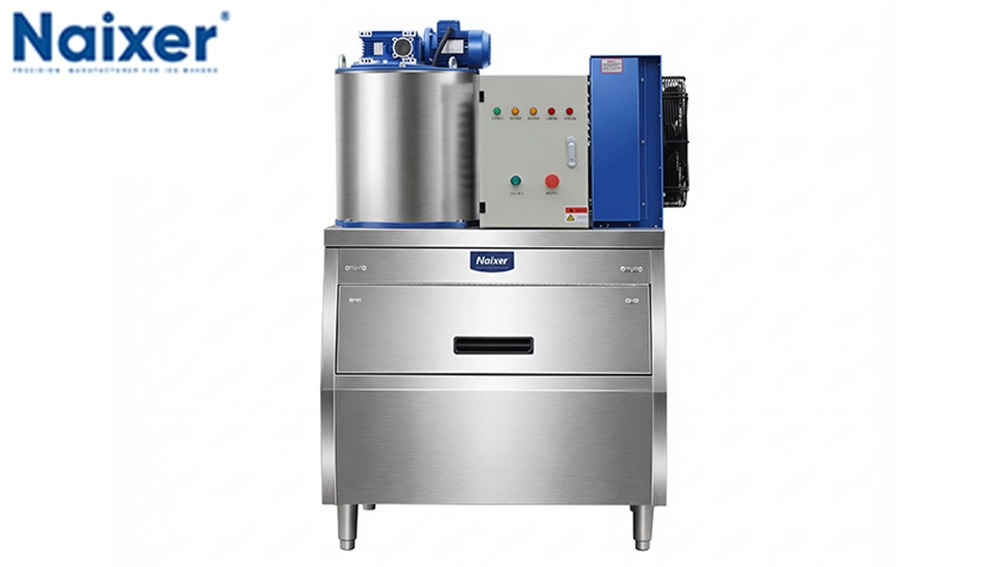
Naixer’s PB Series covers the commercial range in three self-contained models, each with a built-in insulated storage bin — so ice production and storage arrive as one unit.

| Model | Daily output | Built-in storage bin | Best suited for |
|---|---|---|---|
| PB-300 | 300 kg (660 lb) / 24h | 150 kg | Small seafood markets, sushi bars, physical therapy clinics, boutique hotels |
| PB-500 | 500 kg (1,100 lb) / 24h | 300 kg (660 lb) | Mid-size seafood wholesalers, food processing plants, full-service hotels, large healthcare facilities |
| PB-1000 | 1,000 kg (2,200 lb) / 24h | 400 kg | Large industrial facilities, concrete cooling, major fishing operations |
All PB Series models: adjustable flake thickness (1.5–2.2 mm), food-grade 304 stainless steel ice-making zone, air-cooled (220V/50Hz), and a 3-year full machine warranty.
← Swipe to view the full table →
Every PB machine shares the same engineering core: food-grade 304 stainless steel in the ice-making zone, continuous production without batch delays, and durable auger systems built for years of commercial duty. All three are covered by a 3-year full machine warranty and a 7–10 year expected service life.
They are built in Naixer’s own 30,000 m² ISO 9001-certified factory in Guangzhou — the same production infrastructure serving KFC and Luckin Coffee across 100+ countries — with helium leak detection, electrical safety testing, and full burn-in cycles before shipping.
Explore the full range on the PB Flake Ice Series page, or start with the most popular configuration: the PB-500 500 kg/24h flake ice machine, a favorite for seafood counters and mid-size food processing.
Frequently Asked Questions About Flake Ice Machines
How does a flake ice machine save my business money?
Three ways: less spoilage (5–10% in seafood display applications), no delivered-ice purchases, and lower labor and handling costs. Businesses that currently buy ice daily typically see the fastest payback; exact ROI depends on your ice volume and local ice prices — a factory quote with your usage numbers is the quickest way to run it.
What size flake ice machine does my business need?
Size for peak demand, not average. As a rough guide: 300 kg (660 lb)/day suits small seafood counters, sushi bars, and clinics; 500 kg (1,100 lb)/day suits mid-size wholesalers, food processing, and full-service hotels; 1,000 kg (2,200 lb)/day suits large processors, fishing operations, and concrete cooling.
Can flake ice be used for drinks?
No. Flake ice melts almost on contact with liquid and will overdilute a drink within about a minute. For beverage service, choose cube, crescent, or nugget ice — many restaurants run a flake machine for food and a cube machine for drinks side by side.
How long does a commercial flake ice machine last?
With routine cleaning and water-filter maintenance, 7–10 years is typical, and premium units can exceed 15 years. The factors that determine longevity are covered in how long a commercial ice machine lasts.
What maintenance does a flake ice machine require?
Scheduled cleaning of the ice-making zone and condenser, water filter replacement, and periodic sanitizing. The process is straightforward and covered step by step in how to clean a Naixer ice machine.
Is flake ice suitable for shipping and cold-chain packing?
Yes. Dry flakes fill void spaces in insulated containers, maintain a consistent cold environment, and — unlike block ice — do not fuse into a solid mass or saturate packaging as they melt. PB-500 and PB-1000 outputs match regional packing operations.
What is the difference between flake ice and nugget ice?
Flake ice is dry, flat, and irregular — designed for surface-contact cooling of products. Nugget ice is soft, porous, and chewable — designed for beverages and patient hydration. Flake ice is a cooling tool; nugget ice is a drink ingredient.
How much does a commercial flake ice machine cost?
Pricing scales with daily output and configuration. For a detailed breakdown of what commercial ice equipment costs to own and operate, see the 2026 ice machine price guide. Then request a factory-direct quote with your capacity and market for exact numbers.
Ready to Size the Right Flake Ice Machine for Your Business?
Share your business type, target daily production, and installation conditions — Naixer’s team will recommend a model and prepare a factory-direct quote within 24 hours. Get a Factory Quote. WhatsApp: +86 133-9248-0997