How Do Flake Ice Machines Work? The 2026 Commercial Engineering Guide
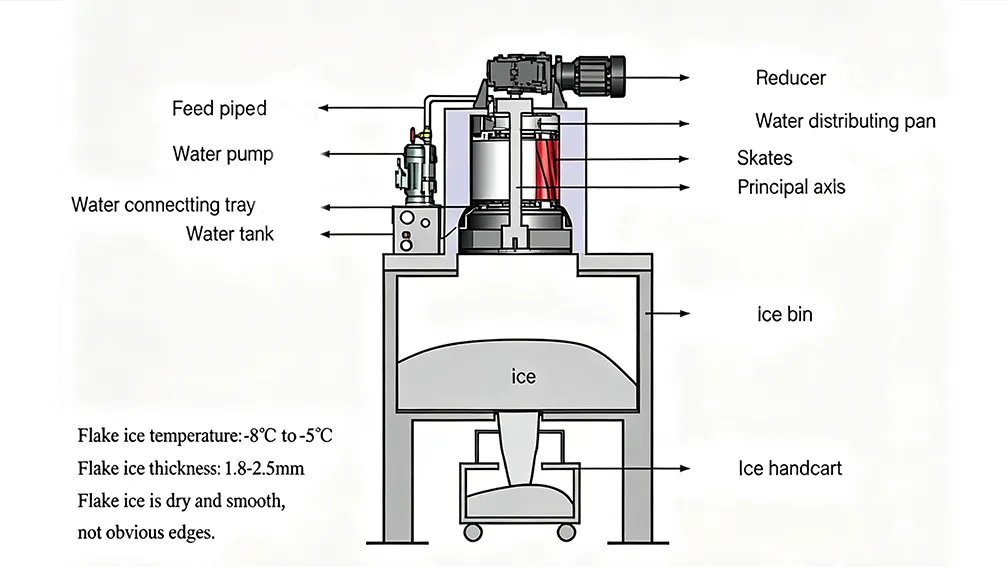
This continuous operation is what makes flake ice the ideal choice for seafood displays, food processing plants, healthcare facilities, and industrial concrete cooling. It produces ice that is soft, moldable, and dry—completely unlike the hard, clear cubes that come out of a conventional ice machine. This guide explains exactly how that process works, step by step, from the water entering the machine to the flake ice falling into the storage bin. For a broader look at where flake ice is used across different industries, the guide on what is a flake ice machine used for covers the five major commercial applications.
In this guide, you will learn:
The Core Components: What Is Inside a Flake Ice Machine

Before walking through the freezing process itself, it helps to understand the four key components that make a flake ice machine different from any other ice maker.
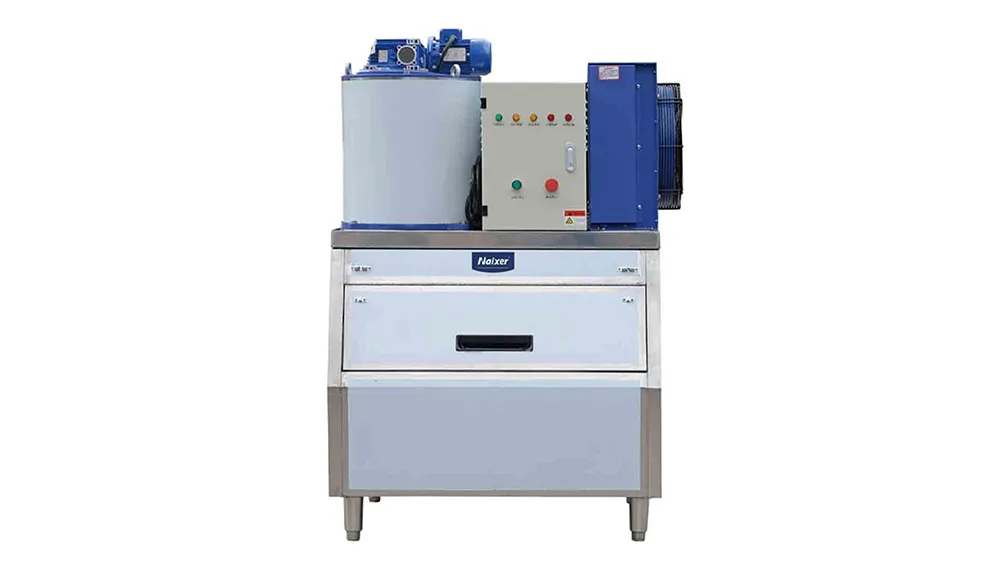
The first is the evaporator cylinder. This is a vertical, double-walled stainless steel tube that sits at the heart of the machine. Refrigerant flows through the space between the inner and outer walls, chilling the inner surface to well below freezing—typically around minus 20 to minus 30 degrees Celsius. The inner wall is the surface on which ice will form. In a Naixer PB Series machine, this cylinder is constructed from food-grade 304 stainless steel, which resists corrosion and maintains a smooth, clean freezing surface through years of continuous operation【产品画册 Page 28】.
The second component is the auger. This is a rotating, spiral-shaped blade that wraps around the inside of the evaporator cylinder. As the auger turns, its edge rides against the frozen inner wall of the cylinder, scraping off the thin layer of ice that has formed there. The auger does two jobs at once: it harvests the ice and it pushes it upward toward the top of the cylinder. The auger is driven by a geared motor, and its speed determines the thickness of the ice flakes. A faster auger produces thinner, finer flakes. A slower auger produces slightly thicker flakes.
The third component is the water distribution system. Unlike a cube ice machine that sprays water into individual molds, a flake ice machine delivers water to the bottom of the evaporator cylinder through a series of nozzles or a water ring. The water is pumped in under pressure, ensuring that it coats the entire inner surface of the cylinder evenly. Any water that does not freeze on the first pass returns to the reservoir and is recirculated until it freezes or is flushed out during the periodic drain cycle.
The fourth component is the compression and discharge system. Once the auger scrapes the ice off the cylinder wall and lifts it to the top, the ice passes through a compression zone that squeezes out any remaining liquid water, then exits through a discharge chute into the storage bin. The ice that comes out is dry, granular, and ready for immediate use—no additional freezing or hardening time required.
The Freezing Process: How Water Becomes Flake Ice in Seconds

The flake ice production process can be broken down into four stages that happen simultaneously, not sequentially.
Water enters at the bottom of the evaporator cylinder. A pump pushes it upward through a water distribution ring or spray nozzles, coating the entire inner wall of the cylinder with a thin, even film of water. The inner wall, chilled by the refrigerant flowing through the double-walled jacket, is cold enough to freeze water on contact. Within a fraction of a second, the water film crystallizes into a thin layer of ice—typically 1.5 to 2.2 millimeters thick, depending on the machine’s settings and operating conditions.
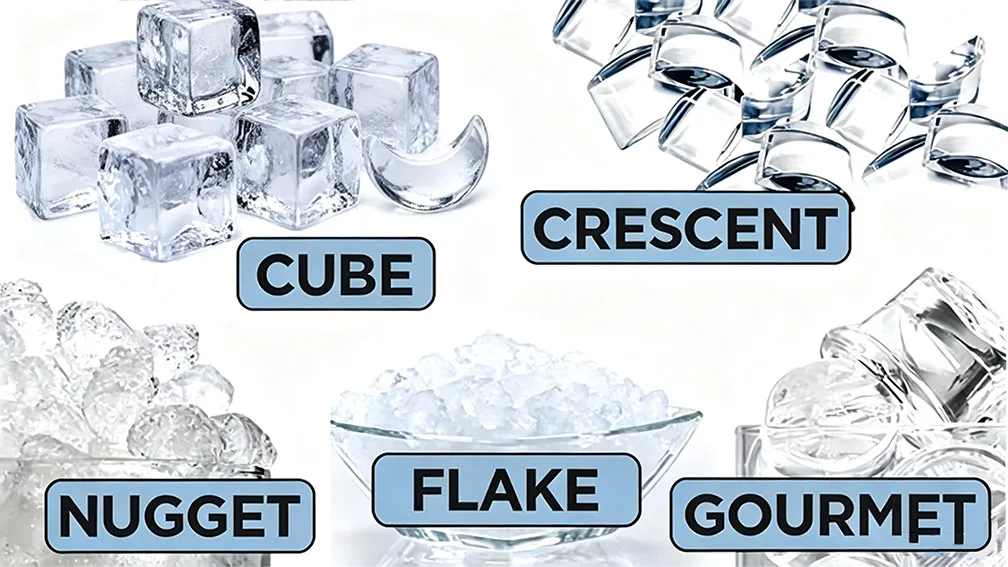
The auger is rotating continuously. As it turns, its spiral blade scrapes the newly formed ice off the cylinder wall. The ice breaks into the irregular, soft flakes that give this ice type its name. Because the ice is scraped off almost immediately after it forms—rather than being allowed to grow into a thick, solid block—it never has time to trap air bubbles or dissolved minerals. This is why flake ice is uniformly white and opaque, rather than crystal-clear like large-format gourmet ice.
Once scraped off, the ice flakes are carried upward by the auger’s spiral motion. As they reach the top of the cylinder, they pass through a compression section where excess water is squeezed out and drained back into the reservoir. The now-dry flake ice exits through a discharge port and falls into the insulated storage bin below.
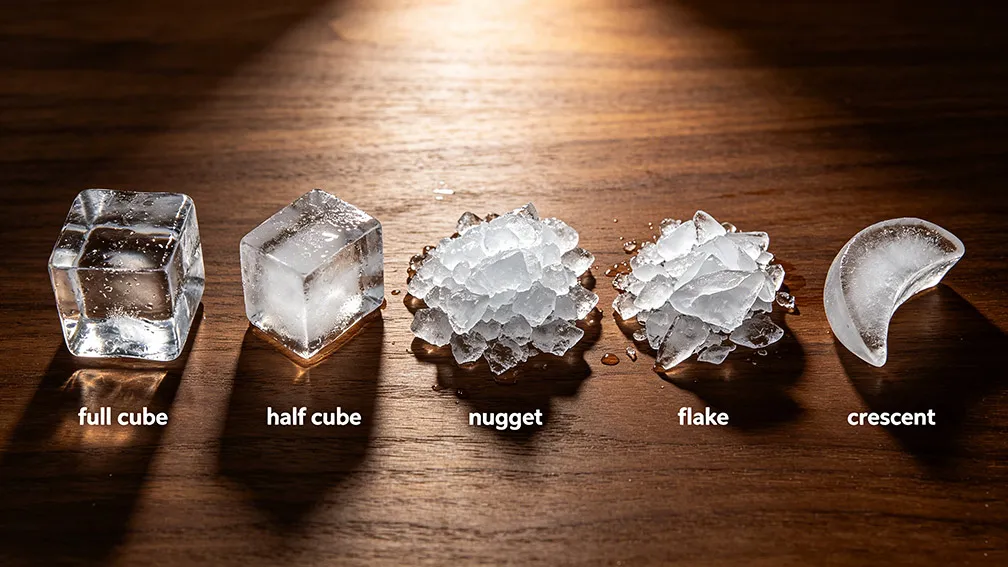
This entire cycle—water in, ice frozen, ice scraped, ice discharged—happens continuously. The machine does not stop to harvest. It does not cycle on and off. As long as the compressor is running and water is being supplied, the machine produces flake ice in an uninterrupted stream. This is the fundamental difference between flake ice and cube ice production: a cube machine works in batches, freezing a full tray of water, then briefly warming the tray to release the cubes, then starting again. A flake machine never pauses. For more on how different ice machines compare, the commercial ice machine buying guide covers the full range of machine types and their applications.
Why Continuous Operation Matters for Commercial Users

The continuous nature of flake ice production is not just an engineering curiosity. It has practical implications for the businesses that depend on this ice.
For a seafood market or a fish processing plant, the ice supply must be constant. Product arrives throughout the day, and every new delivery needs to be iced immediately. A batch-freeze machine that pauses between cycles creates gaps in ice availability. A continuous flake ice machine produces ice at a steady rate from the moment it is turned on until the moment it is turned off. The Naixer PB-300, for example, produces 300 kilograms of ice per day without ever stopping to harvest. The ice is always there when the next fish delivery arrives.
For a food processing plant, flake ice is mixed directly into sausage, dough, or other products to control temperature during mixing. The ice must be available on demand, in the exact quantity needed, without waiting for a harvest cycle to finish. A continuous machine integrates into a production line. A batch machine creates a bottleneck.
For a hospital or physical therapy clinic, flake ice is used to make ice packs that mold around injured limbs. The machine needs to produce ice whenever a patient requires treatment—not on a timer. Continuous production means the bin is always stocked.
This continuous design also means that a flake ice machine begins producing usable ice within minutes of being turned on. There is no long initial freeze cycle to wait through. The first ice appears almost as soon as the evaporator cylinder reaches operating temperature, which typically takes only a few minutes.
How a Flake Ice Machine Is Different From a Cube Ice Machine

The continuous nature of flake ice production is not just an engineering curiosity. It has practical implications for the businesses that depend on this ice.
For a seafood market or a fish processing plant, the ice supply must be constant. Product arrives throughout the day, and every new delivery needs to be iced immediately. A batch-freeze machine that pauses between cycles creates gaps in ice availability. A continuous flake ice machine produces ice at a steady rate from the moment it is turned on until the moment it is turned off. The Naixer PB-300, for example, produces 300 kilograms of ice per day without ever stopping to harvest. The ice is always there when the next fish delivery arrives.
For a food processing plant, flake ice is mixed directly into sausage, dough, or other products to control temperature during mixing. The ice must be available on demand, in the exact quantity needed, without waiting for a harvest cycle to finish. A continuous machine integrates into a production line. A batch machine creates a bottleneck.
For a hospital or physical therapy clinic, flake ice is used to make ice packs that mold around injured limbs. The machine needs to produce ice whenever a patient requires treatment—not on a timer. Continuous production means the bin is always stocked.
This continuous design also means that a flake ice machine begins producing usable ice within minutes of being turned on. There is no long initial freeze cycle to wait through. The first ice appears almost as soon as the evaporator cylinder reaches operating temperature, which typically takes only a few minutes.
The Naixer PB Series: Flake Ice Machines Built for Continuous Duty

Naixer’s PB Series flake ice machines are engineered for the demands of continuous commercial operation. They are available in three capacities—300, 500, and 1,000 kilograms per day—covering everything from a small seafood market to a large industrial food processing plant.
All three models share the same core engineering: a 304 stainless steel evaporator cylinder and auger that resist corrosion through years of contact with water and ice, a high-efficiency hermetic compressor designed for continuous duty cycles, and a robust geared motor that drives the auger at a consistent speed regardless of load. The R404A refrigerant system is optimized for the low evaporator temperatures that flake ice production requires.
The PB-300 is the entry point, producing 300 kilograms per day with a 150-kilogram storage bin. The PB-500 doubles that output to 500 kilograms per day with a 300-kilogram bin. The PB-1000 reaches 1,000 kilograms per day with a 400-kilogram bin. All three are backed by Naixer’s global service network and the same manufacturing quality—a 30,000-square-meter ISO9001-certified smart factory, more than 300 technical patents, and a 3-year comprehensive warranty on core systems.
For a complete picture of how a flake ice machine fits into your equipment budget, the restaurant ice machine cost guide breaks down purchase price, installation, utilities, and long-term operating costs. For an understanding of how long you can expect the machine to last, the commercial ice maker lifespan guide explains the factors that determine longevity.
Need help finding the right ice machine for your business? Naixer Ice has the right machine for you.
Flake Ice Machine Working Principle — Quick Answers
How does a flake ice machine work?
Water is sprayed onto the inner wall of a refrigerated cylinder, where it freezes instantly into a thin layer of ice. A rotating auger scrapes the ice off the cylinder wall continuously, and the ice flakes are carried upward and discharged into a storage bin. The process runs without pause—no batch cycle, no harvest delay.
What is the difference between a flake ice machine and a cube ice machine?
A flake ice machine runs continuously, producing ice in seconds and scraping it off immediately. A cube ice machine works in batches, freezing a full tray of water over 15 to 20 minutes, then briefly warming the tray to release the cubes. Flake ice is soft and moldable. Cube ice is hard and solid.
How long does it take a flake ice machine to make ice?
Flake ice begins to appear within minutes of the machine being turned on, because the ice freezes in a thin layer and is scraped off almost instantly. There is no long initial freeze cycle.
What type of ice does a flake ice machine produce?
Flake ice is soft, dry, and irregularly shaped. It molds around objects it touches, making it ideal for seafood displays, food processing, and healthcare cold therapy. It is not suitable for beverages because it melts almost instantly.
How often should a flake ice machine be cleaned?
Every six months at minimum, more frequently in hard-water areas. The water distribution nozzles and evaporator cylinder should be descaled, and the auger bearings inspected. Naixer PB Series machines include a One-Touch Cleaning function that automates the descaling cycle.