How Much Water Does a Commercial Ice Machine Use? 2026 Data & Cost Analysis
Author:
Paeson
April 7, 2026
How Much Water Does a Commercial Ice Machine Use? 2026 Data & Cost Analysis
If you‘re running a restaurant, café, hotel, or any food service business, you’ve probably wondered: How much water does a commercial ice machine actually use? And will it send my utility bills through the roof?
The short answer is: it depends on whether you choose an air-cooled or water-cooled model.
According to the Los Angeles Department of Water and Power (LADWP), ENERGY STAR®-certified air-cooled ice makers use a maximum of only 15 to 25 gallons of water per 100 pounds of ice produced. In contrast, traditional water-cooled units can use more than 100 gallons of water for each 100 pounds of ice — most of which goes toward cooling the refrigeration system, not making ice.
That‘s a water use reduction of at least 75% when you choose air-cooled over water-cooled. And with water rates rising across the country, that difference adds up fast.
This guide provides 2026 data on commercial ice maker water consumption, a comparison of air-cooled vs water-cooled units, real cost calculation methods, and practical tips to help you minimize your water bill — whether you’re buying your first machine or optimizing an existing one.
In this guide, we’ll cover:
Use our ice calculator to find the perfect commercial ice maker for your restaurant, bar, or hotel. Learn how to calculate daily ice needs and choose the right machine.
Air-Cooled vs Water-Cooled: The Real Water Usage Data
The single biggest factor determining your ice machine‘s water consumption is its cooling method. Many people see the words “water-cooled” and assume it’s more water-efficient. The opposite is true.
Water Usage Comparison
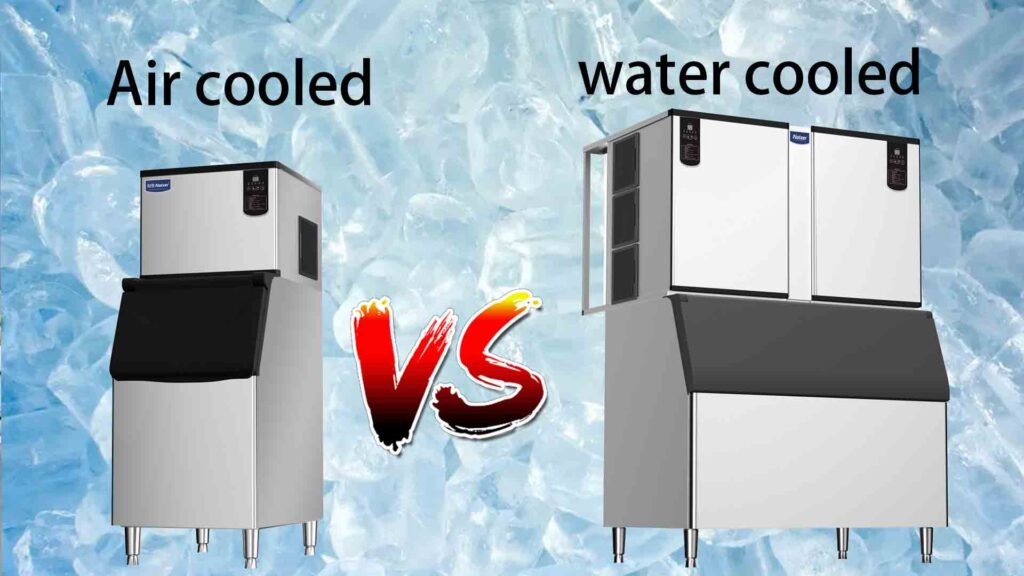
The most dramatic difference between the Air-Cooled and Water-Cooled two systems lies in water efficiency. ENERGY STAR certified air-cooled ice machines use just 15-25 gallons of water to produce 100 pounds of ice, delivering a minimum 75% reduction in water usage compared to water-cooled models, which consume 100 gallons or more for the same ice output. This makes air-cooled units the clear choice for water conservation and long-term utility cost savings, and the only viable option in regions with strict water usage restrictions.
Energy & Operational Cost Tradeoff
Water-cooled ice machines use approximately 15% less electricity than air-cooled units, as they eliminate the power draw required for cooling fan operation. However, this marginal reduction in electricity costs is almost always offset by the extreme water usage and higher maintenance expenses of water-cooled systems, resulting in a higher total cost of ownership for most commercial operations.
Installation & Maintenance Requirements
Air-cooled ice machines offer a far simpler installation process, only requiring standard power and water line connections to operate. Their maintenance needs are also minimal, limited to periodic condenser cleaning to preserve heat dissipation efficiency. In contrast, water-cooled units require a dedicated, filtered cooling water loop for installation, and demand ongoing, labor-intensive maintenance — including frequent filter cartridge changes and regular flushing of cooling lines to prevent scale buildup and system failure.
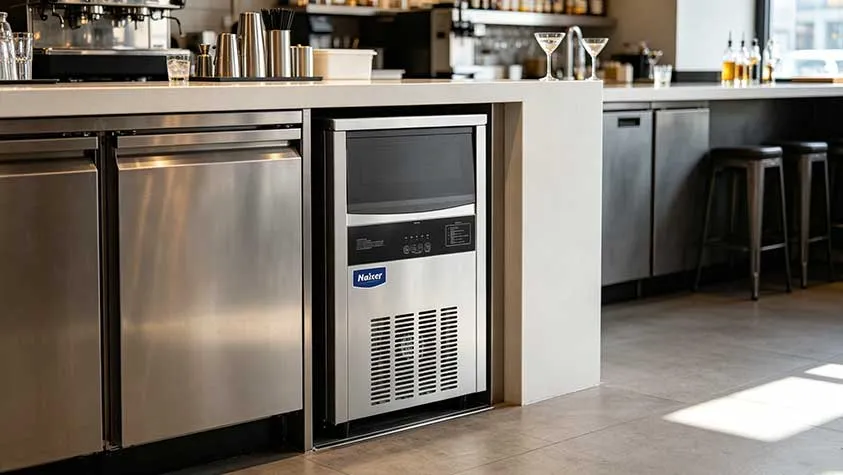
Still struggling to choose the right under-counter ice maker for your restaurant or bar?
Learn how Naixer can help you easily select the right under-counter ice maker.
Beyond cooling method, ice type and machine category also affect water consumption. Different ice shapes require different freezing processes, which impacts both water and energy use.
Ice Type / Machine Category
Water Use (gallons/hour)
Estimated per 100 lbs ice
Cube ice maker (commercial)
2–5 gal/hour
~15–25 gal
Flake ice maker
3–7 gal/hour
Higher (continuous flow)
Nugget ice maker
3–6 gal/hour
Medium-high
Countertop/under-counter (~24 lbs/day)
2.5–3 gal
~10–13 gal
Dispenser-style (hotels, medical offices)
Varies by size
Moderate
Key findings:
Flake and nugget ice machines generally consume more water than cube ice makers due to their continuous freezing mechanisms. Continuous-type ice makers are not currently eligible for ENERGY STAR certification until standardized testing protocols are established.
Countertop units have a smaller absolute water footprint but lower efficiency per pound — making them better suited for low-volume applications like home use or office break rooms.
Cube ice makers operate in batches, purging residual water after each harvest cycle to prevent impurity buildup. The theoretical minimum water requirement to produce 100 lbs of ice is 12 gallons — but actual consumption is higher due to these purge cycles.
5 Factors That Affect Commercial Ice Machine Water Usage
Understanding what drives water consumption can help you make better purchasing and maintenance decisions.
1. Cooling method (the biggest factor) As detailed above, water-cooled vs air-cooled creates a 5x+ difference in water consumption. Air-cooled is almost always the better choice unless your kitchen consistently exceeds 100°F (38°C).
2. Ice type Flake and nugget ice makers typically use more water than cube ice makers due to their continuous freezing mechanisms. Batch-type cube makers purge residual water after each harvest, adding to consumption. The theoretical minimum to produce 100 lbs of ice is 12 gallons — but real-world usage is higher due to these purges.
3. Machine efficiency rating ENERGY STAR-certified batch-type ice makers are about 20% more water-efficient than standard models. Certified continuous-type ice makers are about 16% more energy-efficient (water efficiency data for continuous types is still being standardized). A single ENERGY STAR machine can save thousands of gallons annually.
4. Maintenance condition A poorly maintained unit — with dirty condenser coils, clogged water filters, or scale buildup — may require extra flush cycles to produce clean ice. This directly increases water consumption.
5. Ambient temperature and water quality High ambient temperatures force the machine to work harder, which can increase both water and energy consumption. Hard water leads to mineral scale buildup, triggering more frequent cleaning cycles and increasing water waste.
7 Practical Tips to Reduce Your Ice Machine’s Water Usage
These actionable tips will help you minimize water waste regardless of which machine you own:
1. Choose air-cooled over water-cooled Unless your kitchen consistently exceeds 100°F (38°C), air-cooled is the smarter choice for both water savings and installation simplicity.
2. Look for the ENERGY STAR label ENERGY STAR-certified batch-type ice makers are 20% more water-efficient than standard models. Look for the blue label when shopping.
3. Use filtered water Water filtration reduces mineral scale buildup, which can trigger more frequent cleaning cycles and increase water waste.
4. Clean the condenser regularly Monthly cleaning with a soft brush along fin direction prevents efficiency loss. A dirty condenser forces the machine to work harder, increasing both water and energy consumption.
5. Optimize flush cycle settings Work with your manufacturer to set flush cycles to the minimum frequency that still maintains ice quality. Batch-type machines purge water after each harvest — optimizing this reduces waste.
6. Choose models with auto-cleaning features Auto-cleaning systems eliminate much of the day-to-day cleaning labor and ensure consistent operation. Naixer‘s one-touch automatic cleaning initiates a full programmable wash cycle that scrubs away mineral deposits with a single touch.
7. Maintain ideal ambient conditions Install your machine in a temperature-controlled area (ideally 50°F–90°F / 10°C–32°C). High temperatures force the machine to work harder, increasing water and energy consumption.
Need help finding the right ice machine for your business?
Naixer Ice has the right machine for you.
Welcome to Guangzhou Naixer Refrigeration Equipment Company Limited! Since 2010, we have been focused on commercial ice machine solutions, helping ice machine distributors and food service professionals worldwide deliver higher-quality ice machines. Our products include commercial ice makers, built in ice makers, ice and water dispensers, and automatic ice vending machines – each designed for maximum profitability. With over 3,000 successful operators in more than 130 countries worldwide, we provide proven strategies, real return on investment data, and expert guidance to help you build a thriving ice making business. Ready to start your passive income journey? 🧊