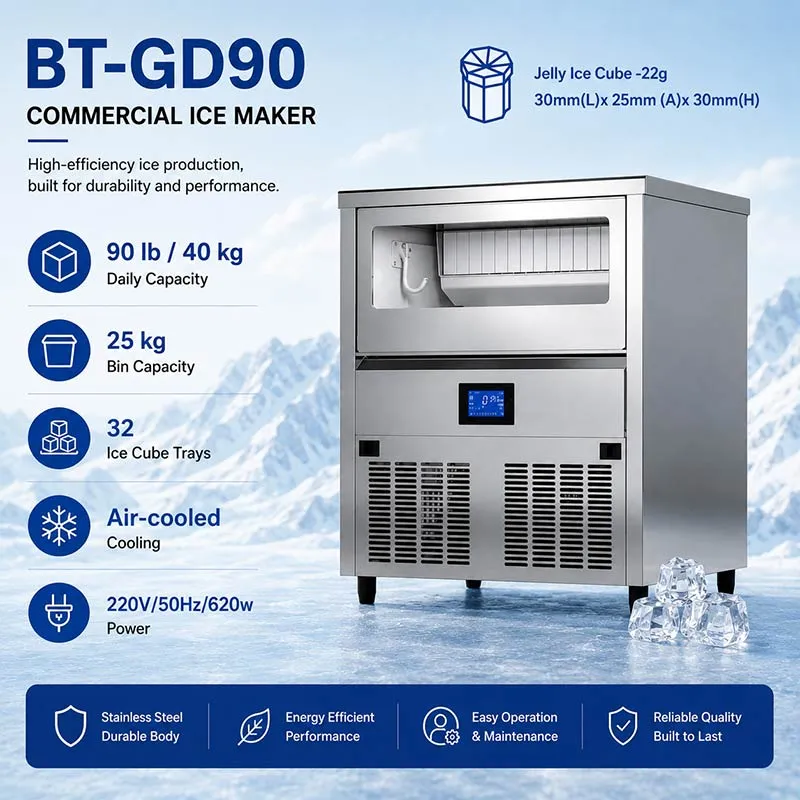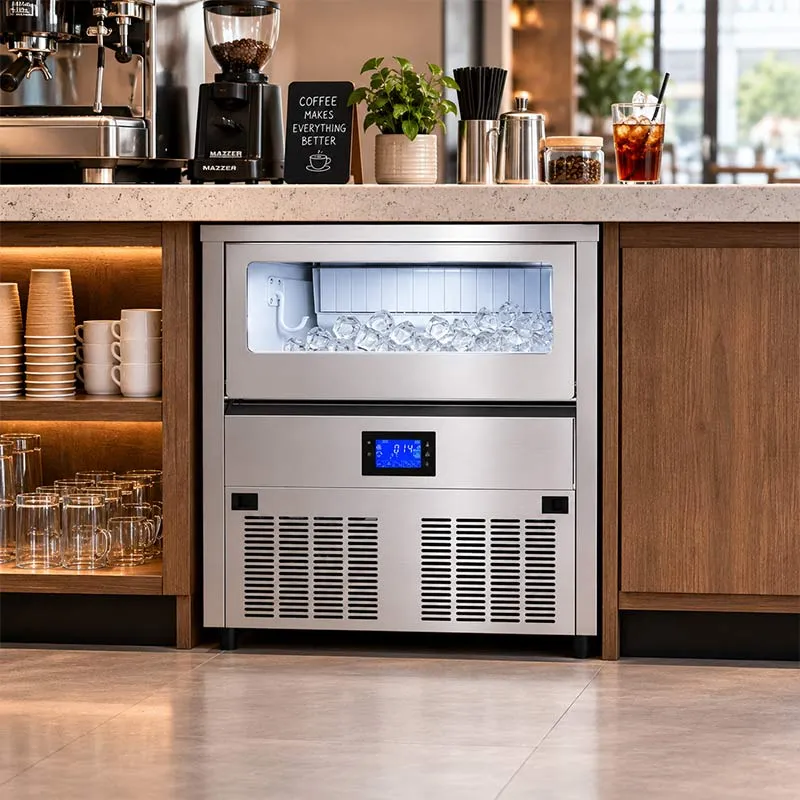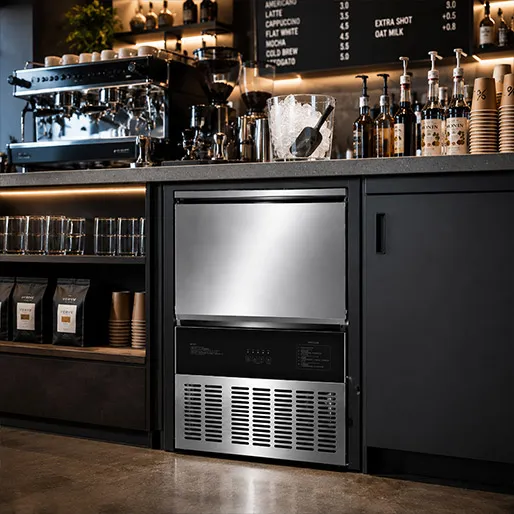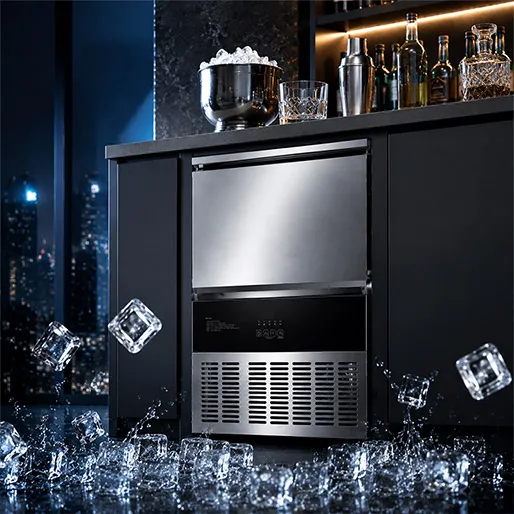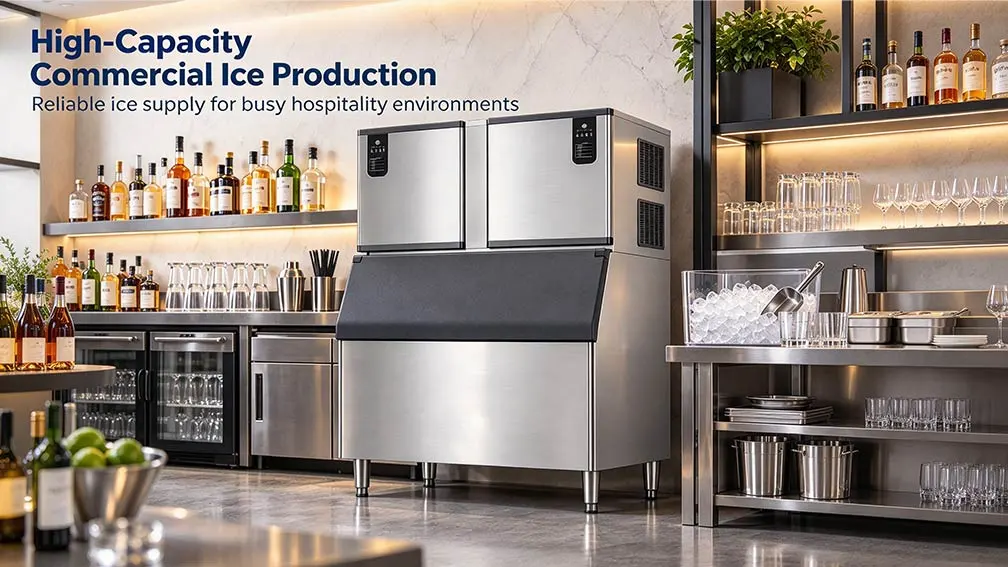
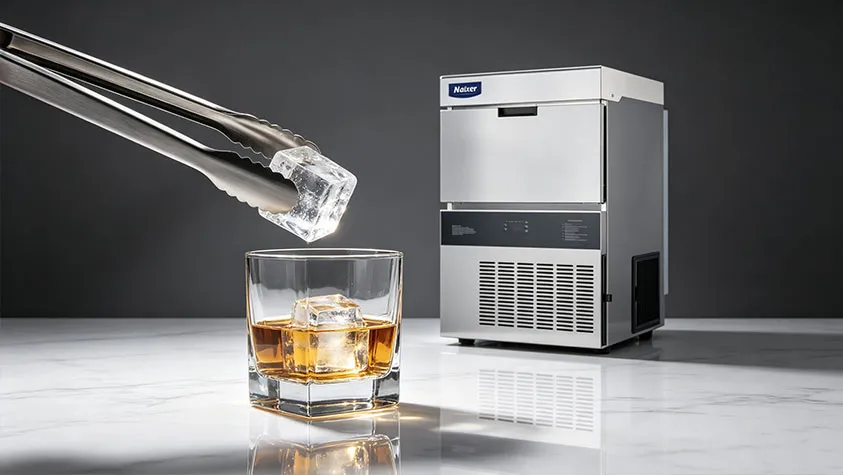
Whether you are the proprietor of a restaurant, hotel, or cafeteria – you need to know how much ice is required within a 24 hour period before researching the type of ice maker you should buy. Different business types have different ice production needs.
Sizing a bar ice machine isn’t complicated. The industry standard is 3 lbs of ice per seat per day, and for high-volume cocktail bars, some estimates go up to 3–5 lbs per seat during peak hours. Add a 20–25% safety buffer, and you‘ve got your target. This guide walks you through the calculation step by step, then helps you match the number to a specific machine.
Table of Contents
Use our ice calculator to find the perfect commercial ice maker for your restaurant, bar, or hotel. Learn how to calculate daily ice needs and choose the right machine.
Production vs. Storage — They’re Not the Same Thing
Before you start calculating, you need to understand the difference between two numbers that often get confused: how much ice your machine can make, and how much it can hold.
Production capacity is the total amount of ice your machine can produce in 24 hours, measured in pounds. This number is tested under lab conditions—typically 70°F ambient air and 50°F water temperature. In your actual bar kitchen, which might run 85°F or hotter on a summer night, real-world output can drop significantly from the spec sheet number.
Storage capacity is how much ice your machine‘s built-in bin can hold at once. This is the buffer between production and demand. When the bin is full, the machine stops making ice. When your bartenders scoop from it, production restarts. A large production number paired with a tiny bin means the machine cycles on and off constantly during peak hours—and you still run out.
Think of it this way: production capacity is your kitchen’s cooking speed. Storage capacity is your pass—how many plates you can hold before they need to be run to the table. Both have to be right for service to flow.
Calculate Your Bar‘s Ice Needs in 3 Steps
For high-volume bars, the most common selection mistake is underestimating peak-hour ice consumption. Daily production ratings (kg/24h) can be misleading if they are not aligned with real service patterns.
Here’s how to do the math correctly.
Step 1: Calculate Your Baseline Daily Demand
Start with the most widely cited number in the industry: 3 lbs of ice per seat per day for bars and cocktail lounges. Some guides put it even more simply: plan for about 3 pounds of ice per customer if your bar serves mixed drinks like margaritas and daiquiris.
The baseline formula is straightforward:
Seats × 3 lbs = Baseline Daily Demand
Here‘s what that looks like for different bar sizes:
| Bar Size | Seats | Baseline Daily Demand |
|---|---|---|
| Small neighborhood bar | 40 | 120 lbs |
| Mid-size cocktail bar | 80 | 240 lbs |
| Large craft bar | 120 | 360 lbs |
| High-volume nightclub | 200 | 600 lbs |
For cocktail-forward bars that shake or stir almost every drink, use 3–5 lbs per seat—the higher end applies if your menu is almost entirely mixed drinks rather than beer and wine. A bar serving 200 people on a busy evening might need somewhere between 600 and 1,000 pounds available.
If your bar also serves food, calculate ice needs for the dining room separately. Casual dining uses about 1.5 lbs per seat per day, while fine dining can push to 3–5 lbs per guest.
Step 2: Add Your Peak-Hour Safety Buffer
A Tuesday night might use 60% of your ice capacity. A Saturday night might push 140%. If you size for the average, you‘ll run out when it matters most.
The widely accepted practice is to add a 20–25% safety buffer on top of your baseline calculation. Don’t just calculate for an average Tuesday. Make sure you‘re covered for your busiest weekends or holidays.
Here’s how it looks with a 25% buffer applied:
| Bar Size | Baseline | × 1.25 Buffer | Target Daily Production |
|---|---|---|---|
| 40 seats | 120 lbs | 150 lbs | 150 lbs/day |
| 80 seats | 240 lbs | 300 lbs | 300 lbs/day |
| 120 seats | 360 lbs | 450 lbs | 450 lbs/day |
| 200 seats | 600 lbs | 750 lbs | 750 lbs/day |
A good rule of thumb is to add 20 percent to your estimate to allow room for growth and especially busy days. Seasonal bars—rooftop lounges, beach clubs, patio bars—should add an additional 20% on top of the standard buffer to account for summer volume spikes.
Step 3: Don‘t Forget the Ice Bin
Production capacity is only half the story. The storage bin matters just as much. For sizing an ice bin, you’ll typically want one that can hold about 75 to 80 percent of what the ice machine can produce.
A machine that produces 500 lbs per day but only stores 50 lbs will cycle on and off constantly during peak hours—and still run out. On the other hand, a well-matched bin means fewer refill interruptions and less stress on the compressor from constant cycling.
If your ice machine produces 600 pounds per day, an ice bin sized around 300–400 pounds works well. This size helps you avoid supply shortages and minimizes ice melting from excess storage.
The complete formula can be captured in one line:
(Seats × 3 lbs) × (1 + Peak Buffer %) = 24‑hour Production Target → Bin ≥ Target × 60%
For a 100‑seat bar: 100 × 3 × 1.25 = 375 lbs/day, with a bin of 225 lbs or more.
Real-World Examples: What Size Machine Does Your Bar Need?
Let‘s run the numbers for three actual bar scenarios so you can see how the formula plays out in practice.
Example 1: Small Neighborhood Bar (40 seats)
Baseline: 40 × 3 = 120 lbs/day
With 25% buffer: 120 × 1.25 = 150 lbs/day
Recommended bin: 150 × 60% = 90 lbs
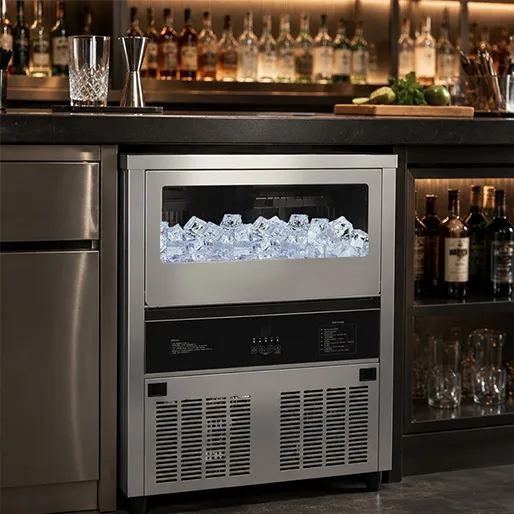
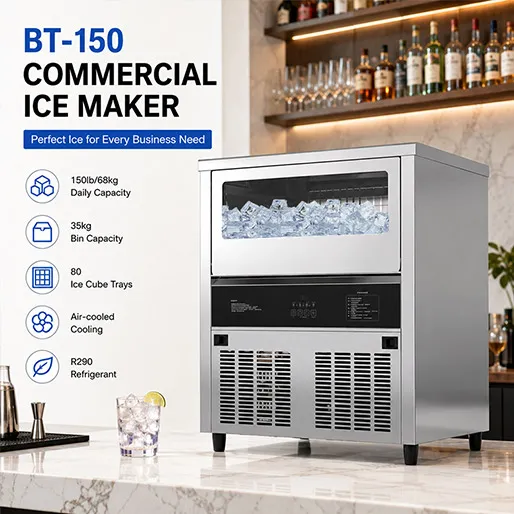
Naixer recommendation: TH‑150B, producing 150 lbs (68 kg) of 22×22×22mm full cube ice per day, with a 45 kg (99 lbs) built-in bin. Compact undercounter design at 665×710×960mm fits neatly beneath standard bar counters.
Example 2: Mid-Size Cocktail Bar (80 seats)
Baseline: 80 × 3 = 240 lbs/day
With 25% buffer: 240 × 1.25 = 300 lbs/day
Recommended bin: 300 × 60% = 180 lbs
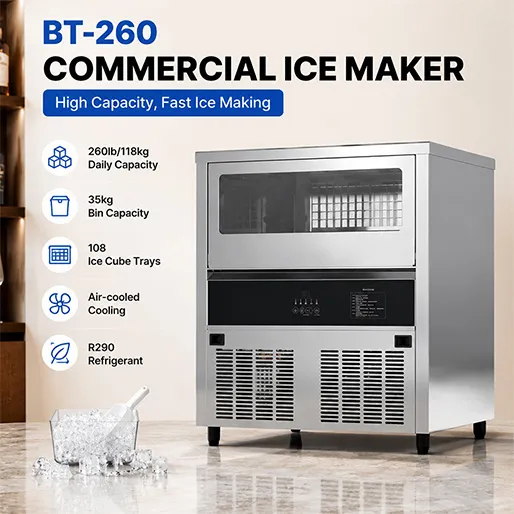
Naixer recommendation: BT‑260, producing 260 lbs (118 kg) of 22×22×22mm full cube ice per day, with a 51 kg (112 lbs) built-in bin. Pushes the upper limit of undercounter production—ideal for bars that need serious output without sacrificing floor space.
Example 3: Large Craft Bar (120 seats)
Baseline: 120 × 3 = 360 lbs/day
With 25% buffer: 360 × 1.25 = 450 lbs/day
Recommended bin: 450 × 60% = 270 lbs
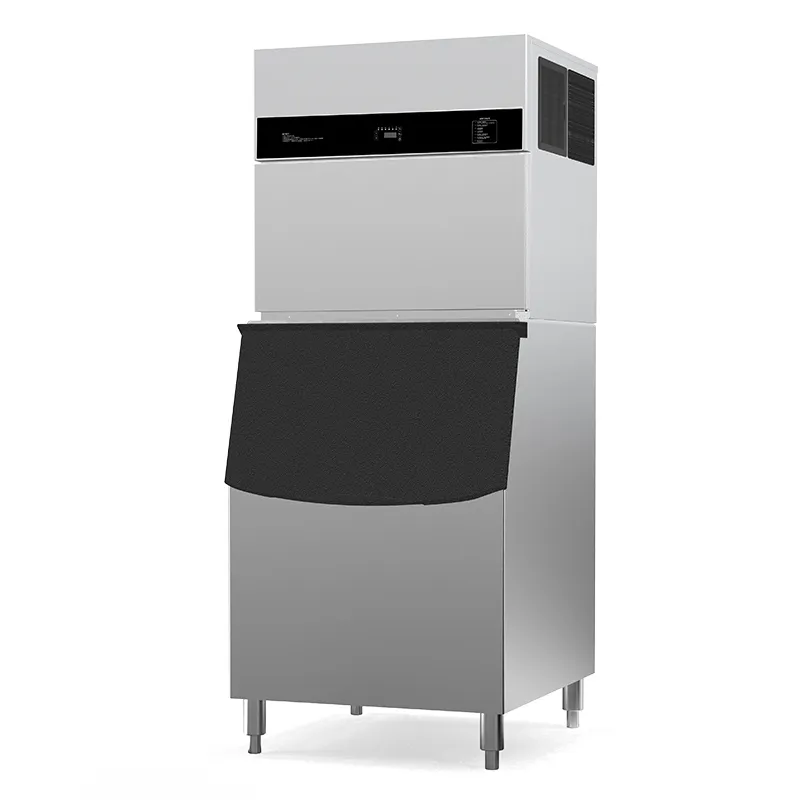
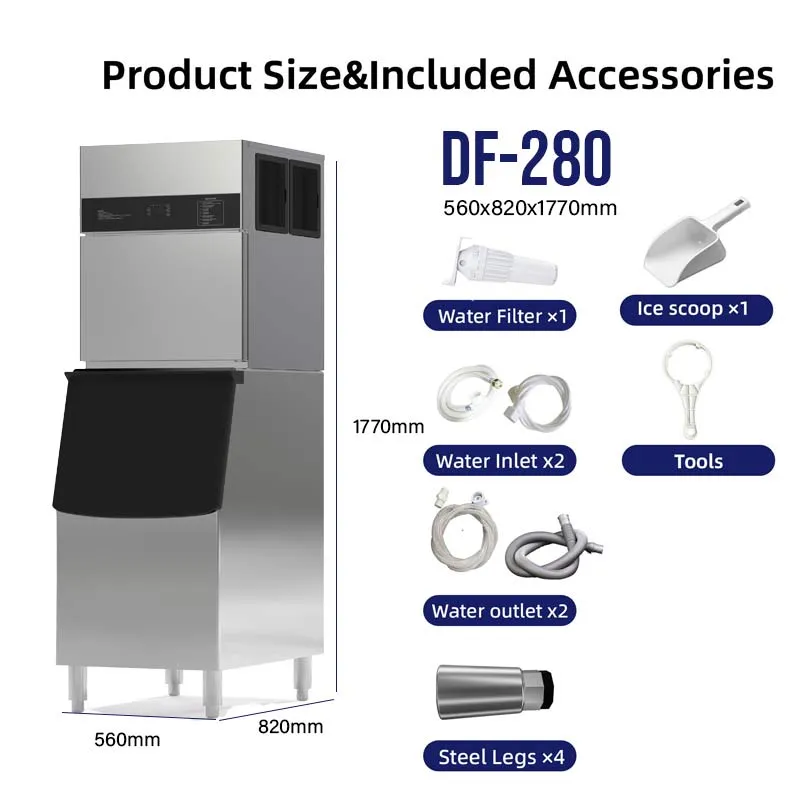
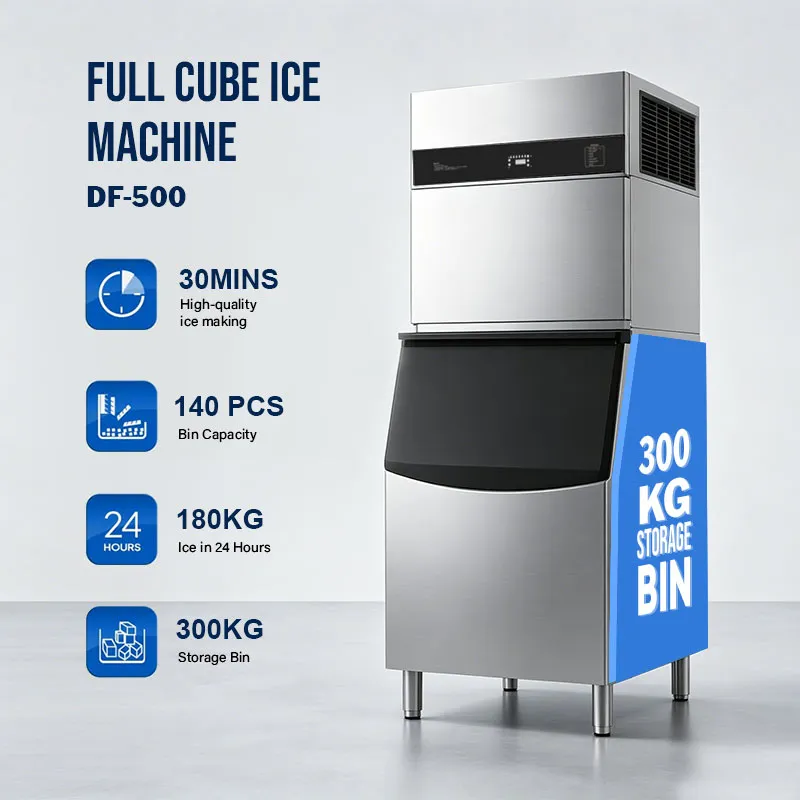
Naixer recommendation: TH‑500C, producing 500 lbs (227 kg) of 22×22×22mm full cube ice per day, with a 300 kg (660 lbs) modular bin. Modular system with separate ice head and bin—flexible, expandable, and built for continuous operation.
Which Naixer Model Fits Your Operation?
Once you have your target daily production number, finding the right machine is a matter of matching capacity, ice type, and installation footprint to your actual operation.
Most bars prefer full cube ice for its slow melt and clean presentation. Cube ice is the workhorse of the bar and restaurant industry—versatile, reliable, and clean-looking in any glass. Crescent ice is preferred by many craft cocktail bars for its rapid cooling and slower dilution. In high-end bars, consistency is as important as quantity.
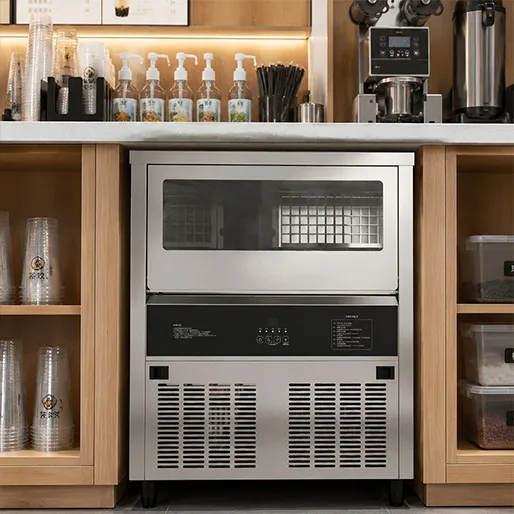
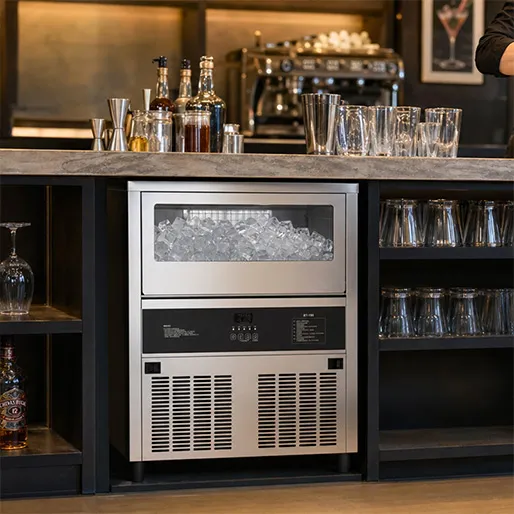
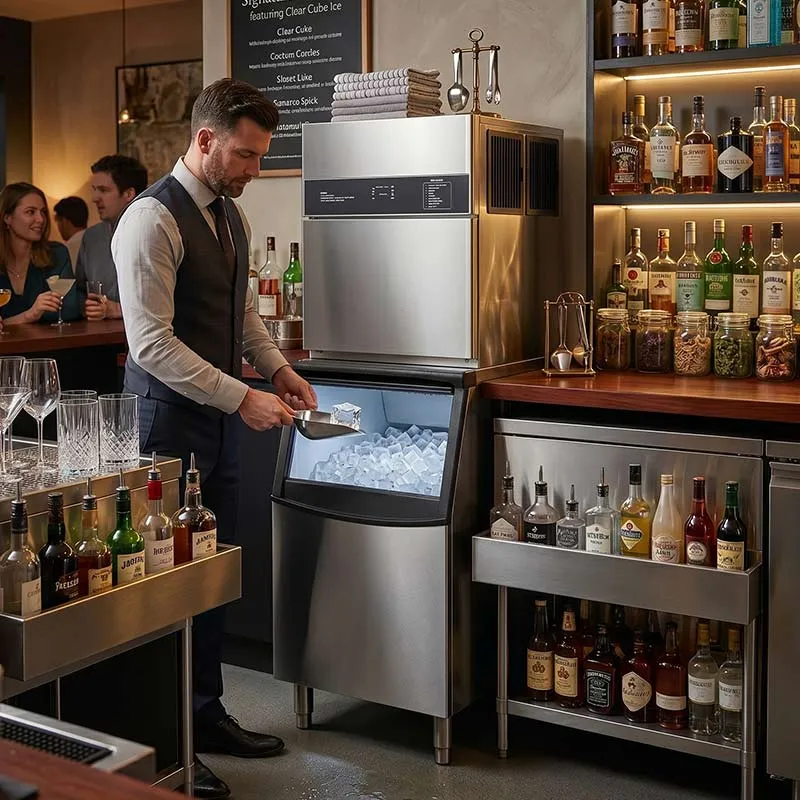
For bar service, undercounter ice machines are the most popular configuration—they fit beneath standard countertops and give bartenders quick, easy access to ice without leaving the service area. For larger venues, modular systems offer flexibility to scale ice production as needs change.
| Bar Profile | Target Production | Naixer Model | Daily Output | Bin Storage | Ice Type |
|---|---|---|---|---|---|
| Micro bar (< 30 seats) | 108 lbs/day | TH‑80B | 80 lbs / 36 kg | 12 kg (26 lbs) | Full Cube 22×22mm |
| Small neighborhood bar (40–60 seats) | 180–216 lbs/day | TH‑150B | 150 lbs / 68 kg | 45 kg (99 lbs) | Full Cube 22×22mm |
| Mid‑size cocktail bar (80–120 seats) | 288–432 lbs/day | BT‑260 | 260 lbs / 118 kg | 51 kg (112 lbs) | Full Cube 22×22mm |
| Large craft bar (120–200 seats) | 450–750 lbs/day | TH‑500C | 500 lbs / 227 kg | 300 kg (660 lbs) | Full Cube 22×22mm |
| High‑volume nightclub (200+ seats) | 750+ lbs/day | TH‑1000C | 1,000 lbs / 450 kg | 300 kg (660 lbs) | Full Cube 22×22mm |
3 Mistakes That Kill a Bar‘s Ice Supply
Buying for Average, Not Peak
A machine sized for a quiet Tuesday will drown on a Saturday. If your whole demand happens in a 2–3 hour window, a “technically adequate” unit may still fail in real-world use. An ice machine that‘s too small means you run out of ice before the end of the day—and that leads to unhappy customers and extra costs in replacement ice.
Seasonal bars—rooftop lounges, beach clubs, patio bars—should add an extra 20% on top of the standard buffer. Plan for summer load, not winter baseline. Ice production drops in hot mechanical rooms at the same time demand increases, which is why undersized machines fail most often in summer.
Ignoring the Ice Bin
Most buyers fixate on the production number and forget the bin entirely. A 500‑lb/day machine with only a 50‑lb bin will cycle relentlessly during peak hours and still leave your bartenders waiting. Common mistakes include pairing a high-production machine with a tiny bin, or matching a large bin with a slow recovery head that can’t refill it.
Always confirm that your storage capacity meets or exceeds 50–60% of daily production. The bin is just as important as the ice head.
Forgetting About Kitchen Heat
An ice machine‘s rated output is measured under lab conditions—typically 70°F air and 50°F water. Your actual kitchen runs hotter, especially if the machine sits near cooking equipment. Calculate peak daily demand by operation type, then add 20–25%—rated output is measured under lab conditions, not your kitchen’s ambient temperature.
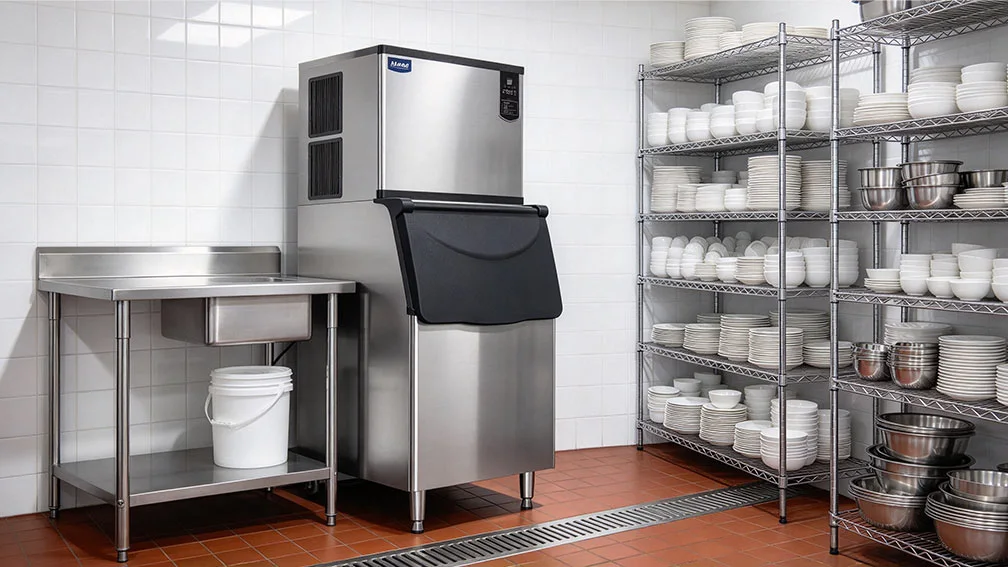
Position the machine away from ovens and grills whenever possible. If hot conditions are unavoidable, consider a water-cooled unit. Water-cooled systems provide more stable ice production regardless of external temperature conditions and are better suited for high-load environments. Air-cooled machines are easier to install and more cost-efficient but rely heavily on ambient temperature and ventilation. In a compact bar with good airflow, air-cooled remains the simplest, most economical choice.
Bar Ice Machine Sizing — Quick Answers
How big of an ice machine do I need for a bar?
The industry standard is 3 lbs of ice per seat per day. Multiply your seat count by 3, then add a 20–25% peak buffer. For a 100‑seat bar, that means 100 × 3 × 1.25 = 375 lbs/day minimum.
How much ice does a bar use per customer?
Most industry guides estimate 3 lbs of ice per customer for bars and cocktail lounges. High-volume cocktail bars may use 3–5 lbs per customer during peak hours.
What size ice machine do I need for a 100‑seat bar?
100 seats × 3 lbs = 300 lbs baseline. With a 25% peak buffer, you need 375 lbs/day. A Naixer TH‑500C (500 lbs/day, 300 kg bin) would provide comfortable headroom for growth.
What type of ice is best for a bar?
Full cube ice (22×22×22mm) is the bar industry standard—slow-melting, clean-looking, and versatile for shaken cocktails, spirit pours, and highballs. Crescent ice is preferred by many craft cocktail bars for its rapid cooling and slower dilution.
Can I put an ice machine under my bar counter?
Yes—if you choose an undercounter model. These machines are specifically designed to fit beneath standard bar counters, combining the ice maker and storage bin in one cabinet. The Naixer TH‑150B (665×710×960mm) and TH‑80B (425×495×760mm) are purpose-built for under-bar installation.
How much ice storage capacity do I need for my bar?
Aim for 60–80% of daily production. A machine that produces 500 lbs/day should ideally have 300–400 lbs of bin storage. For sizing an ice bin, you’ll typically want one that can hold about 75 to 80 percent of what the ice machine can produce.
What‘s the difference between air-cooled and water-cooled ice machines for bars?
Air-cooled machines are easier to install and use less water. Water-cooled machines provide more stable ice production regardless of external temperature conditions, making them better suited for hot kitchens or poorly ventilated areas.
Need help finding the right ice machine for your business? Naixer Ice has the right machine for you.
Related Topics for Your Ice Maker Business Research
- How Much Water Does a Commercial Ice Machine Use
- What Size Ice Machine for a Coffee Shop?
- How Much is a Commercial Ice Maker?
- How to Make Clear Ice: The Complete Guide to Commercial Ice Makers for Bars
- Sonic Ice Maker: How It’s Made & Why Businesses Love Nugget Ice
- Commercial Ice Machine for Restaurant: The 2026 Buyer’s Guide by Type & Need
- Air Cooled vs Water Cooled Ice Machine: The 2026 Buyer’s Guide