Air Cooled vs Water Cooled Ice Machine: The 2026 Buyer’s Guide
Selecting the right commercial ice machine involves more than just capacity and ice type. One of the most fundamental and impactful decisions you’ll make is the cooling method: air-cooled vs water-cooled. This choice isn’t about a minor feature—it directly determines your long-term operating costs, machine reliability, and where you can successfully install the unit.
Understanding this technical difference is key to finding the best commercial ice machine for your specific business environment. A wrong choice can lead to soaring utility bills, inadequate ice production in peak seasons, or frequent breakdowns. This guide will demystify both technologies, providing a clear, unbiased comparison based on 2026 efficiency standards and real-world operational data to empower your decision.
As a manufacturer with deep engineering expertise, Naixer designs robust machines in both cooling types, ensuring you have the right tool for your unique conditions.
air-cooled vs water-cooled
How They Work: A Tale of Two Cooling Systems
The core function of any ice machine’s condenser is to remove heat. How it removes that heat defines its type and its suitability for your space.
Need help finding the right ice machine for your business? Naixer Ice has the right machine for you.
Air-Cooled Ice Machines: The Power of Circulation
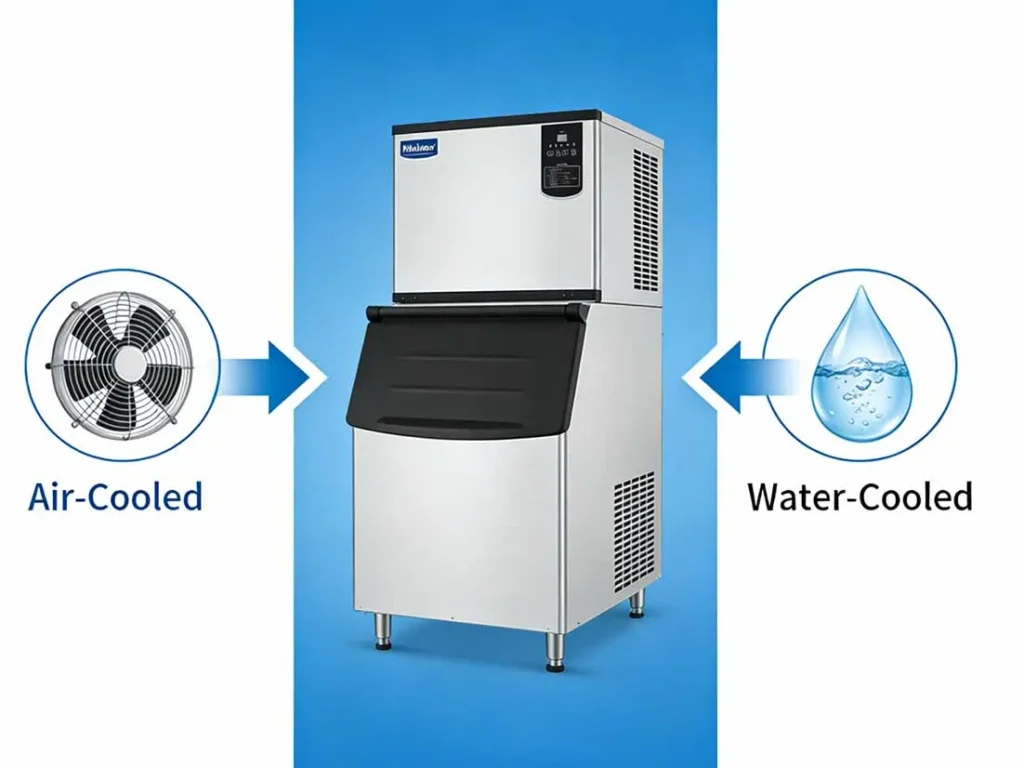
Air-cooled ice machines operate like a refrigerator or a computer cooling fan. They use an integrated fan to draw ambient air from the room over a set of condenser coils. This air absorbs the heat from the refrigerant and is then expelled back into the environment, usually through vents at the rear or sides of the unit.
Key Takeaway: Their performance is inherently tied to the quality and temperature of the surrounding air.
Water-Cooled Ice Machines: Efficiency Through Flow
Water-cooled ice machines take a different approach. Instead of air, they use a continuous stream of water that flows over the condenser coils. The water absorbs the system’s heat and is then carried away down the drain, effectively dumping the heat into the wastewater system.
Key Takeaway: Their cooling efficiency is independent of the room’s air temperature, making them stable in hot environments.
Head-to-Head Comparison: Choosing Your Champion
The best choice depends on weighing trade-offs across several critical factors. The table below provides a snapshot of the core differences.
| Comparison Factor | Air-Cooled Ice Machines | Water-Cooled Ice Machines |
|---|---|---|
| Operating Principle | Cools by circulating ambient air over condenser coils. | Cools by running water over condenser coils, which is then drained. |
| Initial & Installation Cost | Generally lower upfront cost. Simpler installation (needs electrical, water line, drain, and AIR SPACE). | Often higher upfront cost. Requires robust plumbing (higher water supply and drain capacity). |
| Long-Term Operating Cost | Higher electrical cost, but minimal water usage. Efficiency drops as room temperature rises. | Lower electrical cost, but extremely high water usage (can use 5x more water than air-cooled). Stable energy efficiency. |
| Ideal Environment | Clean, temperature-controlled, well-ventilated spaces (e.g., standard restaurant kitchens with AC). | Hot, confined, or poorly ventilated spaces (e.g., hot kitchens, storage rooms, enclosed bars). Where air quality is poor (grease, flour dust). |
| Maintenance Focus | Condenser coil cleaning is critical. Must remove dust, grease, and debris to maintain efficiency. | Water scale prevention is critical. Requires water treatment/filtration. Must ensure drain lines are clear. |
| Environmental Impact & Restrictions | Energy use varies with climate. Many models have CE certification. | High water consumption is a major drawback. Use may be restricted or banned in areas with water conservation laws. |
| Impact on Ice Production | Production capacity can decrease significantly in hot ambient temperatures (>90°F / 32°C). | Production capacity remains consistent and reliable regardless of ambient air temperature. |
The Decision Flowchart: Find Your Perfect Match
Still unsure? Follow this logical path to narrow down your choice.
Is the installation room consistently cool (<80°F / 27°C) and well-ventilated? → YES: Air-cooled is a strong candidate. Proceed to question about environment.
Is the environment relatively free of airborne grease, dust, or flour? → YES: Air-cooled is likely your most cost-effective option. → NO: Consider water-cooled to avoid constant coil clogging.
Is water inexpensive and are there no local restrictions on high-volume water disposal? → YES: Water-cooled remains viable. → NO: Air-cooled is likely mandatory.
Is consistent, maximum ice production critical, even if utility costs are higher? → YES: Water-cooled may be necessary for reliability. → NO: Air-cooled with proper sizing and maintenance is sufficient.
The Naixer Advantage: Engineered for Real-World Performance
At Naixer, we build both air-cooled and water-cooled ice machines to meet the diverse needs of the foodservice industry. Our commitment is to provide not just hardware, but the right solution.
Built for Durability: Whether air or water-cooled, our machines feature 304 stainless steel in critical areas and commercial-grade components designed for longevity.
Informed Guidance: Our experts don’t just sell a machine—we analyze your specific location (space, ambient temperature, air quality, water quality/cost) to recommend the cooling technology that will deliver the lowest total cost of ownership and highest reliability for you.
Precision Engineering: Our air-cooled models are designed with optimized airflow to maximize efficiency, while our water-cooled models can be configured with filtration systems to mitigate scale.
Conclusion & Your Next Step Towards the Right Choice
There is no universally “best” cooling technology—only the best choice for your unique operation. An air-cooled unit in a hot, dirty kitchen will fail, just as a water-cooled unit in a region with high water costs will become a financial burden.
The key is to make an informed decision based on your environment, resources, and operational non-negotiables.
Ready to cut through the confusion and get a data-backed recommendation?
[Contact Naixer’s technical specialists today for a free consultation]. Share your facility details, and we’ll provide a clear analysis on whether an air-cooled or water-cooled ice machine is the optimal investment for your business’s efficiency and bottom line.
Need help finding the right ice machine for your business? Naixer Ice has the right machine for you.
FAQ
Q: Can I convert an air-cooled ice machine to water-cooled, or vice versa?
A: No. The cooling system is a fundamental, factory-engineered component of the machine. The condenser coils, compressor sizing, and internal circuitry are designed specifically for one method. They are not convertible in the field.
Q: My kitchen gets very hot in the summer. Can I just add a fan to my air-cooled ice machine?
A: While improved room ventilation can help, it’s often not a complete solution. Air-cooled machines require a significant volume of cool air. Blowing hot air from the same room over the condenser provides diminishing returns. For chronically hot spaces, a water-cooled model is the technically correct solution to maintain rated production.
Q: How often do the condenser coils need cleaning?
A: For air-cooled machines in a typical commercial kitchen, a thorough cleaning every 3 to 6 months is essential. In very dirty environments (like fryer-heavy kitchens), it may be needed monthly. For water-cooled machines, the focus is on water treatment; the coils themselves require less frequent cleaning if scale is prevented, but an annual check by a technician is recommended.