Commercial Ice Machine for Restaurant: How to Choose the Right Type, Capacity & Configuration
A commercial ice machine is more than a piece of kitchen equipment. For a restaurant, it supports beverage service, cocktails, iced coffee, soft drinks, food preparation, catering, and other daily operations. When the machine is too small, ice can run short during peak service. When it is too large or poorly matched to the kitchen, you may be paying for unnecessary capacity, space, utilities, or installation.
The right commercial ice machine for a restaurant depends on several factors working together: how much ice you use, when you use it, what type of ice your menu requires, how much storage you need, where the machine will be installed, and what water, drainage, ventilation, and electrical conditions are available.
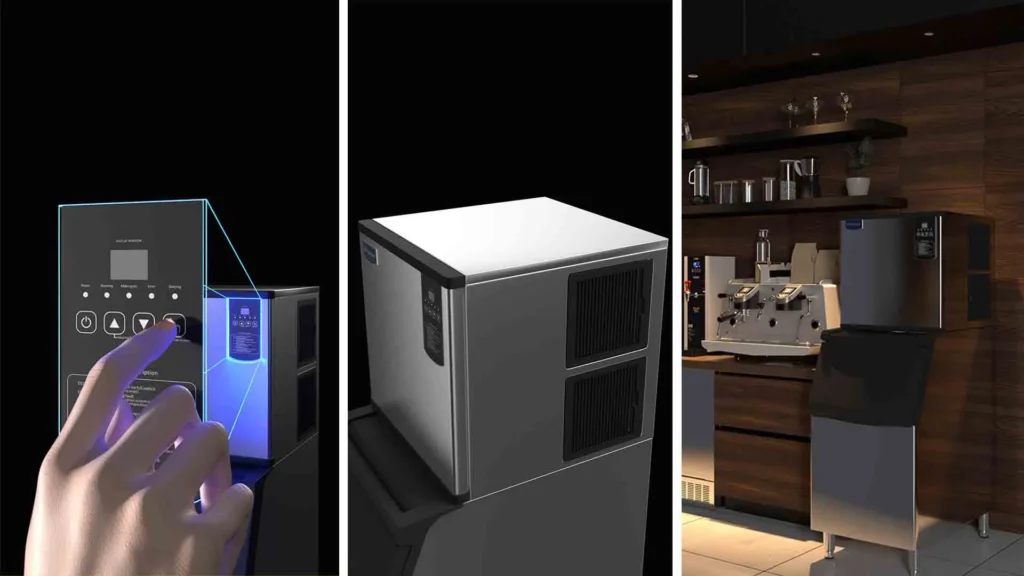
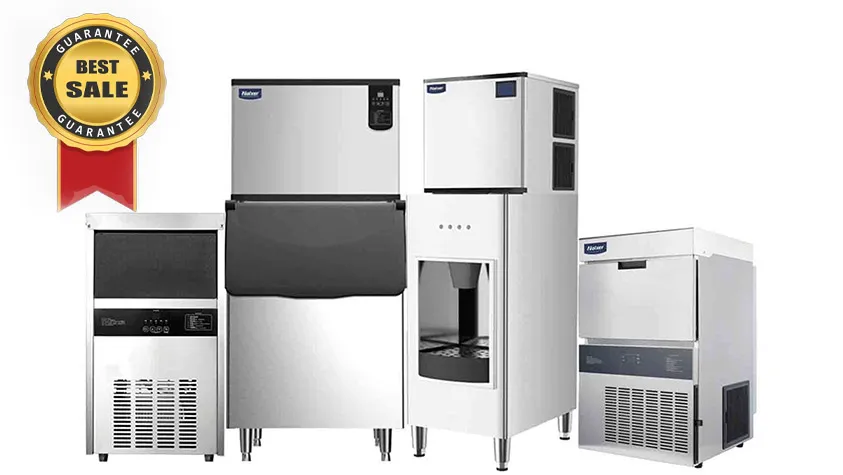
Naixer manufactures commercial ice machines covering cube, square, cylinder, crescent, nugget, and flake ice, with multiple production capacities and configurations for foodservice and other commercial applications.
In this guide, you will learn:
Quick Answer: What Is the Best Commercial Ice Machine for a Restaurant?
There is no single best commercial ice machine for every restaurant.
A suitable machine should match:
- your busiest-day ice demand;
- the amount of ice needed during peak service;
- the ice type required by your menu;
- storage capacity;
- available installation space;
- water, drainage, ventilation, and electrical requirements;
- and the maintenance and service conditions of your location.
For a small restaurant, café, bar, or space-constrained kitchen, a compact undercounter commercial ice machine can be practical. For larger restaurants and high-volume foodservice operations, a higher-output system with more storage or a separate ice bin may be a better fit. Current restaurant-focused buying guides consistently emphasize capacity, storage, ice type, installation, and peak demand rather than machine price alone.
What Makes a Commercial Ice Machine Suitable for a Restaurant?
Restaurants use ice differently from one another.
A small café may mainly need ice for iced coffee and cold beverages. A full-service restaurant may need ice for water service, soft drinks, cocktails, iced tea, and bar operations. A seafood restaurant may have additional cooling requirements. A restaurant with catering or outdoor events may need considerably more storage than its normal daily consumption suggests.
That means the correct restaurant ice machine should be selected around the actual workflow of the business rather than simply choosing the machine with the largest advertised daily output.
A practical restaurant selection process starts with five questions:
- How much ice does the restaurant use on its busiest days?
- What type of ice does the menu require?
- How much ice needs to be available during peak service?
- Where can the machine be installed?
- What power, water, drainage, ventilation, and maintenance conditions exist?
How Much Ice Does a Restaurant Need?
This is usually the first question a restaurant owner should answer before comparing commercial ice makers.
Current restaurant buying guides use different planning benchmarks, including figures around 1.5–2 lb of ice per customer per day for many restaurant operations, with higher demand for beverage-heavy businesses and bars. These are planning ranges rather than universal standards because menus, climate, customer traffic, and non-beverage ice use can vary substantially.
A better approach is to estimate your restaurant’s actual demand.
Start With Customer Volume
Customers per day × estimated ice use per customer
Then add ice used for:
- cocktails;
- iced coffee;
- fountain drinks;
- iced tea;
- food preparation;
- seafood or food displays;
- catering;
- staff drinks;
- other non-beverage applications.
Plan for the Busiest Day
A restaurant should not size its machine only around an average weekday.
Consider:
- Friday and Saturday demand;
- lunch and dinner rushes;
- seasonal increases;
- special events;
- catering;
- new menu items;
- and future business growth.
The goal is not simply to produce enough ice across 24 hours. The machine must also support the periods when demand is concentrated.
Production Capacity vs. Ice Storage Capacity
One of the most important commercial ice machine buying decisions is understanding the difference between ice production and ice storage.
A machine’s daily production rating tells you how much ice it can make under specified test conditions. Storage capacity tells you how much finished ice is available before the bin needs to be replenished.
These are not the same thing.
For example, a restaurant may have enough total daily production but still run out of ice during dinner service if too much demand happens in a short period and the storage bin is undersized.
This is why restaurants should compare:
Daily production + peak demand + storage capacity
rather than looking at daily production alone.
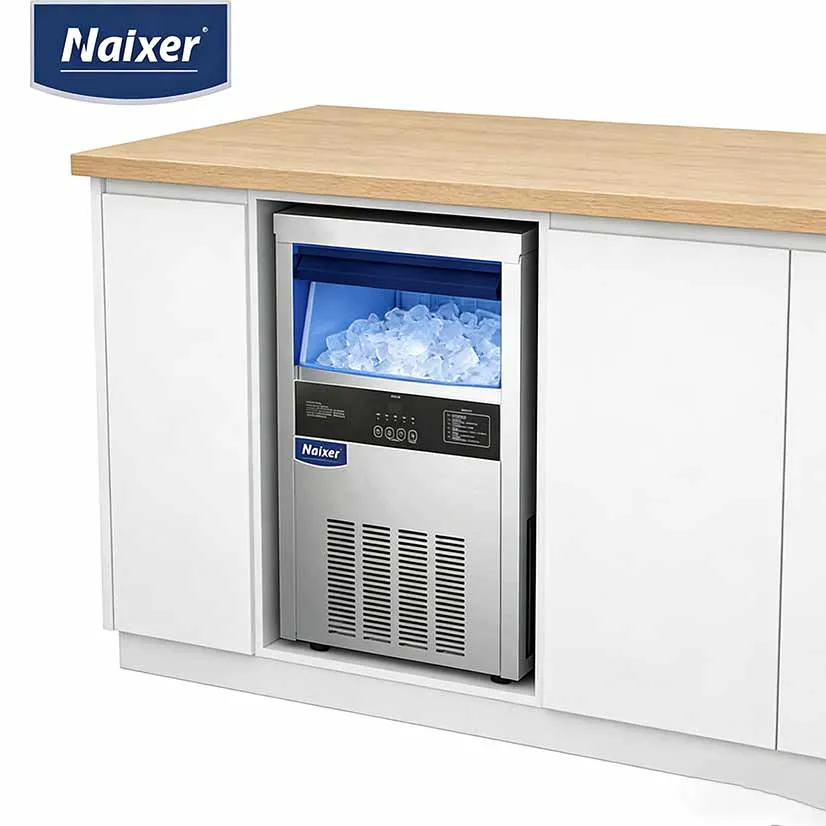
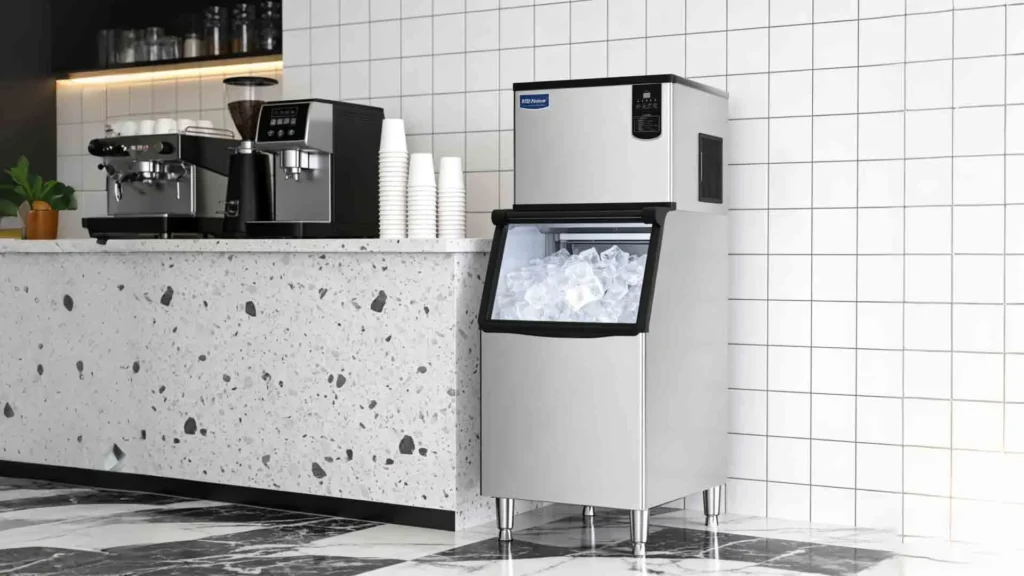
The Naixer BT-210, for example, is a self-contained undercounter cube ice machine rated at up to 210 lb (95 kg) per day, with a 51 kg built-in storage bin. It is positioned by Naixer for cafés, bars, small restaurants, and hospitality spaces where floor space is limited.
The TH-260B provides up to 260 lb/day of full cube ice with a 45 kg built-in insulated storage bin, giving restaurants a larger production option while keeping production and storage in one cabinet.
For higher-volume operations, Naixer’s broader commercial range includes larger-capacity cube ice machines, and its product brochure lists Series C machines at 320, 500, 700, and 1,000 lb/day classes.
What Type of Ice Is Best for a Restaurant?
The best ice type depends on the restaurant’s menu.
Ice shape affects beverage presentation, cooling behavior, melting, texture, and food-cooling applications.
Commercial Cube Ice Machines for Restaurants
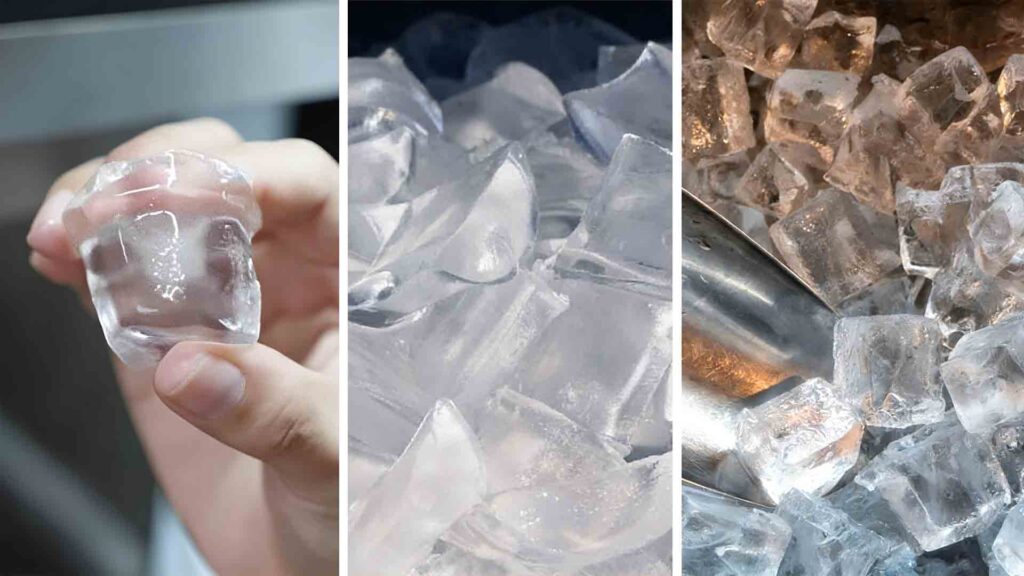
Full cube ice is one of the most versatile choices for general restaurant beverage service.
It can be used for:
- soft drinks;
- iced tea;
- iced coffee;
- cocktails;
- water service;
- general foodservice.
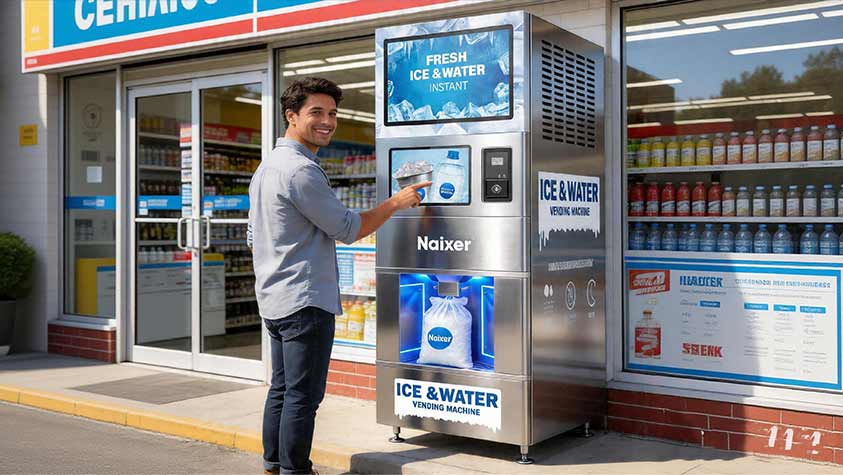
Naixer’s cube ice range includes built-in-bin and split-type configurations, alongside ice dispensers and ice-and-water vending equipment.
For many small and medium restaurants, cube ice is a sensible starting point because the same ice format can support multiple beverage applications.
Commercial Square Ice Machines for Premium Drinks
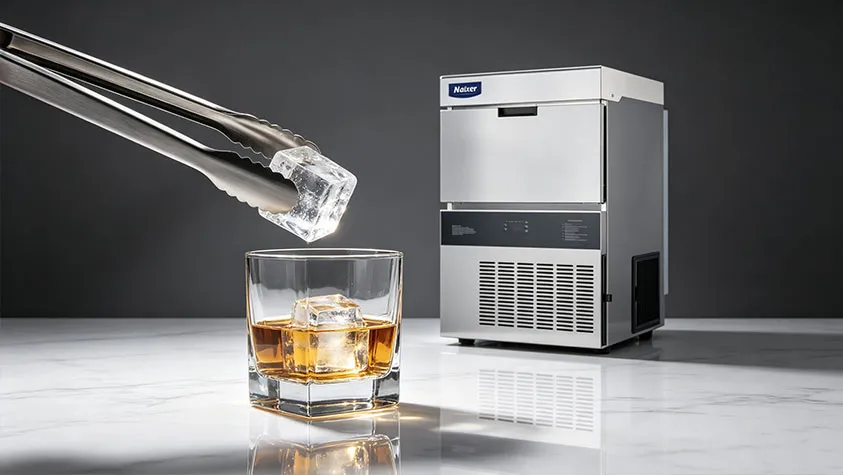
Square ice is particularly useful when beverage presentation and slower melting are part of the restaurant experience.
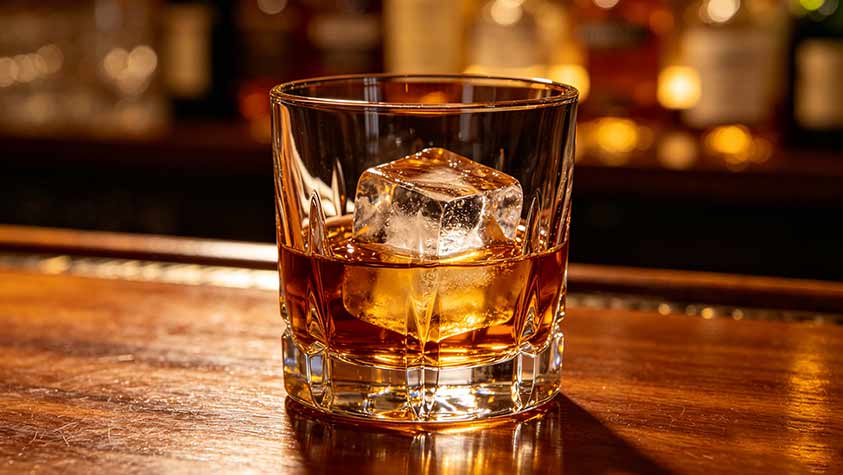
Naixer’s square ice series includes 30×30×30 mm and 50×50×50 mm formats, with products positioned for cocktails, spirits, restaurants, hotels, cafés, and premium beverage programs.
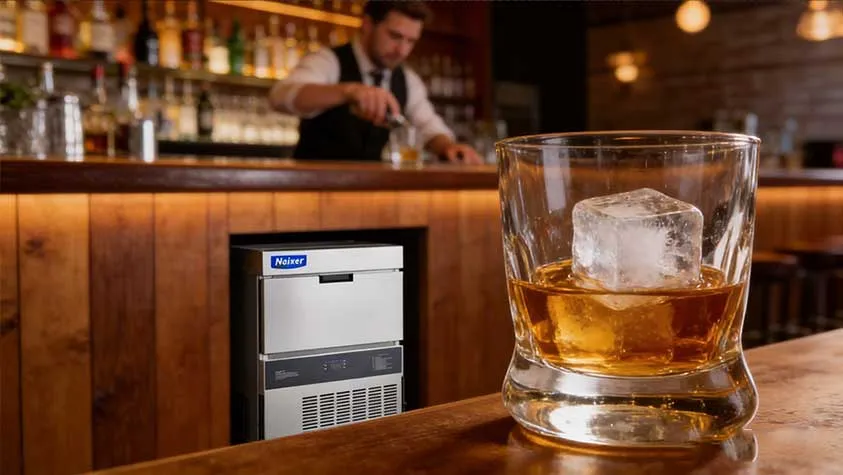
A restaurant with a strong whiskey or cocktail menu may prefer large-format square ice for selected drinks rather than using one ice type across the entire operation.
Commercial Crescent Ice Machines for Restaurants
Crescent ice is another option for restaurant beverage service.
Naixer describes its crescent ice systems as producing clear, hard crescent-shaped ice and offers both built-in-bin and split-type configurations. The product family is positioned for restaurants, cafés, bars, hotels, and hospitality applications.
This makes crescent ice particularly relevant for restaurants that want a different ice profile without moving entirely into a high-capacity modular-style setup.
Commercial Cylinder Ice Machines for Restaurants
Cylinder or “jelly” ice is a more specialized beverage option.
Naixer’s cylinder ice series is designed around compact built-in-bin machines and is positioned for restaurants, cafés, bars, bubble tea shops, juice bars, and other beverage-focused businesses.
This type of ice can be useful when the restaurant’s beverage concept places more emphasis on ice appearance and drink presentation.
Commercial Nugget Ice Machines for Restaurants
Nugget ice is soft and chewable and is often associated with beverage concepts where ice texture is part of the customer experience.
It can be considered for restaurants with:
- soft-drink programs;
- quick-service beverages;
- specialty drinks;
- self-service stations;
- or concepts where chewable ice is part of the product experience.
Naixer’s current Product Center includes a Nugget Ice Series.
Commercial Flake Ice Machines for Restaurant Food Cooling
Flake ice has a different role.
Rather than being primarily a beverage ice, it is better suited to applications requiring rapid, flexible cooling, including seafood and food displays.
Naixer’s Flake Ice Series includes PB-300, PB-500, and PB-1000 models.
For a restaurant with seafood displays or other food-cooling requirements, flake ice may be more useful than a standard beverage cube machine.
What Type of Commercial Ice Machine Does a Restaurant Need?
Once you know how much ice you need and which ice type fits your menu, the next decision is machine configuration.
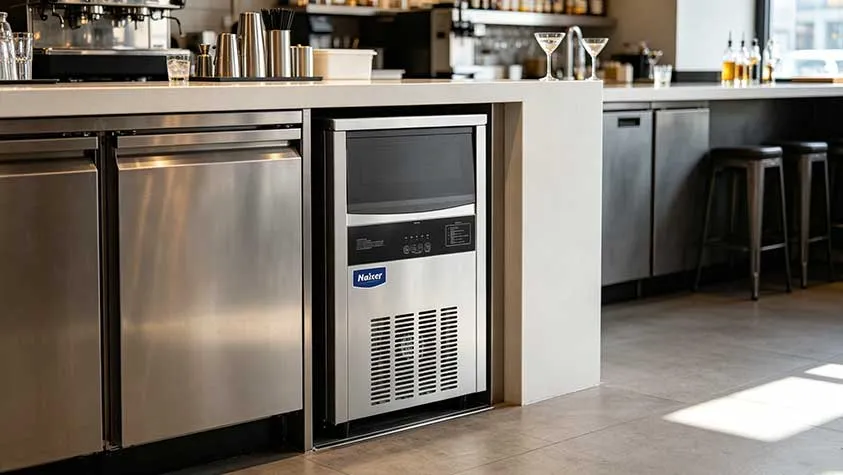
Undercounter Commercial Ice Machines
Undercounter machines combine ice production and storage in a compact footprint.
They are especially useful when:
- floor space is limited;
- the ice needs to be near a bar or service counter;
- the restaurant does not require very large daily production;
- and production and storage should remain in one cabinet.
The Naixer BT-210 is a good example: it produces up to 210 lb/day of full cube ice, has a 51 kg built-in bin, and is designed for undercounter use.
For smaller restaurant operations, this type of configuration can simplify installation and workflow.
Built-In Bin Commercial Ice Machines
Built-in-bin machines integrate ice production and storage in one unit.
The advantage is straightforward:
one machine, one integrated storage system, simpler space planning.
Naixer’s product center currently includes built-in-bin cube, cylinder, and crescent ice machines.
This makes the configuration particularly useful for restaurants that want a self-contained system without designing around a separate storage bin.
High-Capacity and Split-Type Commercial Ice Machines
Larger restaurants may need more production and more storage flexibility.
Naixer’s product brochure shows its Series C cube ice machines in 320, 500, 700, and 1,000 lb/day classes, with larger storage capacities and air/water-cooled configurations depending on model.
Naixer also offers split-type crescent ice systems that pair the ice-making head with a compatible storage bin or dispenser, giving higher-volume commercial operations more flexibility in matching production and storage.
For a restaurant group, hotel restaurant, banquet kitchen, or other high-volume foodservice environment, production capacity and storage architecture become more important than simply choosing the smallest machine that can meet average demand.
Commercial Ice Machine Installation Requirements for Restaurants
Before purchasing any commercial ice maker, measure the actual installation area.
Check:
Machine Dimensions
Measure:
- width;
- depth;
- height;
- door and bin clearance;
- staff access.
Electrical Requirements
Confirm:
- voltage;
- frequency;
- power requirements;
- local electrical configuration.
For example, Naixer product specifications vary by model, so the exact model page should be used for final electrical planning.
Water Supply and Drainage
Confirm:
- water connection;
- drainage location;
- drainage height;
- water quality;
- filtration requirements.
Ventilation
Air-cooled units need adequate airflow around the condenser.
Don’t assume that because a machine physically fits under a counter, the installation is automatically suitable.
Always check the model-specific installation requirements before finalizing the kitchen layout.
How Much Does a Commercial Ice Machine for a Restaurant Cost?
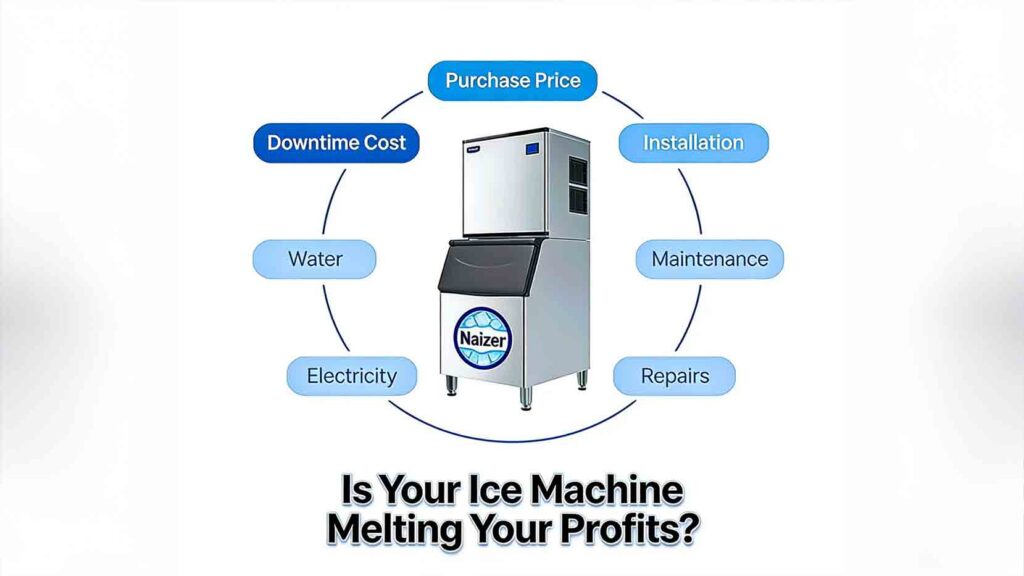
The purchase price is only one part of the cost.
Restaurant operators should consider:
- Machine price
- Installation
- Water and drainage work
- Electrical work
- Water filtration
- Energy and water consumption
- Cleaning and maintenance
- Replacement parts
- Downtime risk
This is why two machines with similar production capacity can have very different total ownership costs.
A compact self-contained machine may reduce installation complexity, while a higher-capacity system may require more planning but provide the production level needed by a larger operation.
For a detailed cost discussion, link this section to your existing:
How Much Does a Commercial Ice Machine Cost?
Later, I recommend changing that internal link to the exact cost article URL once we confirm the current slug.
Recommended Commercial Ice Machines for Restaurants
Rather than saying that one machine is “the best,” it is more useful to match the model to the restaurant’s operating situation.
Best for Small Restaurants and Limited Space: BT-210
The Naixer BT-210 is a compact undercounter cube ice machine producing up to 210 lb (95 kg) of ice per day, with a 51 kg built-in storage bin. Naixer positions it for cafés, bars, small restaurants, and hospitality environments where floor space matters.
Recommended for:
- small restaurants;
- cafés;
- bars;
- compact kitchens;
- satellite beverage stations.
Best for Medium-Demand Restaurant Beverage Service: TH-260B
The TH-260B produces up to 260 lb (118 kg) of 22×22×22 mm full cube ice per day and uses a 45 kg built-in storage bin. Its self-contained design makes it suitable for operations that need more capacity without moving to a larger commercial installation.
Best for High-Volume Restaurant Operations: TH-500B
The Naixer TH-500B is positioned as a high-output commercial cube ice machine for restaurants, bars, hotels, and convenience stores. Its official product page specifies up to 225 kg/day (approximately 500 lb/day) of 22×22×22 mm cube ice with a 180 kg storage bin.
This makes it a strong candidate for restaurants where beverage demand is significantly higher than a compact undercounter machine can support.
Best for Premium Cocktail and Whiskey Service: DF-130
For restaurants with a premium beverage program, Naixer’s square ice series offers larger-format ice options, including 50×50×50 mm ice. The series is positioned for premium cocktails, spirits, restaurants, hotels, and beverage businesses.
Best for Restaurant Food Cooling: PB Series
When a restaurant also needs ice for seafood, food displays, or rapid cooling, a flake ice machine may be more appropriate than relying only on beverage cubes. Naixer’s product center identifies PB-300, PB-500, and PB-1000 within its flake ice series.
How to Choose a Commercial Ice Machine for Your Restaurant
Before requesting a quotation, use this checklist.
1. Define Your Peak Ice Demand
Don’t size the machine around a quiet weekday.
Use your busiest operating period as the primary planning reference.
2. Identify the Main Ice Application
Is ice mainly being used for:
- beverages;
- cocktails;
- iced coffee;
- self-service drinks;
- food preparation;
- seafood;
- food displays?
3. Choose the Ice Type
Select cube, square, cylinder, crescent, nugget, or flake according to actual business use.
4. Compare Production and Storage
A higher daily production number does not automatically mean better service if storage and peak recovery are inadequate.
5. Check Installation
Confirm dimensions, power, water, drain, airflow, and maintenance access before ordering.
6. Consider Future Growth
If your restaurant plans to add:
- more seats;
- a bar;
- catering;
- a new beverage program;
- or additional locations,
consider whether today’s machine will still meet tomorrow’s demand.
Why Choose Naixer for Commercial Restaurant Ice Machines?
Naixer Group was established in 2010 in Guangzhou and has developed dedicated R&D, manufacturing, marketing, and service capabilities around commercial foodservice equipment. Group materials describe a 30,000 m² integrated R&D, production, and logistics base, more than 300 technical patents, CE and ISO9001 certifications, and a manufacturing capacity exceeding 200,000 units annually.
The current Naixer commercial ice machine portfolio covers multiple ice types and configurations, allowing restaurant buyers to compare machines according to ice type, daily production, storage, and installation requirements rather than selecting from a single machine format.
Naixer’s group materials also describe a dedicated service center with more than 400 city service points and 20+ full-time technical staff, alongside stated response and solution targets for service requests.
For B2B restaurant projects, the goal should be simple:
Choose the right ice type, the right production capacity, and the right machine configuration for the real operating environment.
Frequently Asked Questions About Commercial Ice Machines for Restaurants
What size commercial ice machine does a restaurant need?
The required size depends on customer volume, beverage demand, bar service, food preparation, peak periods, storage, and ice type. Restaurant buying guides commonly use planning ranges around 1.5–2 lb per customer per day, but actual demand should be calculated from the restaurant’s specific operation rather than treated as a universal standard.
What type of ice is best for a restaurant?
Cube ice is a versatile option for general beverage service. Square ice works well for premium cocktails and spirits. Nugget ice is useful when chewable texture matters, while flake ice is better suited to food cooling and seafood applications.
Is an undercounter ice machine good for a restaurant?
Undercounter machines can be a good option for small restaurants, cafés, bars, and kitchens with limited space. The key is confirming that daily production and storage are sufficient for peak demand.
Should I choose a built-in bin or split-type ice machine?
A built-in-bin machine combines production and storage in one cabinet and is convenient when simplicity and footprint are priorities. A split-type configuration gives larger operations more flexibility to match an ice-making head with a separate storage bin or dispenser.
How much does a restaurant ice machine cost?
Cost varies with production capacity, ice type, configuration, storage, installation, and market. The purchase price should be evaluated together with utilities, maintenance, parts, and installation.
What should I check before installing a commercial ice machine?
Confirm the exact model’s dimensions, voltage, frequency, power, water supply, drainage, ventilation, ambient conditions, and required service clearance before installation.
How often should a restaurant ice machine be cleaned?
The cleaning frequency depends on the model, water quality, usage, and operating environment. Always follow the product-specific maintenance instructions rather than assuming one cleaning interval applies to every commercial ice machine.
How do I choose between cube, square, crescent, nugget, cylinder and flake ice?
Start with the application. Beverage-focused restaurants often choose cube, square, crescent, or cylinder ice. Nugget ice is useful for chewable beverage concepts. Flake ice is more appropriate for food cooling, seafood, and display applications.