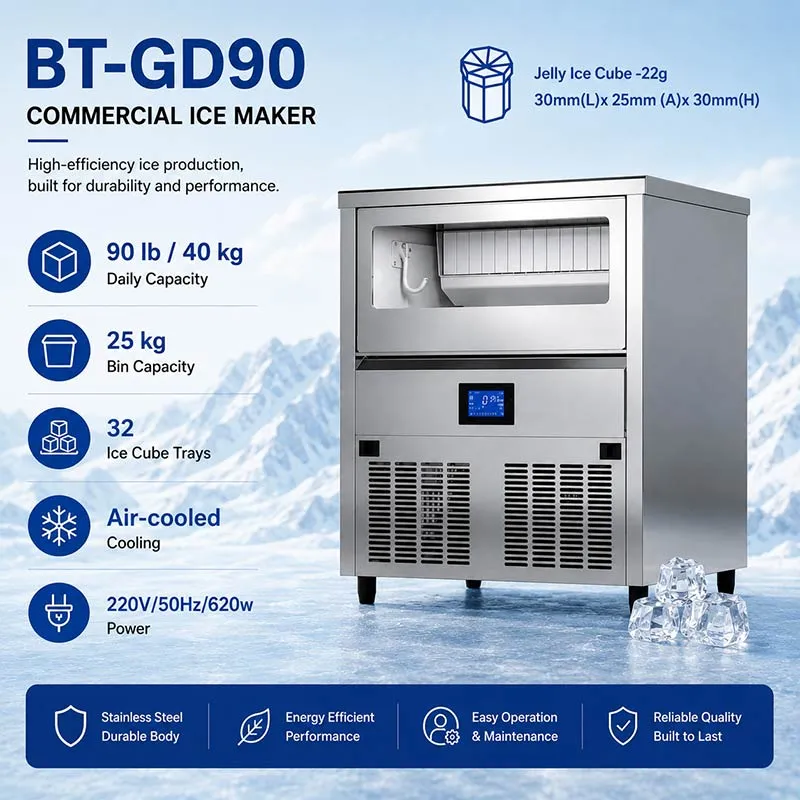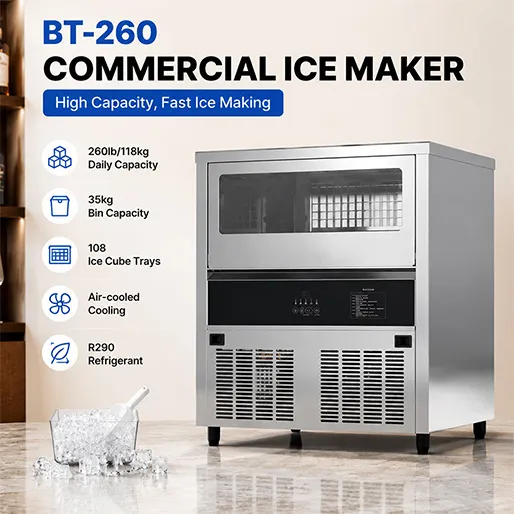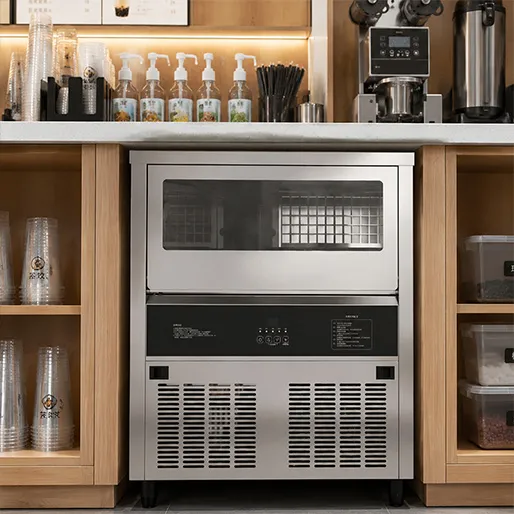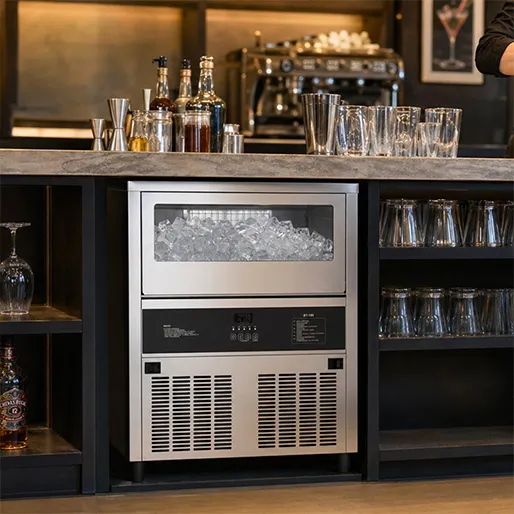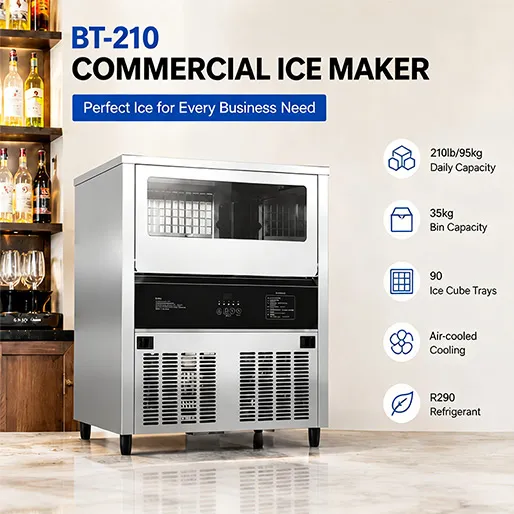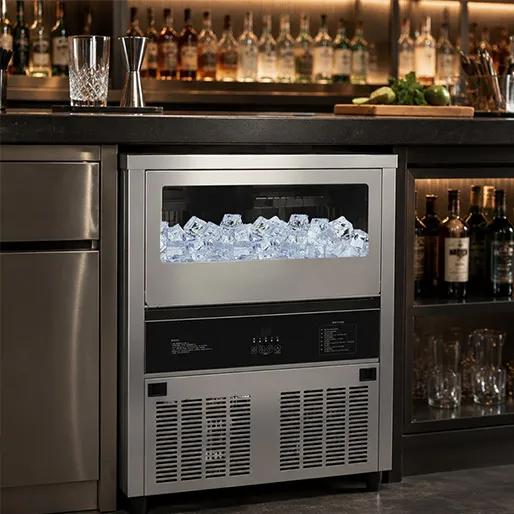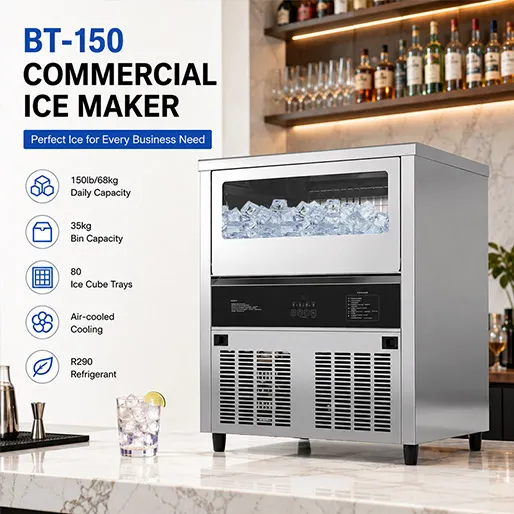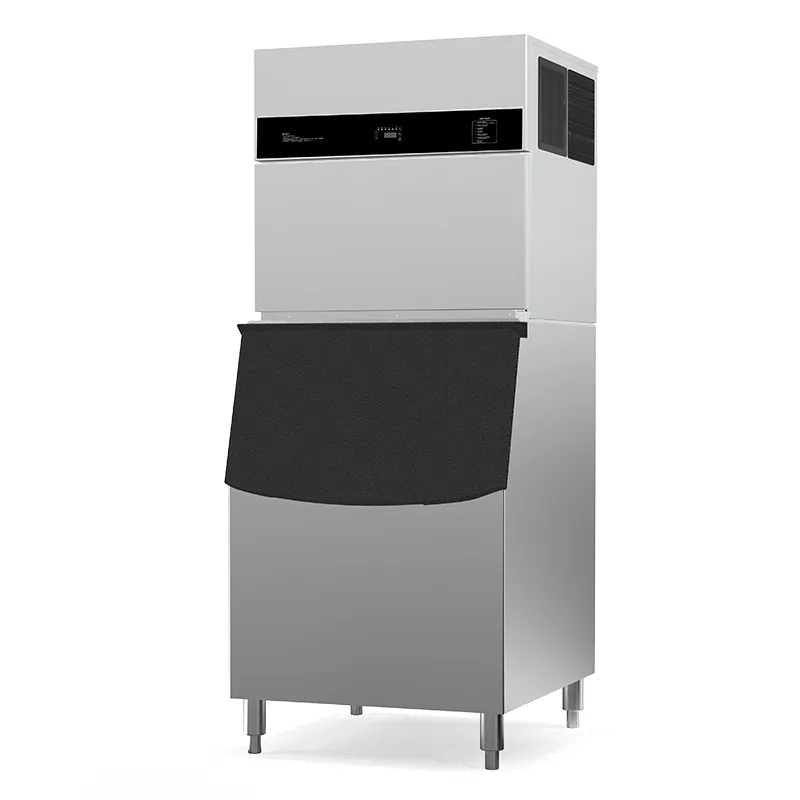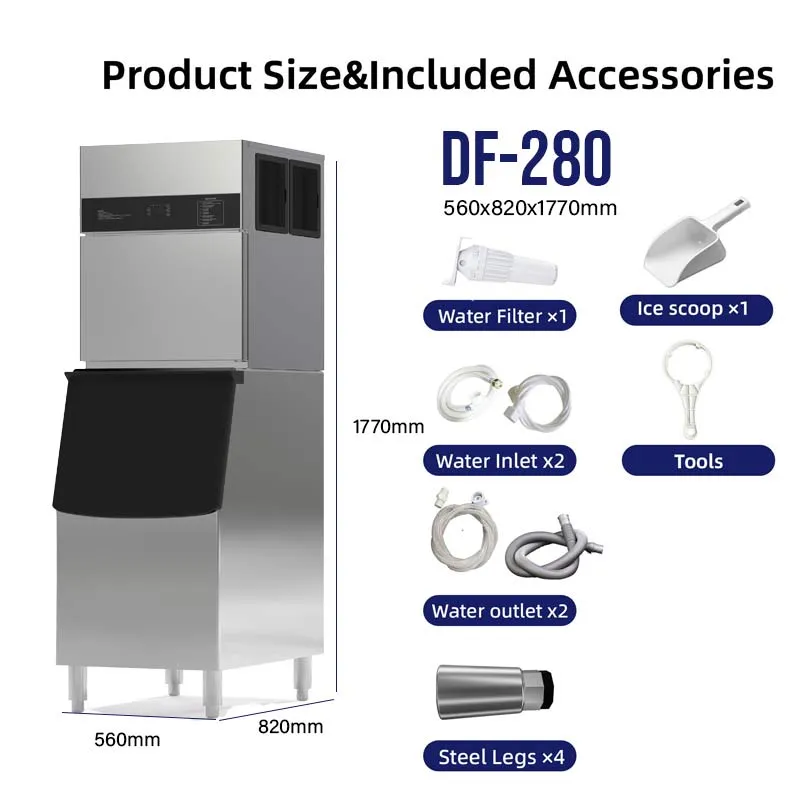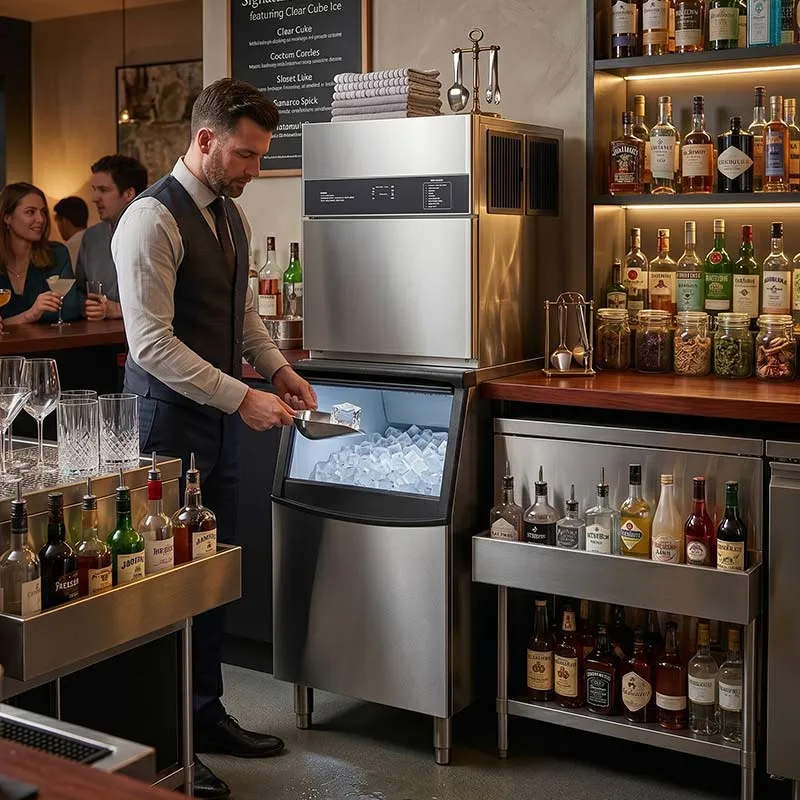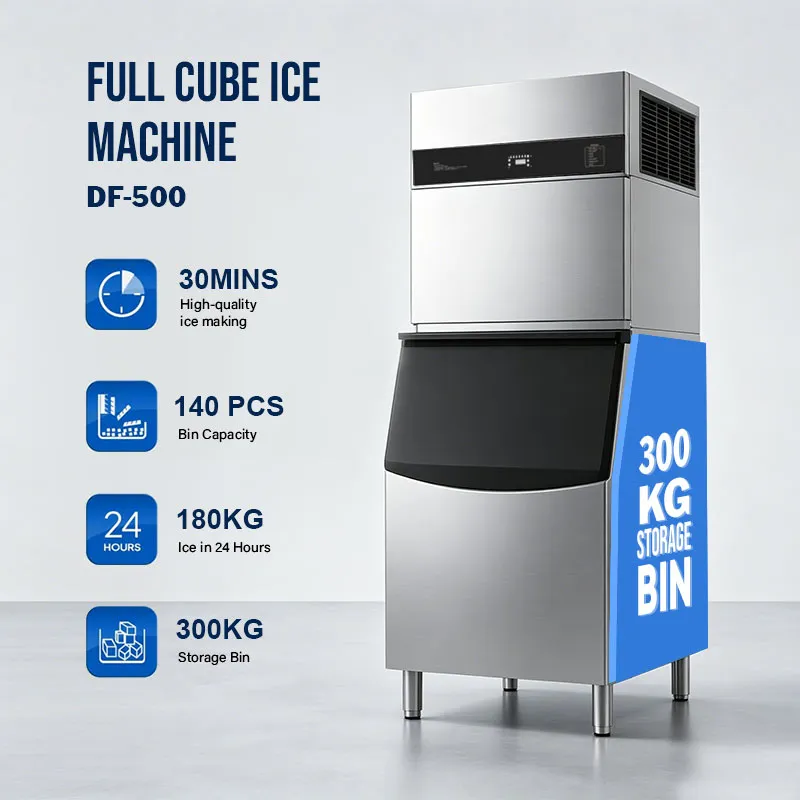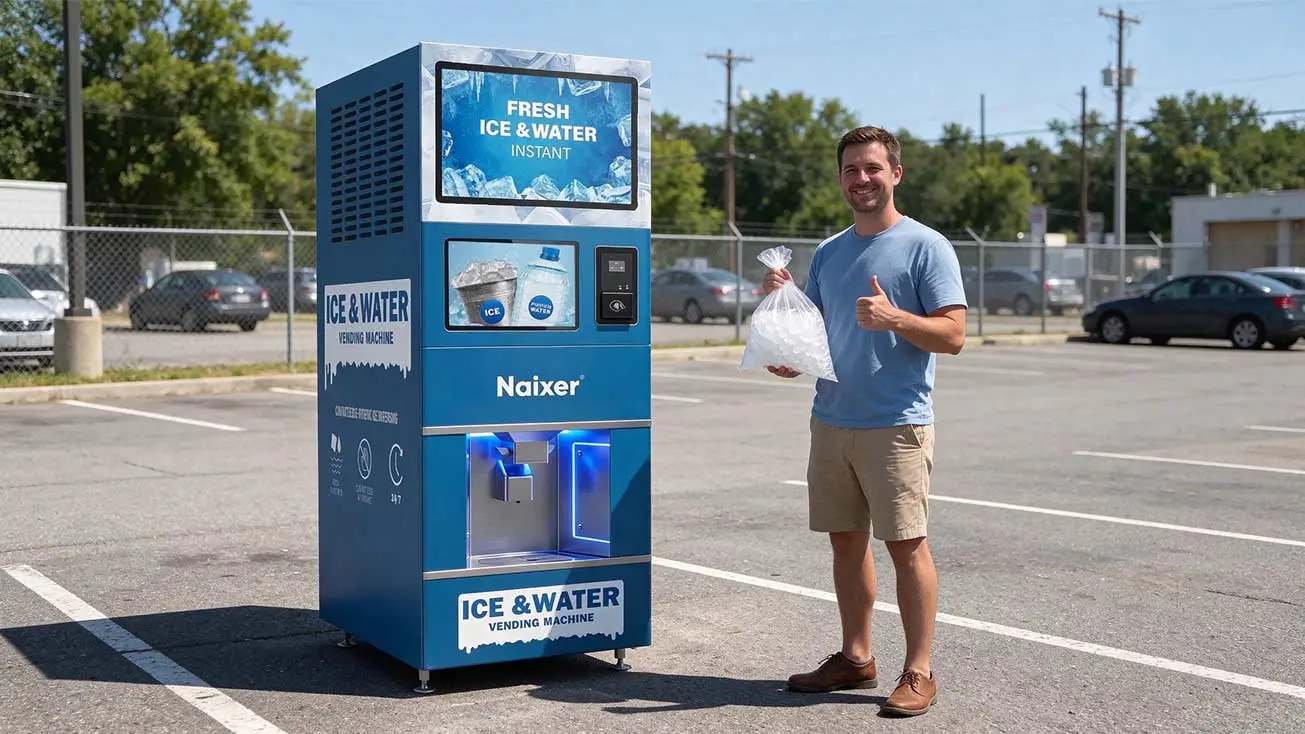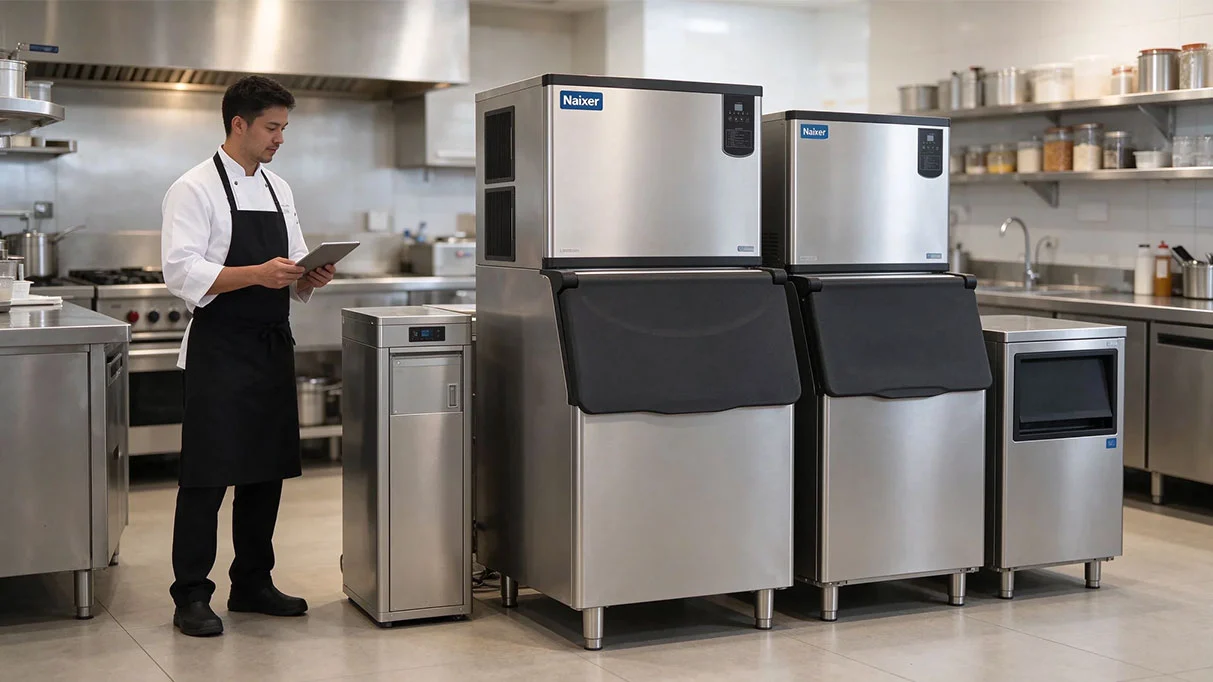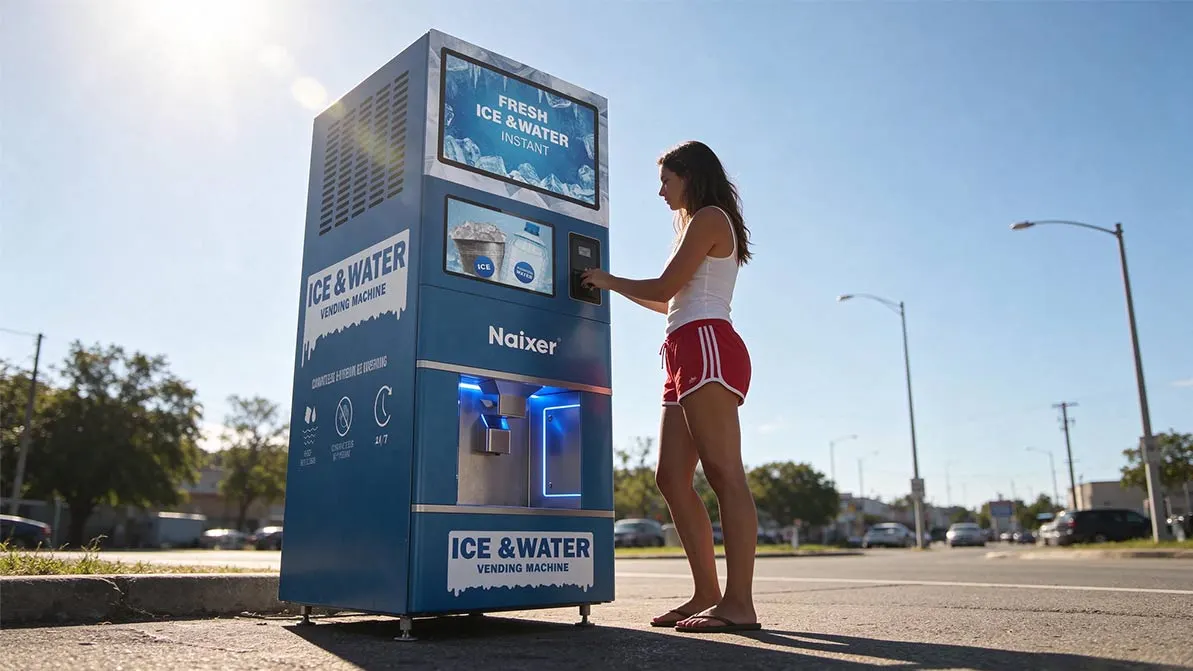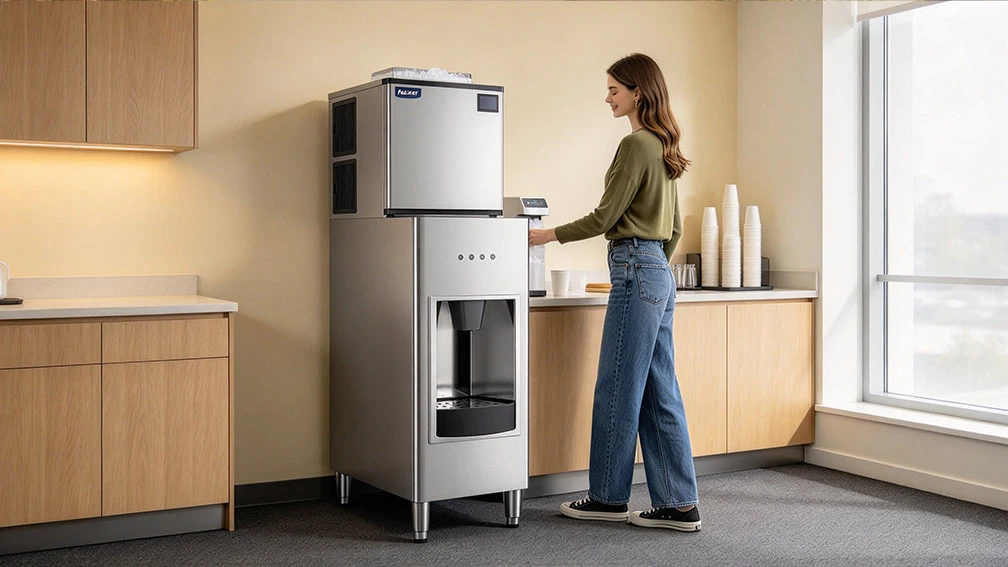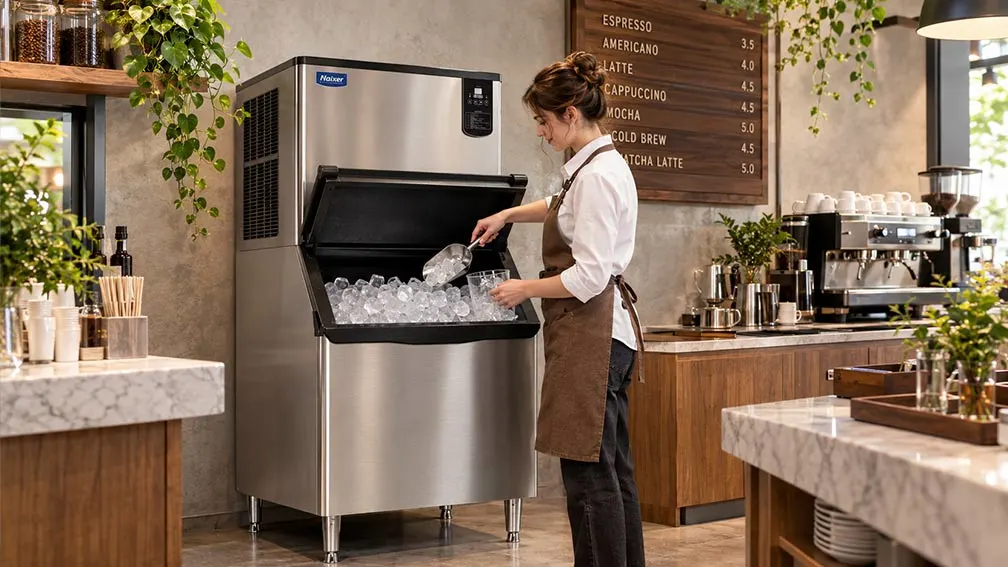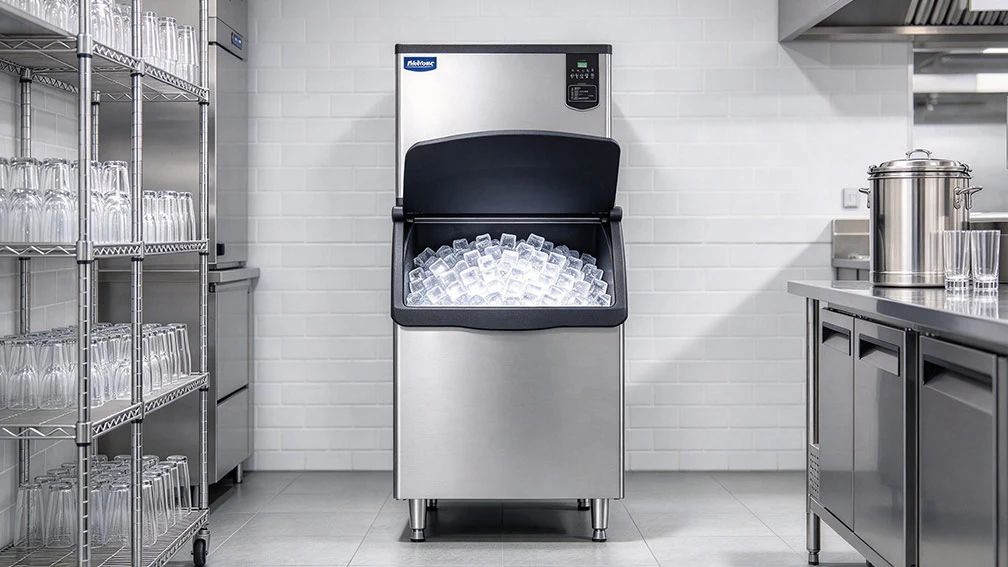
An entry-level commercial ice vending machine costs $7,000–$9,000. A commercial-grade unit typically runs $25,000–$70,000. The difference is not cosmetic — it buys a heavier compressor, a stainless cabinet, a longer warranty and a service network. But it only buys those things if the specification actually shows them. Price is a signal, not a proof.
This is written from the manufacturing side. Naixer has built commercial ice equipment since 2010 and sells vending machines at the entry-level tier, so we have an obvious interest in telling you the premium is unnecessary. We are not going to do that. We are going to show you what the premium pays for, where it genuinely matters, and the four situations where an entry-level unit will cost you more than it saves.

In this guide, you will learn:
The two tiers, side by side
Most comparison content in this category compares brands. That is the wrong axis. What actually differs between a $9,000 machine and a $25,000 one is a short list of design decisions, and every one of them is visible on a specification sheet if you know where to look.
| Dimension | Entry-level $7,000–$9,000 | Commercial-grade $25,000–$70,000 | Why it matters |
|---|---|---|---|
| Duty cycle | Fill and rest; intermittent running | Near-continuous through a trading day | Drives every hardware decision below |
| Compressor | Commercial-grade possible; must be named | Heavier commercial compressor | Highest-cost component and most expensive failure |
| Cabinet | SUS304 on better entry units | Stainless throughout | Coated steel fails at seams outdoors |
| Warranty | 1 year standard; 3-year full machine on some | 1–3 years, varies | A warranty is the maker's bet on its own BOM |
| Payment | Cashless standard, coin optional | Cashless plus branded app ecosystem | Affects transaction speed, not durability |
| Telemetry | Often standard | Standard, sometimes with managed dashboard | Determines whether you learn about faults remotely |
| Service network | Thinner; verify parts lead time | Thicker; regional technicians | The most under-priced risk in the category |
| Break-even volume | ≈9 bags/day | ≈25 bags/day | Assumes $3.00 bag, 60% margin, $400/$700 fixed |
Important note Tier characteristics are typical patterns, not universal rules. Price does not guarantee a better bill of materials in either direction — verify each row against the actual specification sheet before you order, at any price.

Two rows in that table deserve more attention than the rest.
Duty cycle is the real dividing line. An entry-level machine is designed to fill a bin and rest. A commercial-grade machine is designed to run near-continuously through a trading day. That single difference drives the compressor selection, the evaporator surface area, the condenser size and the control logic — which is why the price gap is larger than the sum of the parts. If your site sells 20 bags a day, you are paying for duty cycle you will never use. At 80 bags a day in July, you are not.
Warranty length is a manufacturer’s bet on its own bill of materials. A one-year warranty is a normal commercial term. A three-year full-machine warranty on a $9,000 unit means the manufacturer expects the components to survive three years of unattended operation — and has priced that expectation into the unit cost. Read the warranty as a data point about the machine, not as a marketing feature.
Where the price difference actually goes
A vending machine is roughly forty percent refrigeration system, twenty percent cabinet and structure, fifteen percent control and payment electronics, and the remainder in assembly, testing, certification and margin. The premium between tiers is concentrated almost entirely in the first two categories.
| Cost area | Share of unit cost | Does the premium buy it? | What to verify |
|---|---|---|---|
| Refrigeration system | ≈40% | Usually yes | Compressor make and model, evaporator material |
| Cabinet and structure | ≈20% | Usually yes | Steel grade and gauge, insulation, seam construction |
| Control and payment | ≈15% | Sometimes | Open industrial controller vs proprietary board |
| Assembly and testing | ≈10% | Sometimes | Per-unit test log, not a single sample report |
| Certification | ≈5% | Yes, where required | Certificate numbers and the models they cover |
| Distribution margin | ≈10%+ | Frequently, but adds no engineering | Ask whether you are buying from the factory |
Cost note Proportions are an approximate industry structure for orientation, not a costed quote. The last row is the one buyers most often pay for without realising it — a distributed brand carries margin that a factory-direct sale does not.
Here is the uncomfortable part, and it is the reason this article exists.
A higher price does not guarantee a better bill of materials. Plenty of $25,000 machines are built around a commodity compressor in a painted cabinet with a one-year warranty and a distributor network that adds margin without adding engineering. Equally, a $9,000 machine can carry a name-brand commercial compressor, a stainless evaporator and a SUS304 cabinet — because the factory selling it has no distributor markup to fund.
What separates them in practice is not the price tag. It is whether the specification names the components. A supplier who can tell you the compressor make and model, the evaporator material and the cabinet grade in writing before you order has nothing to hide. A supplier who answers “high-quality imported brand” has told you nothing, at any price.

The four components that decide service life
Service life in commercial ice equipment is decided by four items. Everything else — the touchscreen, the payment terminal, the app — can be replaced in an afternoon. These four cannot.
| Component | Why it decides lifespan | Ask exactly this | Red flag |
|---|---|---|---|
| Compressor | Most expensive part; most expensive failure; hardest to source quickly | Make and model, and local replacement lead time | "High-efficiency imported brand" |
| Evaporator | Where ice forms and where hard water binds scale | Material, plating, specified descaling procedure | No descaling procedure documented |
| Cabinet | Outdoor machines fail at seams when coating breaks down | Steel grade (304 or better) and gauge | "Stainless steel" with no grade stated |
| Control board | Determines whether a general technician can diagnose a fault | Open industrial controller or proprietary? Schematic available? | Factory-only service; no schematic released |
Key takeaway Everything else on the machine — touchscreen, payment terminal, telemetry module — is replaceable in an afternoon and should not drive the purchase decision. These four items cannot be retrofitted.

Compressor. It is the single most expensive component in the machine and the one that fails most expensively. Ask for the make and model. A named commercial compressor from a major manufacturer is a specification; “imported brand” is a hope. Note also that compressor availability in your market matters as much as compressor quality — a premium compressor you cannot source a replacement for in under three weeks is a liability in July.
Evaporator. This is where ice actually forms, and where hard water does its damage. Material and plating determine how quickly scale binds and how easily it is removed. Ask what the evaporator is made of and what descaling procedure is specified.
Cabinet. A food-grade stainless cabinet — 304 grade is the common standard — resists corrosion and cleans properly. A painted or coated cabinet will look fine for two years and then start to fail at the seams, which on an outdoor machine is where water gets in.
Control board. The board ties the refrigeration cycle, the bin sensor, the payment terminal and the telemetry together. Ask whether it is a proprietary design or a standard industrial controller, because that determines whether a fault can be diagnosed by a general refrigeration technician or requires a factory part and a factory engineer.
What entry-level units genuinely do well
We sell at this tier, so treat this section with the scepticism it deserves. But these points hold regardless of who is making them.
They make a first site financially survivable. A $25,000 machine with $700 a month in fixed costs needs roughly 25 bags a day just to break even. A $9,000 machine with $400 a month in fixed costs needs around nine. On an unproven site, that difference is the difference between validating a location and gambling on one. If you want the full arithmetic, our breakdown of what ice vending machines cost in 2026 runs the numbers line by line.
They are the right tool for seasonal and low-volume sites. A campground that does 100 bags a day in July and 15 in January does not need continuous-duty hardware for eleven months of the year. Entry-level units suit exactly this profile.
They let you test a location before you commit capital to it. Most first-time operators do not know their real bag volume until they have traded a season. Discovering that with a $9,000 machine is a cheap lesson. Discovering it with a $70,000 machine is not.
Modern entry-level units are not stripped-down. The machine we build integrates the ice maker, insulated bin, bagging chute and payment terminal into one weather-proof SUS304 cabinet, with cashless payment and IoT remote monitoring as standard rather than as upgrades. The ZD-160-A320 carries a three-year full-machine warranty and CE, RoHS and CB certification. Ten years ago, that specification at this price did not exist.
Where entry-level units actually fail
This is the section most manufacturer content omits. Here it is anyway.
Continuous summer load. If your site genuinely sells 60–80 bags a day through a four-month peak, an entry-level machine will spend that peak at its design limit. It may not fail, but it will run hotter, cycle more often, and consume more power per bag. That is the scenario the commercial tier exists for.
High ambient temperature. Machine output ratings are stated at a reference ambient — commonly 25 °C. A forecourt in Phoenix or Riyadh in August is not 25 °C, and output falls as ambient rises. Ask for the derating curve, not just the headline number. This applies to every tier, but entry-level units have less headroom to absorb it.
Unattended sites far from service. The cheapest machine in the world is expensive if a fault means four days of downtime because the nearest technician is three hours away and the part has to be imported. If you are placing a machine remotely, buy the local parts availability, whatever tier that means.
Growth beyond the site’s original profile. A machine sized for 30 bags a day will not serve 70. If you expect the site to grow — a new development nearby, a change of host business — plan the tier for the site you expect in two years, not the one you have today.
For anyone deciding whether this category is worth entering at all, our analysis of whether ice vending machines are profitable sets out the honest margin ranges and the two ways operators most often get them wrong.
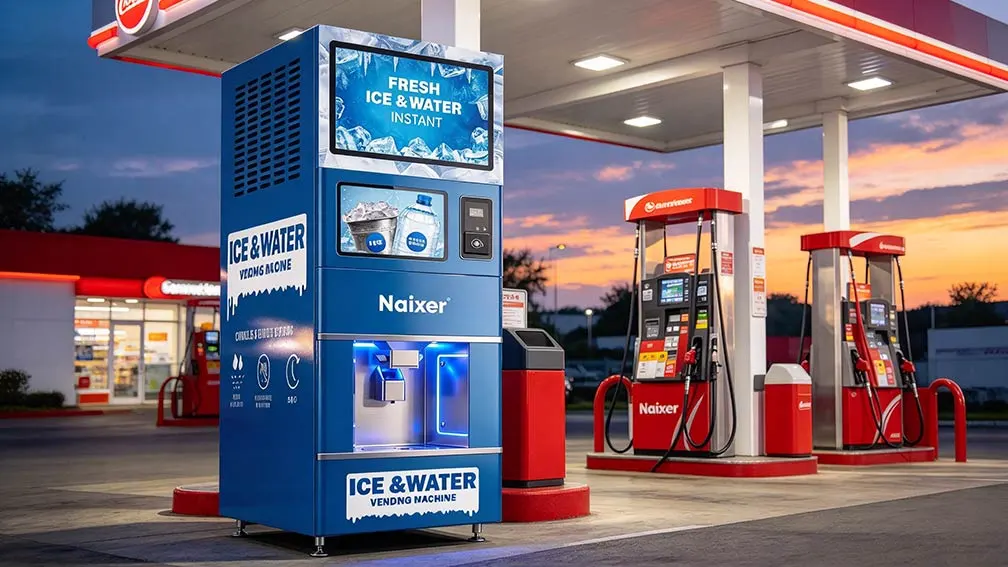
Match the tier to daily bag volume, not to budget
The correct input to this decision is bags per day at the specific site. Everything else — brand, price, features — is downstream of that number.
| Measured bags/day | Appropriate tier | Monthly gross at $3.00 | Verdict |
|---|---|---|---|
| Under 15 | No machine | under $1,350 | Site does not justify the capital at any tier |
| 15 – 35 | Entry-level ($7,000–$9,000) | $1,350 – $3,150 | Entry tier is correct; commercial premium cannot be repaid |
| 35 – 60 | Entry-level, high-output model | $3,150 – $5,400 | Verify derating at site ambient before committing |
| 60 – 90 | Commercial-grade ($25,000+) | $5,400 – $8,100 | Duty cycle now justifies the premium |
| Over 90 | Commercial or multi-machine | over $8,100 | Consider two units before one larger unit |
Planning note Assumes a $3.00 bag price and 60% gross margin. Volume bands are guidance based on duty-cycle headroom, not a warranty of performance. Measure traffic at the specific pad over at least two weekdays and two weekend days before using this table.
The break-even figures in that table assume a $3.00 bag price and a 60 percent gross margin, with fixed costs of $400 a month for the entry tier and $700 for the commercial tier. Change the assumptions and the numbers move, but the shape does not: higher tiers need proportionally more volume to justify themselves, and the volume has to be measured rather than estimated.
If you have not counted traffic at the pad, you do not have the input this decision requires. Our guide to choosing a location for an ice and water vending machine covers what to count and over how many days.
Two other benchmarks worth holding against your own model: business planning consultancies commonly report retail bagged ice at $1.50–$3.00 per bag with gross margins of 55–65%, and net profit for a single well-sited machine in the $1,200–$2,400 per month band. Our own monthly revenue modelling shows a wider range depending on traffic and pricing. If your projection sits materially above those bands on a first machine, you need a specific documented reason, not optimism.
What to ask before you buy either tier
This list works on any machine from any supplier, at any price. It is deliberately unfriendly.
| # | Ask | A good answer looks like |
|---|---|---|
| 1 | Compressor make and model? | A named brand and model number, given in writing |
| 2 | Daily output, and at what test conditions? | A figure quoted with ambient and inlet-water temperature |
| 3 | Evaporator material and descaling procedure? | Material named; procedure documented in the manual |
| 4 | Cabinet steel grade and gauge? | 304 food-grade or better, with gauge stated |
| 5 | Certificate number and production address? | Address matches the entity on your purchase order |
| 6 | Warranty terms, split by component class? | Separate terms for compressor, core systems, consumables |
| 7 | Recommended spares kit, and ship time? | A concrete orderable list with quoted lead time |
| 8 | Which refrigerant, and is it permitted here? | R290 or R404A named, with charge quantity confirmed |
| 9 | Voltage and frequency variant for my market? | The exact variant named, not "we can customise" |
| 10 | Can I see the line that builds my units, live? | A scheduled video walkthrough, not a stock factory video |
Key verification Question 5 is the highest-value item on this list. A trading company can reproduce a factory's certificate in a slide deck; matching it to the entity that invoices you is materially harder to fake.
The single highest-value item on that list is the fifth: ask for the certificate number and the production address, and check that they match the entity invoicing you.
A trading company can reproduce a factory’s certificate in a slide deck. Matching it to the address on your purchase order is materially harder to fake. If the answer is vague, you are not buying from a factory, and everything else in the quotation should be re-read with that in mind.
Frequently asked questions
What is the difference between an entry-level and a commercial-grade ice vending machine?
The main difference is duty cycle. Entry-level units are designed to fill a bin and rest; commercial-grade units are built to run near-continuously through a trading day. That drives compressor selection, evaporator size, cabinet construction and warranty length — and accounts for most of the price gap between roughly $9,000 and $25,000.
Why do some commercial ice vending machines cost $10,000 and others $25,000?
Four reasons: refrigeration duty rating, cabinet construction, warranty length, and distribution. A factory-direct machine avoids distributor margin, which is why an entry-level unit can carry a stainless cabinet and a three-year warranty at a price a distributed brand cannot match.
Is a cheaper ice vending machine worth it for a first site?
Usually yes, for one specific reason: it lowers the cost of being wrong about the location. A $9,000 machine breaks even at roughly nine bags a day; a $25,000 machine needs around twenty-five. On an unvalidated site, that difference is the whole risk profile.
How many bags per day can an entry-level machine handle?
It depends on the model and on ambient temperature, which is why the rating matters more than the tier. Ask for the published daily output together with the ambient and inlet-water test conditions behind it. A rating quoted without test conditions is not a specification.
What is the most common failure on an ice vending machine?
The compressor, followed by scale-related evaporator problems from hard water. Both are addressable at the specification stage — by naming the compressor and by confirming the descaling procedure and water filtration — and both are expensive to fix after installation.
Should I buy a used ice vending machine instead?
Only with a documented service history and a parts plan. Used machines are often priced attractively because a compressor is near end of life, and the replacement cost plus downtime can exceed the saving. If you cannot see the maintenance record, price the machine as though the compressor will fail in year one.
What warranty should I expect?
One year is a normal commercial term on vending equipment. A three-year full-machine warranty covering core systems and key components is above market and is worth weighing as evidence about the bill of materials, not just as a benefit.
How do I verify a supplier is a real factory?
Match the certificate address to the invoicing entity, request a live walkthrough of the specific production line that will build your units, and ask which components are bought in and from whom. A factory answers these quickly. A trader changes the subject.
Next step
If you are comparing an entry-level unit against a commercial-grade one for a specific site, the useful next action is not another comparison article. It is a specification sheet with the component list and a landed-cost quote for your destination.
If you are earlier in the process and want to understand the full path from site selection to first sale, our guide to starting an ice and water vending machine business covers the sequence. If you are sizing a route rather than a single site, how many machines you need to reach $100k a year is a more useful starting point.