Published estimates for the global commercial ice machine market range from roughly $1.0 billion to $5.5 billion for the same year. That is not a rounding difference — it is a five-fold disagreement. And almost none of it comes from the machines being counted differently. It comes from where each analyst draws the boundary of the market.
This guide does not add a sixth estimate. Naixer has manufactured commercial ice equipment since 2010, and what we can contribute is the supply side: what actually changes when a distributor in Frankfurt, Riyadh or Manila buys the same class of machine.

In this guide, you will learn:
Why the published market-size figures disagree
Four widely cited estimates for the same category, in the same year, do not agree with each other. Understanding why is more useful than picking one.
| Source | Scope | Base figure | Projection | Growth |
|---|---|---|---|---|
| Statifacts | Global, ice machine | USD 1.02 bn (2025) | USD 1.35 bn (2035) | ≈2.8% implied |
| Market.us | Global, commercial ice machine | USD 2.1 bn (2025) | USD 4.5 bn (2035) | 7.80% CAGR |
| PW Consulting (as cited by third parties) | Global, commercial ice machine | USD 5.46 bn (2025) | USD 8.73 bn (2032) | ≈6.9% CAGR |
| Future Market Insights | Oceania only | USD 89.4 m (2025) | USD 93.5 m (2026) | Not stated here |
| Market Research Future | EMEA only | USD 245.0 m (2024) | USD 350.7 m (2035) | Not stated here |
| Industry commentary (public post) | Japan only | ≈USD 320 m (2024) | — | — |
Figures reproduced as published by each source on 18 November 2026, with no adjustment, normalisation or reconciliation by Naixer. Different scope definitions and reporting years mean these rows are not directly comparable and must not be added, subtracted or used to cross-validate one another. The spread between the highest and lowest global figure is approximately 5.4×.

The spread has three causes, and none of them is an error in arithmetic.
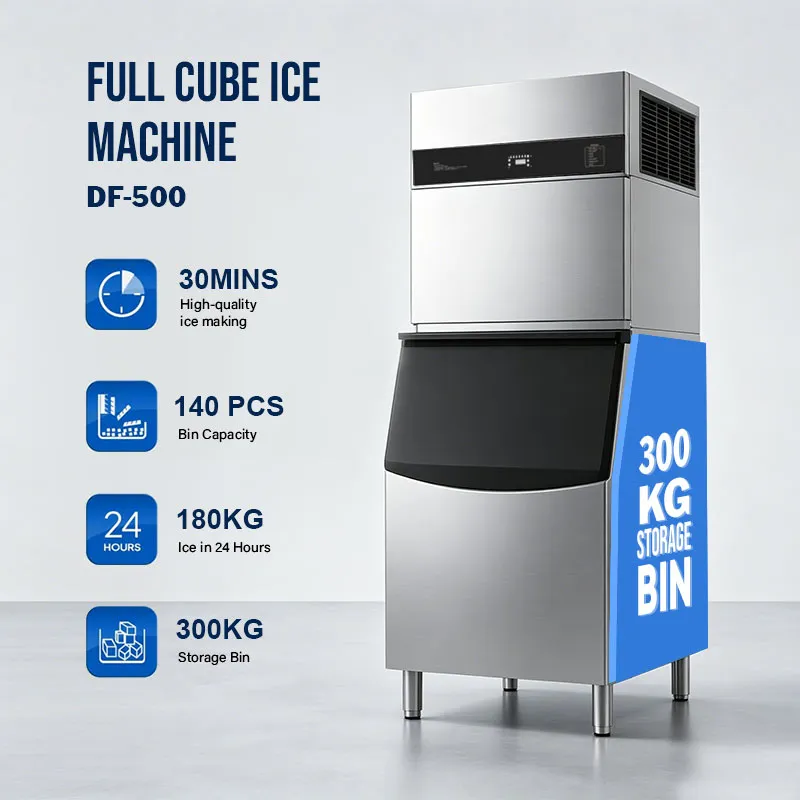
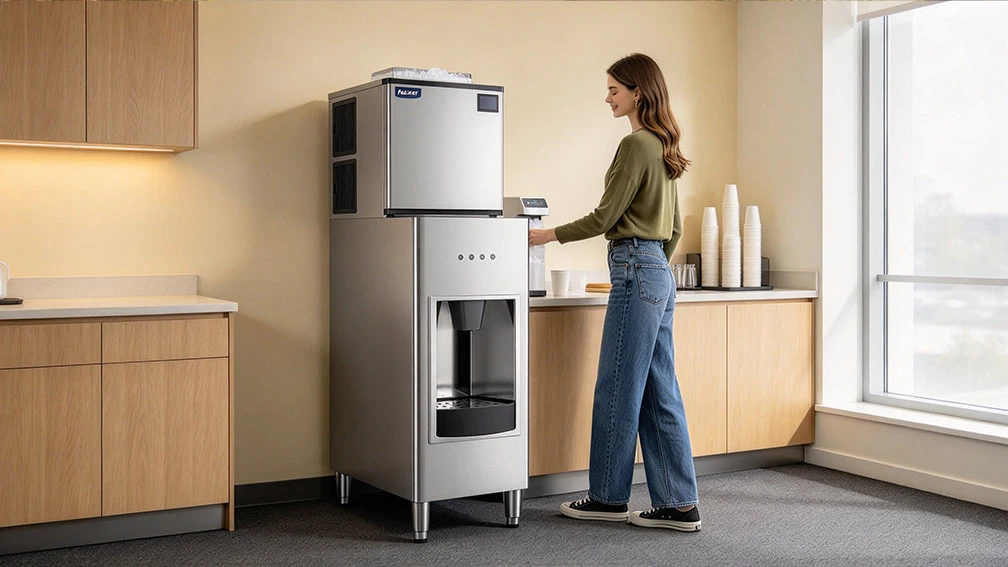
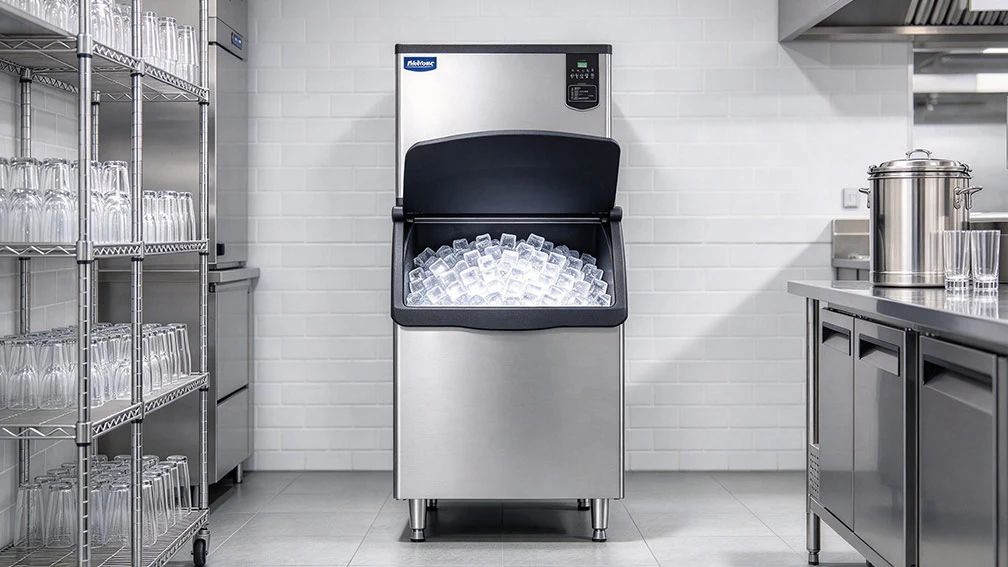
Cause one: the boundary. Some estimates count only the ice-making head — the refrigeration unit that drops cubes. Others include the storage bin. Others include the ice and water dispensers and bagging cabinets that sit downstream of the ice head. A commercial ice machine sold as a head plus a separate 300 kg bin is one transaction to a distributor and two product categories to an analyst.
Cause two: geography of the sample. The Oceania figure and the EMEA figure in Table 1 come from different firms using different scope definitions. You cannot add them, subtract them from a global total, or use them to sanity-check one another. That limitation is stated here deliberately, because it is the single most common analytical error in articles about this market — including several currently ranking on page one.
Cause three: exchange rate and reporting year. A 2024 figure converted at 2024 rates and a 2026 figure converted at 2026 rates are not comparable.
Several published tables mix them without saying so. The same contamination runs through published price ranges — our line-by-line breakdown of how much a commercial ice machine costs separates equipment price from installation, freight and duty for precisely that reason.
What we will not do. Naixer is a manufacturer, not a market research firm. We have no proprietary dataset that lets us adjudicate between $1.02 billion and $5.46 billion, and any number we published would carry exactly the same unverifiable status as the six already in circulation. If you need a defensible figure for a lender or an investment committee, buy the underlying report and read its scope note — not the summary page, and not this article.
What the market actually splits into
Practically every commercial ice machine sold falls into one of six formats. The distinction matters more than the marketing suggests: the types of commercial ice makers you stock determine which factories can supply you, which customers you can serve, and how much of your capital sits in inventory.
| Format | Typical use | Price position | Supply constraint |
|---|---|---|---|
| Full cube (≈22 mm) | General food service, bagged retail, hospitality | Baseline | Widely tooled; many capable factories |
| Large / square cube (30 mm+) | Craft bars, premium spirits service, slow-melt presentation | Premium | Fewer factories; longer cycle times |
| Crescent | Soft drinks, high-volume beverage service | Baseline | Dedicated tooling; not interchangeable with cube lines |
| Cylinder / octagonal | Bars, cafés, iced-coffee programmes | Mid–premium | Narrow supplier base |
| Nugget / chewable | Healthcare, premium beverages, retail bagged | Highest retail premium | Patented or licensed mechanisms; hardest to source |
| Flake | Seafood display, bakery, food preservation | Volume / input cost | Sold on reliability, not margin |
Price positions describe typical relative positioning rather than absolute margins. A factory tooled for one format generally cannot quote another without retooling — the practical consequence is that a shortlist of eight suppliers may contain only three quoting the same product.

Two commercial consequences follow from this table that rarely appear in market summaries.
Format determines your supplier shortlist, not your budget. A factory tooled for crescent ice cannot quote you on a 30 mm square cube without retooling. This is why distributors who “shop the market” and get eight quotes often find that only three are quoting the same product. Narrowing by format first is faster than working through a trade-show floor — a list of ten commercial ice machine manufacturers is a reasonable place to build the first draft of a shortlist.
Format determines your customer, which determines your price ceiling. Nugget ice commands a retail premium in beverage-led markets; large clear cubes serve craft bar programmes; flake ice is a preservation input sold on reliability rather than margin. A market-share figure that aggregates all six tells you almost nothing about the segment you would actually enter.
Where demand actually sits — six regional profiles
Regional demand is not a scaled version of a global average. The machine that sells in Chicago is often the wrong machine for Jakarta, and the constraint is rarely price.
| Region | Dominant demand | What decides the sale | Common failure mode |
|---|---|---|---|
| North America | Food service chains, hospitality, retail bagged ice | Listed equipment, parts availability, short lead time | Specification met but lead time too long to hold the account |
| Western Europe | Hospitality, retail, bakery, seafood | Documentation, refrigerant compliance, service network | Incomplete declaration set; machine not sellable on arrival |
| Middle East / Gulf | Hospitality, catering, events, retail | High-ambient performance, 60 Hz supply, after-sales support | 60 Hz variant not stocked; rating does not hold in summer heat |
| Southeast Asia | Food service, beverage chains, retail bagged ice | Price, serviceability, local technician familiarity | Sophisticated design that cannot be repaired locally |
| Sub-Saharan Africa | Beverage, hospitality, cold-chain build-out | Robustness, hard-water tolerance, simple maintenance | Scale and water-quality assumptions that do not hold on site |
| Latin America | Food service, retail, beverage | Price, local approval, financing terms | Approval route assumed to mirror the US or EU |
Profiles describe general procurement patterns and are not market-size estimates. Requirements, approval routes and supply norms vary within regions and change over time — confirm locally before committing to a specification.

Three patterns are worth stating plainly.
North America rewards certification and punishes lead time. Buyers expect NSF-listed equipment and UL or ETL listing, and they expect replacement units or parts within days. A factory that can meet the specification but ships in twelve weeks will lose the account to a domestic distributor holding stock. This is the region where inventory depth, not price, decides.
Europe rewards documentation and is unforgiving on refrigerant. The F-Gas framework has been steadily pushing high-GWP refrigerants out of new equipment, and a machine that cannot be documented against the applicable standard is not sellable regardless of what it costs. Procurement here also asks for declarations that many factories simply do not produce.
Emerging markets reward serviceability. Where the ambient temperature is high, the water is hard and the technician may be three hours away, the winning machine is the one that can be repaired with common parts by a general refrigeration technician. Sophistication that cannot be serviced locally is a liability. That constraint surfaces before price does — the Philippines specification, for instance, starts with 60 Hz supply and local parts availability rather than with features.
Certification is the real market barrier
Price is the wrong first question. The first question is which approvals your target market requires, because an uncertified machine has no market regardless of its cost.
| Market | Electrical safety | Food-contact / hygiene | Other commonly requested |
|---|---|---|---|
| European Union | CE marking (LVD); RoHS declaration | Food-contact material compliance | F-Gas refrigerant compliance; CB test report often preferred |
| United States | UL or ETL listing (AHJ-dependent) | NSF/ANSI 7 for commercial ice machines | EPA refrigerant rules; state-level plumbing where relevant |
| Canada | cUL / cETL listing | NSF or provincial equivalent | Provincial electrical authority acceptance |
| Saudi Arabia / Gulf | IEC-based national scheme; SABER registration | Food-contact compliance | Country-of-origin and conformity documentation |
| Australia / NZ | RCM marking | Food-grade materials | Water-mark requirements where plumbed |
| Japan | PSE where applicable | Food sanitation requirements | 100 V / dual-frequency supply consideration |
Summarised for orientation only. Approval schemes change, are model-specific and factory-specific, and are administered locally. Verify the exact document set with your importer or a local conformity body before production begins — not after the container ships.

Three things to understand before you request certificates.
Not all certificates are equal, and not all are transferable. A CE declaration of conformity is a manufacturer’s self-declaration against applicable directives. A CB test certificate from an accredited lab is a test report other national schemes can recognise. A UL or ETL listing is a third-party listing tied to a specific factory and a specific design. When a supplier says “we are certified”, the useful follow-up is: certified by whom, against which standard, for which model, and can I see the certificate number.
Certificates are model-specific and factory-specific. A certificate covering a 60 kg unit does not cover the 200 kg unit from the same catalogue, and a certificate issued to one production site does not automatically follow production moved to another. If your supplier subcontracts, ask where your units will actually be built.
Certification is a cost line, and it belongs in your landed cost. Testing, listing and maintaining approvals are real money, and they are usually amortised across the units sold in that market. Distributors who benchmark only ex-works price systematically underestimate the true cost of entering a regulated market. Water and power belong in the same calculation, except that they scale with production rather than with the order — measured water consumption for commercial ice machines is where that number comes from.
Voltage, frequency and refrigerant by region
The single most common reason a container of machines cannot be sold on arrival has nothing to do with quality. It is a nameplate that says the wrong number. The second most common is an installation that assumed the wrong supply — both are drawing-stage decisions, which is why commercial ice machine installation requirements belong in the same conversation as the specification, not in a separate one after the order.
| Market | Typical supply | Specification risk | Refrigerant note |
|---|---|---|---|
| United States | 120 V / 60 Hz; 208–240 V / 60 Hz | Dual-voltage catalogue lines; plug and cord differ | EPA rules apply; R290 charge limits by standard |
| Canada | 120 V / 60 Hz; 208–240 V / 60 Hz | Same as US, separate listing required | Federal and provincial rules |
| European Union | 230 V / 50 Hz | Low; standard across member states | F-Gas phase-down drives low-GWP selection |
| United Kingdom | 230 V / 50 Hz | Low; separate UKCA marking | UK F-Gas regime now separate from EU |
| Saudi Arabia / Gulf | High 220–240 V / 60 Hz | High 60 Hz variant frequently not stocked | Confirm charge quantity permitted locally |
| Philippines | High 220 V / 60 Hz | High Same 60 Hz trap | Confirm refrigerant accepted |
| Japan | High 100 V / 50 or 60 Hz | High East/west frequency split | Separate national scheme |
| Australia | 230–240 V / 50 Hz | Low | RCM marking required |
Frequency mismatch is the most common cause of a machine being unsellable on arrival: a 50 Hz motor on a 60 Hz supply overspeeds, and the published production rating no longer holds. Refrigerant global warming potential: R290 ≈ 3; R404A in the region of 3,900–4,700 depending on the IPCC assessment report cited. Confirm permitted charge quantity for your destination.
Frequency is the trap, not voltage. A 220 V motor designed for 50 Hz running on a 60 Hz supply will overspeed; the compressor and fan curve shift and the ice production rating no longer holds. Several markets — parts of the Middle East, the Philippines, Saudi Arabia and others — sit at 220–240 V / 60 Hz, a combination that manufacturers based in 50 Hz regions frequently do not stock. The Saudi Arabia build specification is a worked example of what that changes at the factory end.
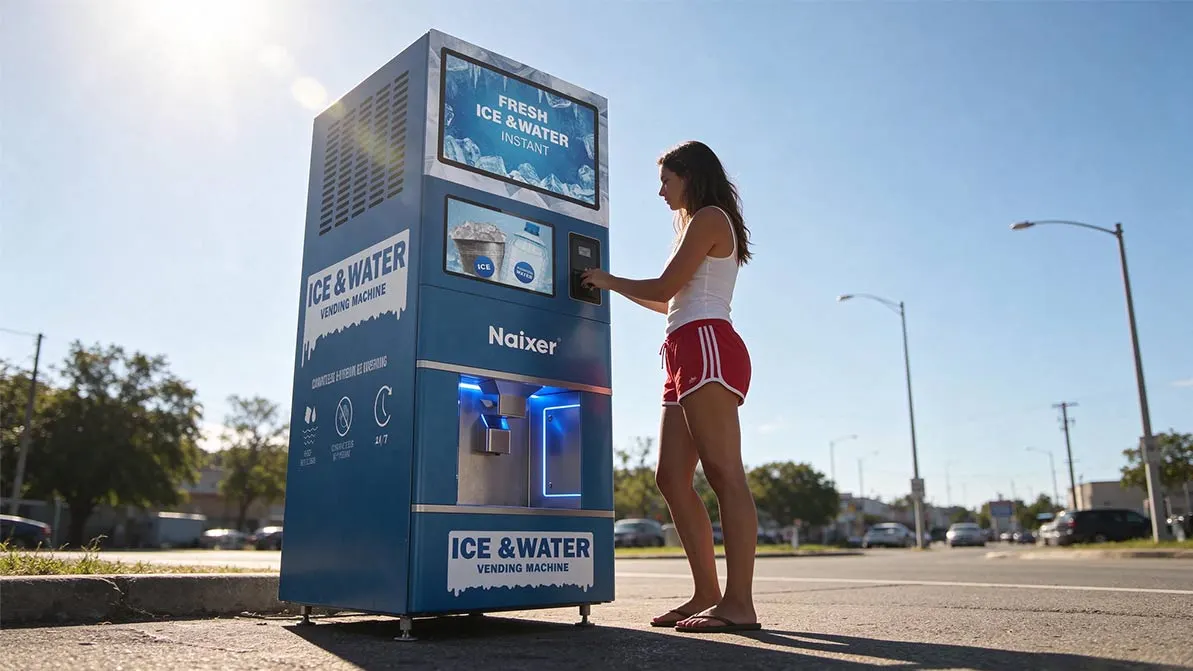
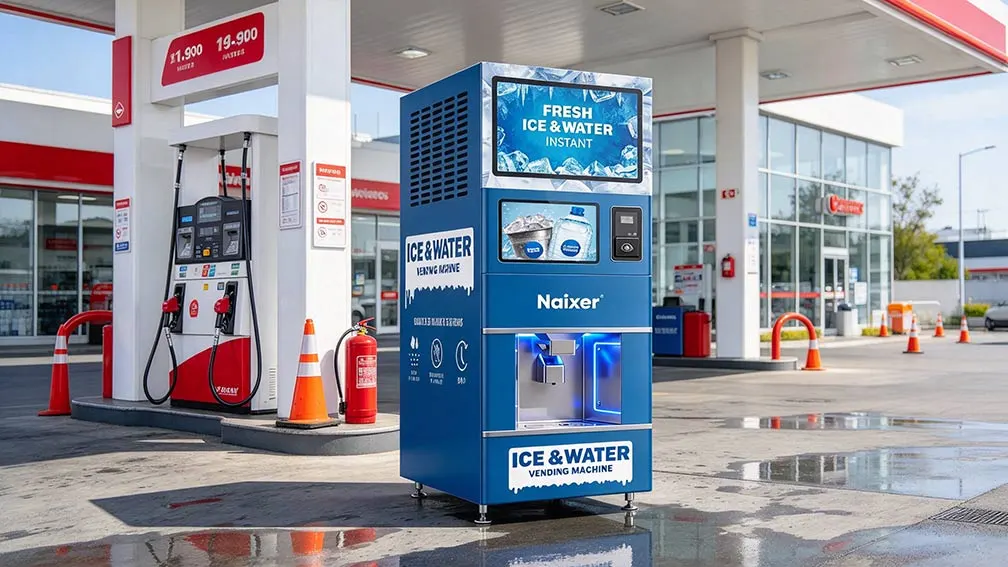
Refrigerant choice is now a market-access decision, not an engineering preference. Propane (R290) has a global warming potential of about 3 and is now common in smaller commercial equipment, but its charge quantity is capped by the applicable product standard and by national rules. R404A, still found in older designs, carries a GWP in the region of 3,900–4,700 depending on which IPCC assessment report you cite, and is being phased down in Europe and increasingly discouraged elsewhere. Ask your supplier which refrigerant they intend to ship and confirm it is permitted in your destination market — this is not a question that can be settled after the order. We build our ice and water vending machine with either R404A or R290 for exactly this reason: the refrigerant is selected per destination rather than defaulted at the factory.
Landed cost: the six lines that decide your margin
Ex-works price is roughly half of what a machine actually costs to put on your floor. The other half is invisible in a quotation unless you ask for it line by line.
| # | Line | What it covers | Question to ask | Red flag |
|---|---|---|---|---|
| 1 | Ex-works unit price | Machine as built, at factory gate | Is this the exact model and voltage variant quoted? | Price given without a model code |
| 2 | Approval and testing | Certification, testing, listing amortised | Which approvals, and are they already held for this model? | "Certified" with no certificate number |
| 3 | Inland and port handling | Trucking, export clearance, terminal charges | Who is the exporter of record? | Buyer named as exporter without discussion |
| 4 | Sea freight | Ocean leg, insurance, demurrage risk | Which route, and what is the seasonal variance? | Fixed freight quote with no validity period |
| 5 | Duty and destination tax | Tariff code, duty rate, VAT or equivalent | Which HS code, and what rate applies to it here? | Duty omitted from the comparison entirely |
| 6 | Spares and first service | Recommended spares kit, warranty handling | Which parts should I stock, and how fast can they ship? | Warranty stated without a parts-shipping commitment |
Important note No benchmark values are given deliberately — duty rates, freight and approval costs are destination- and time-specific, and any published range would be misleading. The value of this table is comparability: two quotes broken into the same six lines can be evaluated, two headline prices cannot.

The reason to insist on this format is that it makes comparison possible. Two quotes of “$4,200” and “$4,700” cannot be evaluated; two quotes broken into the same six lines can. In our experience the second is almost always cheaper, because it is the one where you can see what you are paying for.
One structural note on lead time. Manufacturing, sea freight and destination clearance are sequential, and the sea freight leg alone can vary by several weeks depending on route and season. A distributor planning around a seasonal peak needs to work backwards from the shelf date, not forwards from the order date. The South Africa route is a useful worst case: ocean transit and destination clearance there stack up in a way that production speed cannot offset.
How to audit a manufacturer before you place an order
Most sourcing failures in this category are not product failures. They are supplier-identity failures — the buyer believed they were dealing with a factory and were dealing with a trader who was also dealing with a factory.
| Check | Ask for | What "good" looks like |
|---|---|---|
| Legal identity | Business licence; name and address on the certificate | Certificate address matches the address on your purchase order |
| Production, not assembly | Live walkthrough of the specific line building your units | Sheet-metal forming, brazing and testing visible on site |
| Component provenance | Compressor make and model; evaporator material; cabinet grade | Named brands and grades, given in writing before the order |
| Certification | Certificate numbers, standard numbers, model coverage | Numbers can be verified independently against the standard |
| Testing regime | Routine test records; what is checked on every unit | Per-unit test log, not a single sample report |
| Warranty structure | Separate terms for compressor, core systems, consumables | Written terms with a stated parts-shipping commitment |
| Spares availability | Recommended stock list; lead time on common failures | A concrete list you can order against today |
| Capacity honesty | Test conditions behind the published daily output | Ambient and inlet-water temperatures stated explicitly |
Key check The highest-value item is the first: matching certificate address to purchase-order address. A trading company can reproduce a factory's certificate in a slide deck; matching it to the entity that invoices you is materially harder to fake.
The highest-value question on that list is the least technical one: ask for the certificate number and the production address, and check that they match. A trading company can reproduce a factory’s certificate in a slide deck. Matching it to the address on your purchase order is harder to fake.
Frequently asked questions
What is the size of the commercial ice machine market?
Published estimates for the same year range from about $1.0 billion to $5.5 billion, depending on whether the analyst counts only ice-making heads or also bins, dispensers and vending cabinets. There is no single agreed figure. Any article quoting one number without a scope note should be treated as incomplete.
Which regions are growing fastest?
Several published estimates point to Asia-Pacific and the Middle East as the faster-growing regions, on the basis of food-service expansion and cold-chain investment. We do not publish an independent forecast. What we can say from order flow is that request volume from Southeast Asia and the Gulf has increased faster than from Western Europe over recent years.
Do I need different machines for different countries?
Usually yes. Electrical supply (voltage, frequency and plug), refrigerant rules, approval requirements and language all change by market. Model-specific certification does not transfer automatically between markets, so the specification has to be set per destination before you order.
Is a CE certificate enough to sell in Europe?
It is necessary but not sufficient. CE is a manufacturer’s declaration of conformity with applicable directives; buyers and national authorities may also expect test reports from a recognised body, documentation against the applicable product standard, and evidence on refrigerant compliance. Confirm the full document set with your importer before shipping.
What refrigerant should I specify?
It depends on your market and on the equipment size. R290 has a very low global warming potential but a capped charge quantity; R404A has a high GWP and is being phased down. Specify per destination market, and confirm the charge quantity is permitted there — do not leave this to a default.
How long should I expect from order to delivery?
Allow for three sequential stages: manufacturing, sea freight, and destination clearance. Each varies. The sea freight leg alone can differ by several weeks by route and season. Plan backwards from the date you need stock on the shelf.
How do I know whether a supplier is a real factory?
Ask for the certificate number and the production address, then confirm they match the entity on your purchase order. Request a live video walkthrough of the specific production line that will build your units, and ask which components are bought in. A factory answers these quickly; a trader usually changes the subject.
Where to go next

If you are assembling a supplier shortlist for a specific market, the useful next step is not another market report. If you would rather start by browsing the range, the commercial ice machine catalogue is organised by ice format and capacity. Otherwise, it is a specification sheet and a landed-cost quote for the machine class you intend to sell.