How to Choose the Right Size Commercial Ice Maker for Your Business
Nothing derails a busy dinner service faster than running out of ice. And nothing drains your equipment budget faster than buying a machine that’s twice the size you actually need. Choosing the right size commercial ice maker isn’t guesswork — it’s a simple calculation that takes your business type, peak demand, and future growth into account. In this guide, we’ll show you exactly how to do that calculation, what to watch out for, and which ice types match your menu.
In this guide, you will learn:
Why Choosing the Right Size Commercial Ice Maker Matters
Before we get to the formula, let’s talk about why sizing matters — because the consequences of getting it wrong show up fast.
If you undersize: You’ll run out of ice during peak service — the Saturday night rush, the wedding reception, the summer heatwave. That means lost beverage sales, emergency ice purchases at premium prices, and a bartender who has to tell customers “sorry, we’re out of ice” at 9 p.m.
If you oversize: You’ll pay more than you need to — not just at purchase, but every month in energy bills. You’ll also sacrifice floor space that could go to prep areas, storage, or additional seating. A machine that’s too large also cycles on and off more frequently, which can actually accelerate wear on the compressor over time.
The sweet spot: A machine that comfortably covers your busiest 24‑hour period of the year — with a buffer — and fits your available space and budget.
The average commercial ice maker stays in service for 7 to 10 years. That means the size you choose today will shape your kitchen’s efficiency for nearly a decade. It’s worth getting it right. (For a detailed breakdown of equipment lifespan, see our guide to undercounter ice maker longevity.)
The Simple Formula for Sizing Your Commercial Ice Maker
Here’s the formula that takes the guesswork out of the decision. Write it down. Tape it to the wall.
Daily Ice Required = Customers per Day × Ice per Customer × 1.2 (20% Peak Buffer)
Let’s break down each piece:
| Variable | What It Means | How to Determine It |
|---|---|---|
| Customers per Day | The number of people you serve on your busiest day — not an average Tuesday | Look at your POS data for the top 5 busiest days last year. Use the highest one. |
| Ice per Customer | How many pounds of ice each customer or seat uses | Use the industry benchmarks in the next section — they vary by business type. |
| 1.2 (20% Buffer) | A safety margin for peak surges, summer heat, and future growth | If your busy season swings wildly (e.g., a beachside bar), bump this to 1.3 or even 1.4. |
A note on “seats” vs. “customers”: For bars and lounges, the industry standard is to calculate by seat — not customer count — because a bar stool may be occupied by one person for two hours, and that person may have three drinks. Seats give you a fixed, countable number to work with. Restaurants with table turnover are better served by customer count per meal period.
Ice Per Customer: How Much Ice Different Businesses Really Use
This is where most sizing guides get too generic. A cocktail bar and a convenience store have wildly different ice needs. Use these benchmarks — compiled from industry guides published by Hoshizaki, Manitowoc, Scotsman, and FES Magazine — to pick the right starting number for your operation.
| Business Type | Ice Per Unit | Unit | Example: Daily Need (Before Buffer) |
|---|---|---|---|
| Full-service restaurant | 1.5–2 lbs | Customer | 200 covers → 300–400 lbs |
| Fast-casual / QSR | 0.5–1 lb | Customer | 400 customers → 200–400 lbs |
| Cocktail bar | 3 lbs | Seat | 60 seats → 180 lbs |
| Hotel (with banquet) | 5 lbs | Room | 100 rooms → 500 lbs |
| Convenience store (bagged ice) | 1–1.5 lbs | Bag | 200 bags → 200–300 lbs |
| Café / tea shop | 0.5–1 lb | Drink | 300 drinks → 150–300 lbs |
| Healthcare / hospital | 3–5 lbs | Patient bed | 50 beds → 150–250 lbs |
One factor many operators miss: climate and seasonality. If your restaurant is in a hot, humid region — or if your busiest months are July and August — consider increasing your baseline from 1.5–2 lbs per customer to 2–2.5 lbs. Likewise, an outdoor pool bar in summer may need double the ice of an indoor lounge in winter. When in doubt, round up.
Worked Examples: Sizing for Your Specific Business Type
Now let’s apply the formula to four real‑world scenarios. Each shows the calculation step by step and the type of machine that fits.

Example 1: 150‑Seat Full‑Service Restaurant
Customers per day (busiest shift): 150
Ice per customer: 2 lbs
Base requirement: 150 × 2 = 300 lbs
After 20% buffer: 300 × 1.2 = 360 lbs/day
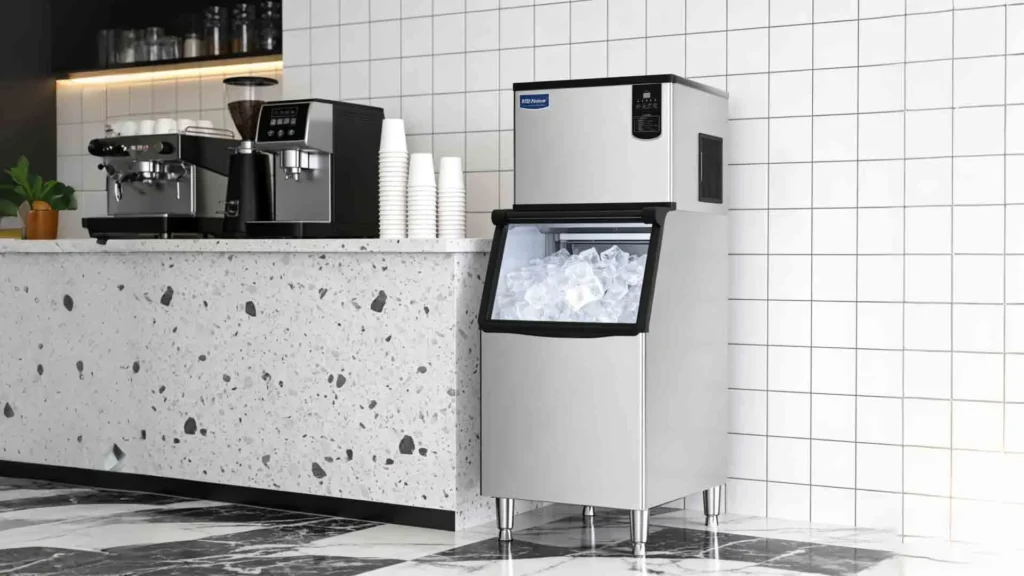
Recommended: A self‑contained full‑cube machine rated at 350–450 lbs/day, such as the Naixer TH‑420B, with a built‑in storage bin holding roughly 180–220 lbs.
Example 2: 60‑Seat Cocktail Bar
Seats: 60
Ice per seat: 3 lbs
Base requirement: 60 × 3 = 180 lbs
After 20% buffer: 180 × 1.2 = 216 lbs/day
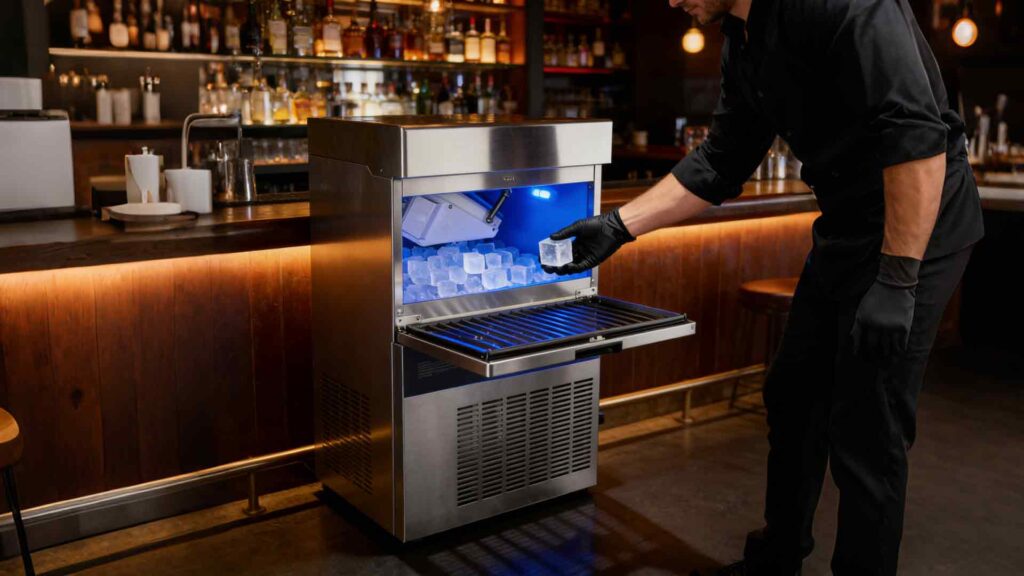
Recommended: A self‑contained undercounter or compact machine rated at 250–350 lbs/day, such as the Naixer TH‑280B or TH‑320B. Both include a built‑in bin and fit under‑bar spaces with front‑vented clearance.
Example 3: 100‑Room Hotel (with banquet)
Rooms: 100
Ice per room: 5 lbs
Banquet add‑on (assuming 2 events/month, averaged): ~15 lbs/day
Base requirement: (100 × 5) + 15 = 515 lbs
After 20% buffer: 515 × 1.2 = 618 lbs/day
Recommended: A self‑contained high‑output machine rated at 600–700 lbs/day, such as the Naixer TH‑700B, paired with a smaller undercounter unit at the lobby bar for bartender access. (Read our complete hotel ice machine sizing guide for more.)
Example 4: Convenience Store Selling 250 Bags/Day
Bags per day: 250
Ice per bag: 1 lb
Base requirement: 250 × 1 = 250 lbs
After 20% buffer: 250 × 1.2 = 300 lbs/day
Recommended: A self‑contained machine rated at 300–400 lbs/day with a storage bin large enough to handle the morning and evening purchase rushes without the machine cycling excessively. The Naixer TH‑320B or TH‑420B would work here, depending on bag volume trends.

Key takeaway: After you calculate your daily requirement, add at least 20% to the number. That buffer is what gets you through the unexpected — the party of 40 that walks in unannounced, the heatwave that doubles drink orders, the compressor that runs slightly less efficiently after five years. The buffer is not a nice‑to‑have; it’s a cost‑of‑doing‑business.
Self‑Contained vs. Modular: Why Your Sizing Decision Affects Budget, Too

Here’s a scenario that plays out every day: you calculate your ideal daily production, find a machine that matches, and get a quote. It looks good — until you realize the storage bin isn’t included. That quote was for the ice head only. The compatible bin will run you another $800–$2,000.
This is the modular‑head trap, and it’s one of the most common budget overruns in commercial kitchen equipment purchasing. Brands like Hoshizaki, Manitowoc, and Scotsman often sell their ice machines this way — head and bin separately — which gives operators flexibility at the high end but catches first‑time buyers off guard.
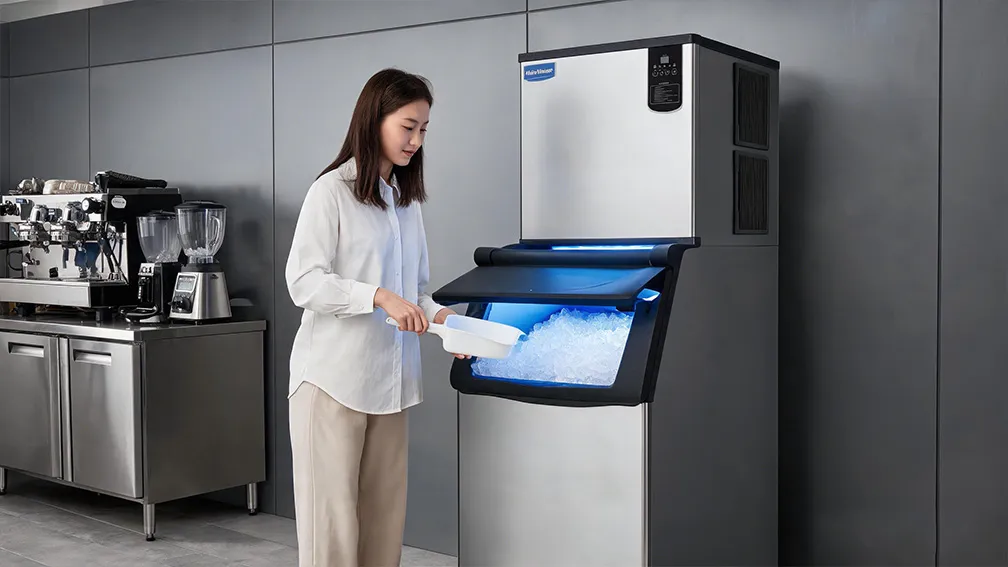
A self‑contained commercial ice maker — the kind where the production unit and storage bin are built into one chassis — eliminates this problem entirely. You buy one unit. You install one unit. You pay one price. Naixer’s entire TH series uses this architecture, so the bin is part of the machine from the factory floor. (For a complete breakdown of what commercial ice machines actually cost, see our 2026 price guide.)
| System Type | What You Pay | Best For |
|---|---|---|
| Modular Head + Separate Bin | Head cost + $800–$2,000 bin cost + extra installation labor | Large banquet facilities, stadiums needing 1,500+ lbs/day and oversized storage |
| Self‑Contained All‑in‑One | One purchase, one installation, one warranty | Restaurants, bars, hotels, and convenience stores producing 200–1,200 lbs/day |
For the vast majority of commercial kitchens, a self‑contained unit is the financially smarter choice — and it’s the one that avoids the hidden bin cost that modular quotes often obscure.

Use our ice calculator to find the perfect commercial ice maker for your restaurant, bar, or hotel. Learn how to calculate daily ice needs and choose the right machine.
Why Naixer Makes Sizing Simpler — and Your Investment Safer
Naixer commercial ice makers are engineered and manufactured in a 30,000 m² ISO9001‑certified smart factory with over 300 technical patents and more than 200 professional technicians. All ice‑contact surfaces are constructed from SUS304 food‑grade stainless steel, meeting CE, RoHS, and CB international hygiene standards.
Here’s how our product line maps to the sizing recommendations in this guide:
| Your Business Type | Recommended Naixer Model | Daily Output | Built‑in Bin | Ice Type |
|---|---|---|---|---|
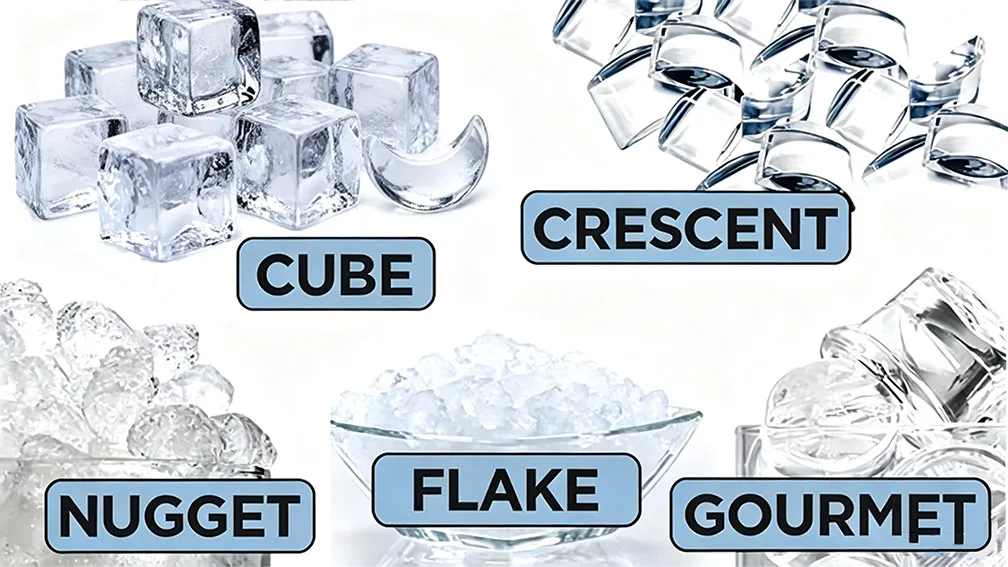
| Small café / bistro | TH‑280B | 280–300 lbs | Yes | Full Cube |
| Mid‑size restaurant / cocktail bar | TH‑420B | 420 lbs | Yes | Full Cube |
| Large restaurant / mid‑size hotel | TH‑700B | 700 lbs | Yes | Full Cube |
| Large hotel / convention center | TH‑1000B / TH‑1200B | 1,000–1,200 lbs | Yes | Full Cube |
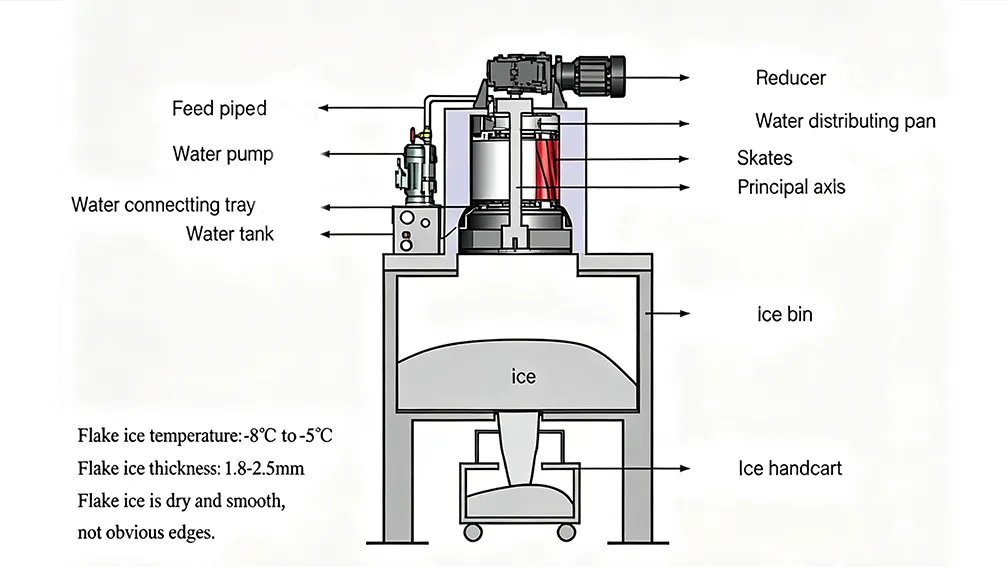
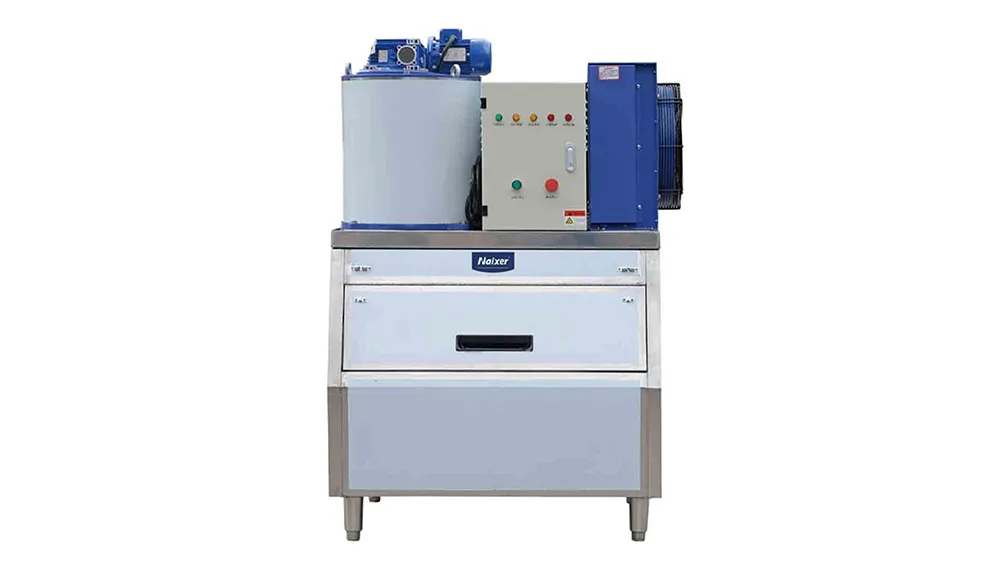
| Seafood display / buffet | PB‑500 | 500 kg | Yes | Flake Ice |
Three things that set Naixer apart when you’re sizing a machine:
A 3‑year full machine warranty covering core systems and key components — well beyond the 1‑ to 2‑year standard in this equipment class. When you’re making a 7‑ to 10‑year investment, that extended protection is a real financial buffer.
Factory‑direct pricing that removes the distributor markup. The money you save by avoiding the modular‑bin trap stays in your budget.
Over 5,000 commercial clients in 100+ countries, including global chains like KFC and Luckin Coffee — operations where ice machine downtime isn’t an option. That same manufacturing DNA, built for punishing commercial environments, sits inside every Naixer unit.